Horizontal purple gradient banner transitioning from blue-purple to pink-purple, used as a background Horizontal purple gradient banner transitioning from blue-purple to pink-purple, used as a background
Local Production Sites in the USA & EU!
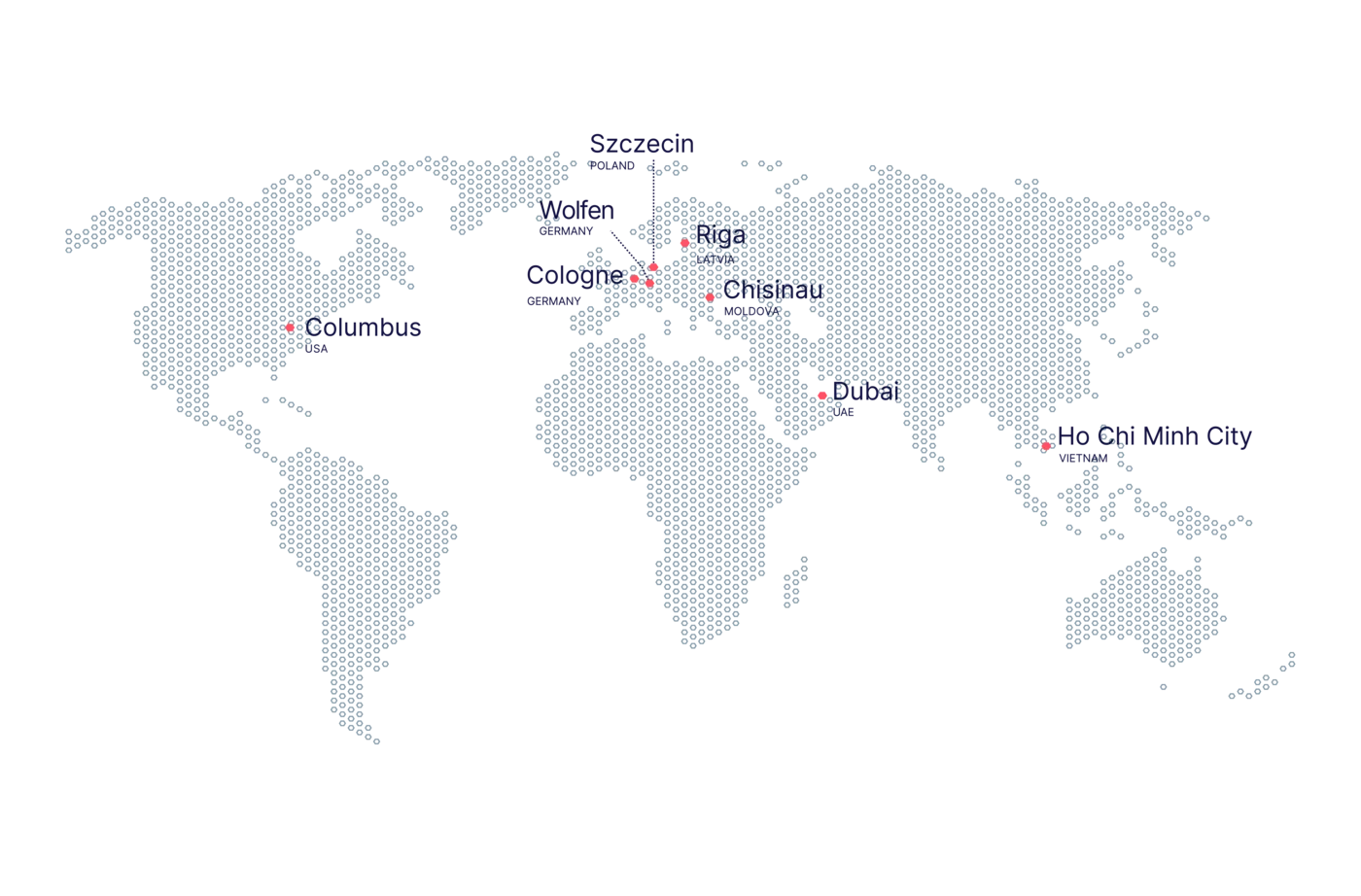
No customs fees and delays - just fast and effective fulfilment to scale!


More than 500,000 premium products manufactured daily for commercial and private customers.

Explore
FEATURE
Back to All Posts
Print-on-Demand 101

Cross-Border Fulfillment for Print on Demand | merchOne x Paypal

Quick Answer

Cross-border fulfillment in print on demand means manufacturing and delivering a product across international boundaries – from a production facility in one country to a customer in another, often through a seller based in a third. The financial complexity goes well beyond shipping. A cross-border POD order can involve customer payments in one currency, supplier billing in another, platform settlement on a separate schedule, VAT obligations in the destination country, and customs duties that depend on where the product was manufactured.

For non-EU sellers serving European consumers, the production location now directly affects the customs route, the applicable VAT scheme, and the total landed cost of the order. Since July 1, 2026, low-value ecommerce goods imported into the EU are subject to a new temporary customs duty that does not apply to goods produced and dispatched within the EU.

Disclaimer

This article is provided for general informational and educational purposes only and does not constitute legal, tax, accounting, financial, customs, intellectual-property, regulatory or other professional advice.

The information may not be complete or applicable to your circumstances. Requirements vary by jurisdiction, business structure, transaction, product and sales channel, and may change over time. Third-party products, services, fees, policies and availability are subject to the relevant provider’s current terms.

Readers should verify current requirements with the relevant authority, platform or provider and obtain advice from a suitably qualified professional before making legal, tax, financial or compliance decisions. Nothing in this article modifies any applicable agreement or service terms.

Cross-Border Fulfillment for Print on Demand | merchOne • merchOne


Key Takeaways

  • Cross-border fulfillment introduces currency conversion, settlement timing, VAT, customs, and regulatory complexity that domestic fulfillment does not.
  • A POD seller operating internationally may receive payments in one currency, pay a production partner in another, and withdraw profit in a third. Each conversion can reduce margin.
  • Ecommerce platform payouts typically take two to seven business days. Cross-border transactions may add one to two additional days, creating a wider gap between customer checkout and available funds.
  • VAT and customs obligations depend on where the goods are produced, where transportation to the customer begins, who makes the retail sale, and whether a marketplace is involved.
  • An order produced and dispatched within the EU follows a different VAT and customs route from an order imported into the EU from a non-EU production facility.
  • Since July 1, 2026, a temporary EUR 3 customs duty applies to qualifying low-value ecommerce imports into the EU. This does not apply to goods genuinely produced and shipped within the EU.
  • White-label fulfillment with localized production can reduce border friction for the customer shipment, but it does not remove the seller’s VAT registration and reporting obligations.

Why Cross-Border Fulfillment Is More Than Shipping

Most discussions of cross-border ecommerce focus on logistics – carrier selection, transit times, tracking, and delivery experience. These are important, but they represent only one layer of a cross-border POD operation.

The global print-on-demand market was valued at approximately USD 6.18 billion in 2022 and is projected to grow at a compound annual rate of over 25% through 2030, according to Grand View Research. As more sellers enter international markets, the operational demands on payment, tax, and customs infrastructure grow alongside shipping volume.

A cross-border POD order creates obligations across several systems simultaneously:

  • The customer payment must be authorized and settled in the customer’s currency.
  • The seller must fund production through the supplier’s billing system, often in a different currency.
  • The ecommerce platform applies its own settlement schedule, which may not align with production timing.
  • VAT must be collected, reported, and remitted according to the rules of the destination country.
  • Customs declarations must be filed when goods cross an international border.
  • Product classification and customs data now affect landed cost more directly than before.

According to a 2024 Statista Global Consumer Survey, 56% of online shoppers abandoned a purchase when they were presented with unexpected fees, taxes, or import charges at checkout or upon delivery. For cross-border POD sellers, the ability to present a complete, accurate price before checkout is directly connected to conversion and customer satisfaction.

A seller that treats cross-border fulfillment as a shipping problem alone may find that currency, tax, or customs issues create costs and delays that the logistics layer cannot solve.

The Currency Problem

International POD sellers often receive money in one currency while paying costs in several others. A seller based in Vietnam, for example, may receive customer payments in USD, pay a European production partner in EUR, run advertising accounts in another billing currency, and withdraw the remaining funds to a VND-denominated bank account.

Each conversion can introduce an exchange-rate difference or provider margin. According to the World Bank’s Remittance Prices Worldwide database, the global average cost of sending USD 200 internationally was approximately 6.4% in Q4 2024. While business payment providers typically offer lower rates than consumer remittance services, FX margins of 1.5% to 3.5% per conversion are common for SME cross-border transactions, depending on the provider, currency pair, and transaction volume.

The objective is not to avoid all currency conversion – that is rarely realistic for a business operating across several markets – but to identify unnecessary conversions and understand where each one occurs.

A seller should map:

  • The currency shown to the customer
  • The currency collected by the checkout
  • The currency settled by the payment processor
  • The currency used to fund the supplier wallet
  • The currency in which the supplier invoices
  • The currency in which the business ultimately reports and withdraws profit

A payment route that converts the same funds several times can reduce margin and make reconciliation harder. However, maintaining a foreign-currency balance is not automatically cheaper. The account may apply different transaction, withdrawal, or conversion rules, and the supplier wallet may not support the same currency.

Payment Settlement Timing Across Borders

POD suppliers typically charge the seller for production and shipping when an order is submitted for fulfillment, while payouts from ecommerce platforms may take several business days to reach the seller’s bank account.

Cross-border transactions can widen this gap. According to a 2024 Stripe report, cross-border transactions add an average of one to two additional business days to settlement compared with domestic transactions. A seller serving international customers may therefore face a longer period during which production charges must be covered from existing working capital.

This timing difference becomes more significant during periods of higher order volume, when more production charges are incurred within the same payout cycle. A campaign targeting European consumers from a non-EU base may appear highly successful in the storefront while a growing queue of orders awaits funding in the fulfillment system.

For agencies and multi-store operators managing cross-border fulfillment across several storefronts, the total amount of production spending that must be covered before payouts arrive can increase rapidly. A prepaid supplier wallet can help by consolidating fulfillment funding into a centralized balance, but the seller must still ensure that the balance is sufficient to cover the settlement gap.

A 2024 McKinsey Global Payments Report estimated that cross-border payment revenues reached approximately USD 240 billion globally, reflecting both the scale and the embedded cost structure of international transactions. For SME sellers, a significant share of those costs sits in the gap between checkout and settlement – a gap that grows wider as the business expands across borders.

How PayPal Supports Cross-Border Ecommerce Sellers

PayPal is one of the largest digital payment platforms in the world, with a direct presence in cross-border commerce that few other payment providers match in both scale and geographic reach. Founded in 1998, the company has grown from a peer-to-peer payment tool into a global financial infrastructure. As of December 31, 2025, PayPal reported over 439 million active accounts across more than 200 markets. In 2025, the platform processed 25.4 billion payment transactions with a total payment volume of USD 1.79 trillion, according to PayPal’s 2025 Annual Report (Form 10-K).

For cross-border ecommerce sellers, PayPal operates at several points in the transaction chain – not only as a familiar checkout option for customers, but as a business payment layer that can help manage multi-currency balances, fund supplier relationships, and reduce friction in international transactions.

Cross-Border Checkout and Customer Trust

Cross-border checkout introduces trust concerns that domestic transactions do not. A customer in Germany paying a seller based in Vietnam may hesitate if the checkout experience feels unfamiliar or if they cannot easily assess whether the transaction is protected. According to the Baymard Institute’s 2024 checkout usability research, 19% of cart abandonments are attributed to the shopper not trusting the site with their payment information.

PayPal addresses this by offering a checkout experience the customer already recognizes. PayPal Buyer Protection covers eligible purchases when an item does not arrive or does not match the seller’s description, which can reduce the perceived risk of buying from an unfamiliar international seller. According to PayPal’s 2024 cross-border consumer survey, 54% of international online shoppers said they were more likely to complete a purchase from an unfamiliar seller when PayPal was available at checkout.

PayPal shared its perspective on how the payment experience can support that process:

“Cross-border expansion is exactly where PayPal is built to help smaller sellers, and Southeast Asia is one of the most dynamic regions for it. For a print-on-demand or custom-products business, the hardest part of going international isn’t making the product, it’s being trusted by a buyer who has never heard of you, and getting paid cleanly across currencies and borders. PayPal helps on both sides of that.

For the shopper, a recognised, protected checkout lowers the hesitation of buying from an unfamiliar overseas seller. For the business, a PayPal Business account provides multi-currency balances, the ability to fund production partners, and reporting that keeps pace as volume grows across markets.

Our role, put simply, is to be the payments layer that lets an SME behave like a global business without having to build global payments infrastructure themselves so a seller in Vietnam can serve customers in Germany or the US with the same confidence a local merchant would have. What we’d stress to POD sellers specifically: lead with trust and price transparency, because personalised products carry more perceived risk, and let the payment layer carry the cross-border complexity rather than passing it to the customer.”

— Warren Hou, Senior Partnership Manager, South East Asia, PayPal; and Nam Ngo, Business Development Manager, South East Asia, PayPal.

Multi-Currency Management

PayPal supports holding balances in over 25 currencies and processing transactions across more than 100 currencies. For cross-border POD sellers who receive payments in USD, EUR, and GBP while paying a production partner in one primary billing currency, multi-currency balances can reduce the number of intermediate conversions that erode margin.

PayPal’s April 2026 cross-border commerce guidance emphasizes local-currency checkout, adaptable payment systems, and wallet interoperability as continuing priorities for international merchants. Merchants who configure their PayPal accounts to hold balances in the currencies they most frequently receive – rather than auto-converting to a single home currency – can retain more control over when and at what rate conversion occurs.

However, PayPal’s merchant fee schedules distinguish between domestic and international transactions and include separate treatment for currency conversions, withdrawals, disputes, and other services. The applicable terms depend on the merchant’s registered market and product configuration. The seller should review the fee schedule for the country in which the PayPal account is registered rather than relying on a rate published for another market.

PayPal shared its view on how wallet interoperability may simplify cross-border checkout:

“The single most useful exercise is to map the full currency path of a typical order – the currency shown to the customer, collected at checkout, settled by the processor, used to fund the supplier, invoiced by the supplier, and finally withdrawn as profit – and then look for the same money being converted more than once. Most avoidable cost sits in those repeat conversions.

From there: hold balances in the currencies you most frequently receive rather than auto-converting everything to a home currency on receipt, so you control when and at what rate you convert; where the supplier supports it, fund production in the same currency you collected, so a EUR sale funds a EUR production charge with no round trip; and convert deliberately, in larger batches, instead of being converted automatically on every transaction.

As you scale, keep a consistent order reference across systems so cross-currency reconciliation stays traceable. One caution: holding a foreign-currency balance is not automatically cheaper – conversion, withdrawal, and transaction treatment vary by your registered market, so confirm against the fee schedule for your account’s country rather than a rate published elsewhere.”

— Warren Hou, Senior Partnership Manager, South East Asia, PayPal; and Nam Ngo, Business Development Manager, South East Asia, PayPal.

PayPal World and the Future of Wallet Interoperability

PayPal World is an initiative designed to connect PayPal and Venmo with participating international digital wallet systems – allowing customers to pay through their preferred local wallet at any merchant that accepts PayPal, without requiring the merchant to build separate integrations for each partner wallet.

For a POD seller serving customers across the US, Europe, and Southeast Asia, this means the range of payment methods customers expect at checkout is likely to continue growing. Markets in Southeast Asia, where mobile wallet adoption has outpaced traditional card penetration, represent a particularly significant opportunity. According to a 2024 Bain & Company and Google report on Southeast Asia’s digital economy, digital payment transaction values in the region were projected to exceed USD 1.3 trillion by 2025, driven largely by local wallet adoption.

PayPal World aims to position PayPal as the interoperability layer – the single integration that gives the merchant access to multiple wallets across markets. This is a forward-looking capability, and the availability of specific wallet partnerships varies by market and timing. However, for sellers planning their international checkout strategy, understanding that wallet interoperability is the direction of cross-border payments – rather than expanding a list of individually integrated card networks – is operationally relevant.

“The direction of cross-border payments is wallet interoperability – giving a customer the ability to pay with the domestic wallet they already trust – rather than merchants integrating an ever-longer list of individual payment methods. PayPal World is our step in that direction, connecting PayPal, Venmo, and participating partner wallets so a single integration can reach customers across markets.

What sellers should do today doesn’t require waiting for every partner to go live: make sure your checkout already offers local-currency pricing in your priority markets, keep your PayPal integration current so you inherit new wallet connections as they roll out in phases, and prioritise the markets where your orders and ad spend are actually concentrated. For sellers serving Southeast Asia, that means paying attention to mobile-wallet-first behaviour, where wallet adoption has outpaced card penetration.

The practical mindset shift is to treat wallet interoperability as the strategy build for it now rather than trying to predict and separately integrate each individual method. Availability of specific wallet partnerships varies by market and timing, so treat it as a capability that expands in phases.”

— Warren Hou, Senior Partnership Manager, South East Asia, PayPal; and Nam Ngo, Business Development Manager, South East Asia, PayPal.

Dispute Management and Seller Protection Across Borders

Cross-border transactions carry higher dispute risk than domestic transactions. The customer may be less familiar with the seller, delivery times are longer, customs delays can create uncertainty, and personalized products may not match the customer’s expectations if the preview or description was unclear.

PayPal provides Seller Protection on qualifying transactions, which can cover the full purchase amount plus applicable fees on eligible claims of unauthorized transactions or items not received – subject to PayPal’s Seller Protection requirements. PayPal’s Resolution Center allows merchants to respond to disputes with evidence including tracking numbers, delivery confirmation, and order documentation.

For POD sellers producing personalized items, maintaining clear order approval documentation – design previews, customer confirmation, production specifications – is directly relevant to PayPal dispute resolution. According to Chargebacks911’s 2024 industry report, merchants who responded to disputes with complete documentation within 48 hours resolved 30% to 40% more cases in their favor than merchants who responded later or with incomplete records.

Cross-border orders can carry additional dispute risk because of longer delivery times, customs delays, and differences between customer expectations and the final product. PayPal shared practical guidance on reducing friction and preparing stronger documentation:

“The most common causes of cross-border payment friction cluster into a few areas: currency mismatches and surprise conversion costs; declines from cross-border fraud screening when transaction patterns look unfamiliar to the issuer; unexpected taxes or duties surfacing at checkout or on delivery; and disputes that arise because delivery took longer or the product didn’t match what the customer expected.

The best practices that move success rates are mostly about removing surprises. Present a complete, accurate price including tax and any duty before checkout, since unexpected fees are one of the biggest abandonment triggers. Offer a checkout the customer recognises and that carries buyer protection, which lowers the trust barrier for an unfamiliar international seller.

For personalised POD goods, keep clear order-approval documentation design previews, customer confirmation, production specs and respond to any dispute quickly and with complete evidence through the Resolution Center. And watch your decline and chargeback patterns as leading indicators, addressing them while they’re small rather than after they start affecting delivery promises.”

— Warren Hou, Senior Partnership Manager, South East Asia, PayPal; and Nam Ngo, Business Development Manager, South East Asia, PayPal.

VAT for Non-EU Sellers: Start With the Fulfillment Route

VAT cannot be determined simply by asking where the seller lives. For a non-EU seller serving European consumers, the more important questions are:

  • Which business is legally making the retail sale to the customer?
  • Where are the goods located when transportation to the customer begins?
  • Are the goods already in the EU, or are they being imported from outside the EU?
  • Is the sale made through the seller’s own store or through an online marketplace?
  • Which business acts as importer or declarant when the goods cross the EU border?

The answers to these questions determine which VAT scheme applies and what obligations the seller must meet.

According to the European Commission’s 2023 annual report on EU VAT gap statistics, the total VAT gap across all Member States was estimated at EUR 89 billion in 2021, of which a significant portion was attributed to cross-border ecommerce transactions. The 2021 ecommerce VAT package – which introduced IOSS, expanded Union OSS, and established marketplace deemed-supplier rules – was designed to close part of this gap. For POD sellers entering the EU market, understanding which scheme applies to their specific transaction structure is not optional – it is a regulatory requirement that directly affects pricing, invoicing, and compliance risk.

Scenario One: The Product Is Produced and Dispatched Within the EU

When a product is manufactured in an EU facility and dispatched from one EU Member State to a consumer in another, the order is generally treated as an intra-EU distance sale rather than an imported-goods transaction.

The seller can use the Union One Stop Shop (Union OSS) for qualifying intra-EU distance sales of goods. Through Union OSS, qualifying sellers can register in one Member State, report covered cross-border EU consumer sales through one portal, and apply VAT according to the customer’s country. Union OSS reduces the need to maintain separate VAT registrations in every destination country, but it does not replace domestic VAT returns or other local obligations that may still apply.

As of 2024, over 200,000 businesses had registered for the EU’s One Stop Shop schemes, according to the European Commission’s progress reports on the 2021 ecommerce VAT package.

The Import One Stop Shop (IOSS) is designed for goods dispatched from outside the EU and is not the relevant scheme for goods already located and dispatched within the EU. Confusing the two can create incorrect VAT collection and customs data.

The European Commission’s 2024 progress report on the ecommerce VAT package noted that Union OSS collected approximately EUR 19 billion in VAT in 2023, representing a 30% increase over 2022. The scheme has significantly reduced the number of separate VAT registrations required for cross-border sellers – the Commission estimated that without OSS, qualifying sellers would need an average of 7 to 10 individual Member State registrations to cover the same sales territory.

Scenario Two: The Product Is Produced Outside the EU and Imported

When the product is manufactured outside the EU and shipped directly to an EU consumer, the transaction follows an imported-goods route. All commercial goods imported into the EU are subject to VAT. The previous VAT exemption for very small consignments was removed in 2021.

For consignments with an intrinsic value not exceeding EUR 150, the Import One Stop Shop (IOSS) can be used to collect VAT during the customer transaction and report it through a single EU registration. A business established outside the EU generally needs to appoint an EU-established intermediary to use the import scheme.

According to the European Commission’s IOSS implementation data, the scheme processed over EUR 1.5 billion in VAT declarations in its first full year of operation (2022). Parcels imported through IOSS-registered sellers generally clear customs faster because VAT has already been accounted for, reducing the risk of delivery delays and unexpected customer-facing charges. The EU Customs Authority reported that IOSS-declared parcels had an average customs clearance time of under 1 day, compared with 2 to 5 days for parcels requiring standard import VAT assessment.

Scenario Three: The Seller Uses an Online Marketplace

When a non-EU seller sells through a marketplace, the marketplace may be treated as the deemed supplier for VAT purposes in defined situations. This can apply when a non-EU seller supplies goods already located in the EU to an EU consumer, or when a marketplace facilitates the sale of imported goods in a consignment not exceeding EUR 150.

However, a marketplace collecting VAT does not automatically remove every obligation from the seller. The seller may still need to provide accurate VAT information, determine the treatment of supplier invoices, report other sales made outside the marketplace, and maintain records.

A 2024 Avalara cross-border compliance survey found that 37% of non-EU ecommerce sellers who used marketplace channels believed the marketplace handled all of their EU VAT obligations. In practice, the deemed-supplier rule covers specific transaction types and does not automatically extend to all sales, direct-channel sales, or record-keeping obligations. Misunderstanding this distinction was the most frequently cited cause of unexpected VAT assessments among surveyed sellers expanding into the EU.

The July 2026 EU Customs Change

Until June 30, 2026, goods imported into the EU in consignments with an intrinsic value not exceeding EUR 150 were generally exempt from customs duty, although VAT and customs declaration requirements still applied.

That customs-duty exemption ended on July 1, 2026.

The European Commission estimated that approximately 2 billion low-value ecommerce consignments entered the EU annually prior to the reform, with around 65% of these consignments undervalued for customs purposes. The new rules are intended to close this gap and create a more level playing field between imported and domestically produced goods.

Under the temporary rules, the EU applies a fixed EUR 3 customs duty to each declared item or tariff line in qualifying low-value distance-sale consignments imported from outside the EU. The measure applies until July 1, 2028, when the EU expects the next stage of its customs system to become operational.

The charge is not simply EUR 3 per parcel in every case. Under the European Commission’s guidance, the treatment depends on how the goods are grouped and classified in the customs declaration. Goods sharing the same tariff classification and description may be handled as one declared item, while different product categories can create separate duty amounts within the same consignment.

From November 1, 2026, Product Identifiers are also scheduled to become mandatory for imported ecommerce distance sales in order to improve product traceability and customs controls.

What the Customs Change Means for POD Sellers

The July 2026 customs change makes the fulfillment location more important when calculating the total cost of serving EU customers.

When a product is produced outside the EU and imported directly to the customer, the seller must account for:

  • Import VAT
  • The IOSS or standard import process
  • The new temporary customs duty
  • Correct tariff classification
  • Customs declaration data
  • Importer or declarant responsibility
  • Carrier processing charges
  • The possibility that the customer may face additional charges during delivery

When the product is produced and dispatched within the EU, the order avoids the external EU import border for that customer shipment. This can simplify the customs route and remove the new low-value import duty from that particular order, although the seller must still manage VAT correctly.

Localized production should therefore not be described only as a shipping-speed advantage. For a non-EU seller serving European consumers, it can also reduce exposure to import customs processes, border delays, and low-value import charges – provided the order is genuinely manufactured and dispatched from within the EU.

At the same time, using an EU production facility can create or confirm a need for EU VAT registration and reporting. Localized production simplifies one part of the transaction while potentially making the seller’s EU VAT position more direct.

A 2024 Eurostat analysis of cross-border parcel flows found that the average EU customs processing delay for non-EU ecommerce imports was 2.3 business days, with peaks of 4 to 6 days during Q4 holiday season. For personalized products that cannot be resold or rerouted, border delays translate directly into customer-facing delivery delays. A 2023 Metapack consumer delivery survey found that 62% of European online shoppers said they would not reorder from a seller whose delivery was delayed by customs processing, making the border route a customer retention issue as well as a cost issue.

VAT Is Not the Same as the Supplier Invoice

A frequent point of confusion for non-EU POD sellers is the assumption that VAT shown on the supplier invoice settles the VAT due on the customer sale.

These are separate transactions. The POD supplier sells production and fulfillment services to the ecommerce seller. The ecommerce seller sells the finished product to the consumer. VAT may arise at both stages, but the treatment, reporting, and parties involved can be different.

A supplier invoice should be reviewed as part of the seller’s business purchase records, not used as proof that the consumer VAT obligation has been completed.

How Production Location Affects Total Landed Cost

For a non-EU seller evaluating fulfillment options, the total cost of serving an EU customer now includes more than product, printing, and shipping. It includes the customs route.

ComparisonProduced Outside EU, Imported to CustomerProduced and Dispatched Within EU
Customs border crossedYes – external EU borderNo – intra-EU movement
Import VATApplicable (IOSS or standard)Not applicable to customer shipment
New EUR 3 customs dutyMay apply to qualifying consignmentsDoes not apply
Customs declarationRequiredNot required for intra-EU dispatch
Risk of customer-facing chargesPossible if VAT/customs not pre-collectedLower
Transit time to EU customerTypically longerTypically shorter
Retail VAT obligationRemains with sellerRemains with seller
Relevant VAT schemeIOSS (for qualifying imports)Union OSS (for qualifying intra-EU sales)

The retail VAT obligation remains in both scenarios. The difference is in the border treatment, customs cost, and delivery risk.

A 2024 DHL Ecommerce Cross-Border Barometer estimated that total landed cost – including product, shipping, duties, taxes, and carrier surcharges – for a typical low-value ecommerce parcel imported into the EU from a non-EU origin was 18% to 32% higher than the equivalent order fulfilled from within the EU. The range depended on product category, origin country, carrier, and whether VAT was pre-collected through IOSS or assessed at the border. For POD products with relatively low unit values, this cost differential can represent a significant share of the seller’s margin.

How merchOne Supports Cross-Border Fulfillment

merchOne’s role is to provide production and fulfillment infrastructure behind the seller’s ecommerce business. The seller continues to manage the customer relationship, storefront pricing, checkout, customer payment methods, tax setup, and the retail sale.

What merchOne provides is an operational structure that connects payment with international fulfillment:

  • A Wallet through which production costs can be funded, reducing the need for repeated external payment authorizations across borders
  • Automatic deduction of eligible order costs from the available balance
  • Manual and automatic top-up functionality where available
  • Notifications when funds become low
  • Pending-order handling after additional funding
  • Payment confirmation documentation and invoice export
  • Automated order routing through supported integrations
  • Support for multi-store setups where agencies or brand operators manage several storefronts through one operational account
  • Access to production capacity in relevant fulfillment regions, including EU-based production

For sellers serving Europe, the availability of EU production can change the customs route of an order. When the order is produced and dispatched within the EU, the customer shipment does not follow the same imported-goods process as an order entering from a non-EU country. The seller must still manage VAT, but the shipment may avoid the border friction and low-value import duty associated with direct imports.

A Practical EU Tax Checklist for Non-EU POD Sellers

Before launching or expanding sales to EU consumers, the seller should be able to answer the following questions clearly:

  1. Which legal entity sells the product to the customer?
  2. Does the customer purchase through the seller’s own store or a marketplace?
  3. Where is the product manufactured?
  4. From which country does the final customer shipment begin?
  5. Is the product already within the EU when the retail sale is fulfilled?
  6. Which business issues the consumer invoice?
  7. Which business is responsible for import declarations?
  8. Does the marketplace act as deemed supplier for this transaction?
  9. Is Union OSS, IOSS, or a domestic VAT return relevant?
  10. Does the seller need an EU VAT number?
  11. Does an IOSS intermediary need to be appointed?
  12. Which destination-country VAT rate applies?
  13. How are supplier VAT invoices recorded?
  14. How long must records be retained?
  15. Are the product classification and customs data accurate?
  16. Is the customer shown a complete price before checkout?
  17. Who is responsible if taxes or duties are requested during delivery?

If the seller cannot answer these questions, the issue should be resolved before scaling paid advertising into the EU.

What Sellers Should Watch Next

The EU adopted the VAT in the Digital Age (ViDA) package in March 2025, with changes being introduced progressively through 2035. Minor clarifications affecting OSS and IOSS users are scheduled from January 1, 2027, while broader Single VAT Registration reforms are planned from July 1, 2028. Digital reporting requirements for cross-border B2B transactions are scheduled from July 1, 2030.

The broader EU customs reform also provides for a handling fee on small ecommerce consignments. As of July 2026, the final amount and practical implementation were still being determined, with application expected no earlier than November 2026.

The practical direction is clear: EU tax and customs authorities are moving toward more connected transaction data, stronger platform responsibility, more detailed product identification, and less reliance on the final consumer to resolve import charges after purchase.

Frequently Asked Questions

What is cross-border fulfillment in print on demand?

Cross-border fulfillment means manufacturing a product in one country and delivering it to a customer in another, often through a seller based in a third country. It involves international shipping, currency conversion, customs declarations, and destination-country tax obligations.

Does EU production mean I do not need to pay VAT?

No. EU production may remove the import stage from the customer shipment, but the seller may still have EU VAT registration, collection, reporting, and record-keeping obligations. The retail sale remains subject to the applicable EU VAT rules.

What is the difference between IOSS and Union OSS?

IOSS is designed for qualifying low-value goods imported from outside the EU. Union OSS covers qualifying intra-EU distance sales where the goods begin their journey within the EU. Using the wrong scheme can create incorrect VAT collection and customs data.

What changed for low-value imports into the EU in July 2026?

From July 1, 2026, the previous customs-duty exemption for ecommerce consignments not exceeding EUR 150 was removed. A temporary EUR 3 customs duty now applies per declared item or tariff line under the applicable low-value import rules.

Does the new EUR 3 duty apply to products made and shipped within the EU?

No, not to the customer shipment when the goods are genuinely produced and dispatched within the EU, because that shipment is not an import from a third country.

Does a marketplace always handle EU VAT for me?

No. A marketplace may be treated as the deemed supplier in specific transactions, but the treatment depends on the transaction type and the seller’s establishment status. The seller remains responsible for understanding whether the marketplace has actually collected and reported VAT for the sale.

Can a non-EU seller use Union OSS?

A non-EU seller can use the Union OSS for qualifying intra-EU distance sales of goods. The seller generally needs a VAT identification in the Member State from which the goods are dispatched before registering for the Union scheme.

How do I reduce unnecessary currency conversions?

Map the full currency path from customer checkout through to profit withdrawal. Identify where the same funds are converted more than once. Where possible, align the checkout currency, wallet funding currency, and supplier billing currency to reduce intermediate conversions. The actual savings depend on the provider, currency pair, and transaction volume.

Does paying EU VAT replace my tax obligations at home?

No. EU VAT relates to transactions within or into the European market. A seller may still have separate corporate, personal, accounting, invoicing, and foreign-exchange obligations in their home country.

author avatar
Ngan Le SEO Specialist
SEO Specialist in the ecommerce and fulfillment industry, focused on driving organic growth and optimizing marketing campaigns to maximize sustainable sales performance. Passionate about data-driven strategies, search optimization, and conversion improvement to help brands scale effectively.