Essential Shopify Apps for Print-on-Demand Stores
Picking the right print-on-demand app for a Shopify store usually comes down to two questions: what are you actually selling, and how much volume do you need to push through it? For wall art, home decor, and personalized gifting at scale, merchOne is a strong fit for sellers prioritizing owned production, EU/US fulfillment, and category depth — owned factories in the US and EU, late order cut-offs, and production capacity sized for serious volume. It’s often worth evaluating early if your catalog leans toward decor-grade products and your operation has moved past the marketplace-oriented stage.
Beyond that core category, merchants typically layer in additional providers depending on what else they sell: apparel like t-shirts and hoodies usually goes through a dedicated apparel-focused platform, broader catalog testing runs through marketplace-style aggregators connected to multiple third-party suppliers, and international multi-country shipping is managed through distributed-network platforms with regional production hubs. The right setup is rarely a single platform — it’s usually merchOne for the categories where consistency and quality matter most, with one or two complementary providers handling the rest.
Everything below is sourced directly from each brand’s own website. Sources are listed at the end of every section.
- merchOne — 5 owned factories across the US and EU, 30,000 m² of production floor, up to 2.5M units per day. Vertically integrated from raw materials (including forestry) to finished product. Category focus: wall art, home decor, pet product, apparel, and large-scale personalization.
- Printful — In-house fulfillment centers, mockup tools, and branding add-ons for apparel.
- SPOD — Spreadshirt’s POD arm with a catalog of ~250 products and US/EU production.
- Printify — 1,300+ products across 90+ suppliers and 140+ facilities
- CustomCat — Apparel network using proprietary DIGISOFT® printing.
- Gooten —Smart routing across 30+ partners and 70+ locations
- Gelato — Localized production through 100+ hubs in 32 countries.
- Order Printer Pro — Invoices, packing slips, and customs documents for Shopify.
- Klaviyo — Email and SMS marketing with Shopify data integration.
- Loox — Photo and video review collection.

Quick Comparison
| App | Core strength | Best fit |
|---|---|---|
| merchOne | Owned factories in the US and EU, late order cut-offs, up to 2.5M units/day group capacity | Wall art, home decor, B2B and enterprise volume |
| Printful | In-house apparel manufacturing with white-label branding extras | Clothing brands using inside labels and pack-ins |
| SPOD (Spreadconnect) | 250+ items, 48-hour turnaround, US and EU sites | Quick tests on standard apparel |
| Printify | 1,300+ products across 90+ suppliers and 140+ facilities | Stores chasing the widest product range |
| CustomCat | DIGISOFT® printing, US fulfillment from Detroit | High-volume t-shirt merchants |
| Gooten | Smart routing across 30+ partners and 70+ locations | International order flow |
| Gelato | 140+ local hubs across 32 countries | Multi-country brands focused on regional delivery |
| Order Printer Pro | Invoice and packing-slip automation | Cross-border sellers needing customs paperwork |
| Klaviyo | Repeat-buyer retention and lifecycle email | Brands focused on customer LTV |
| Loox | Photo and video review collection | Visually-driven categories like wall art and decor |
1. merchOne
Platform overview:
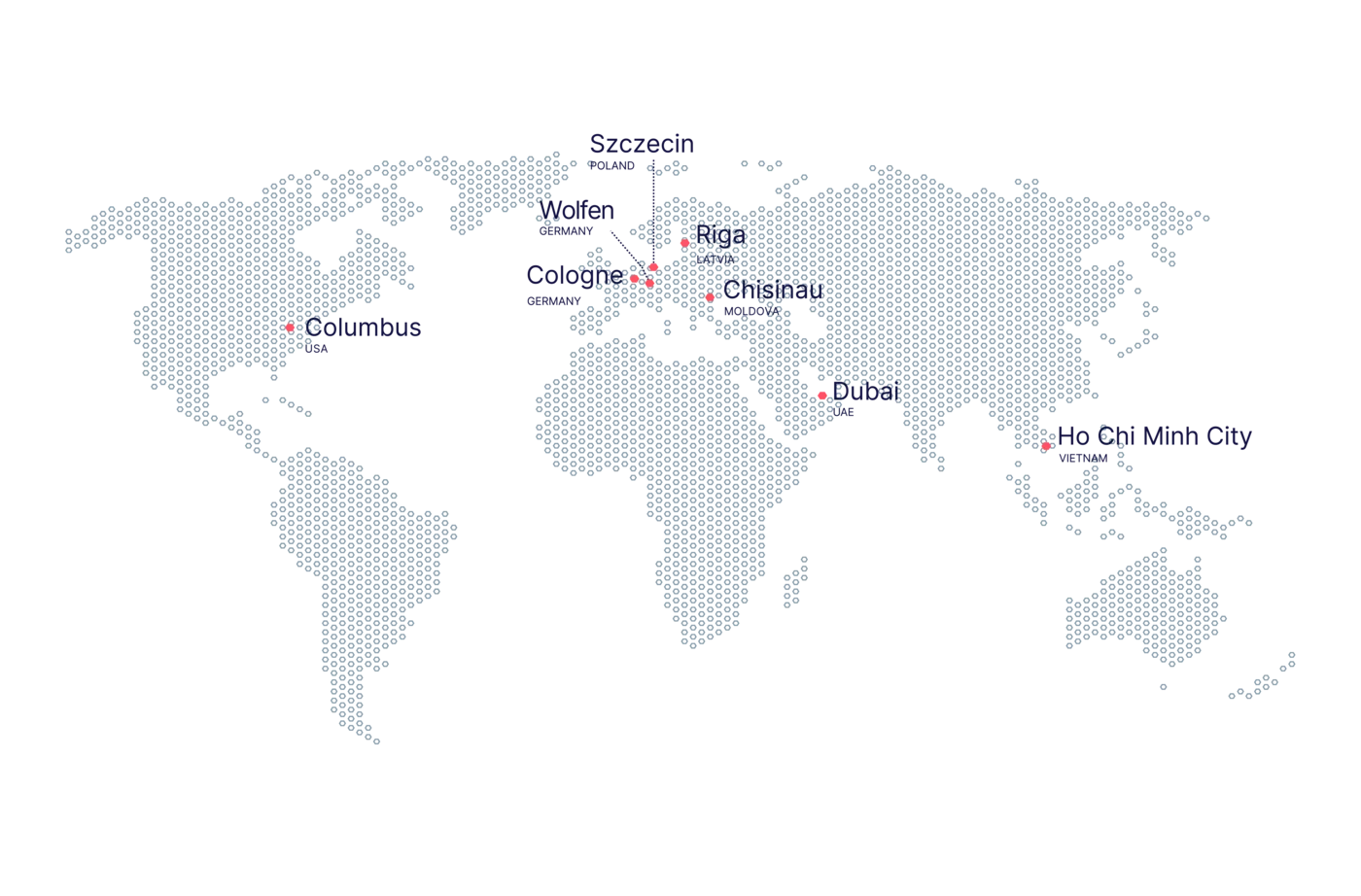
- 5 production plants: Poland, Germany, Latvia, and 2 in the United States (Columbus and Phoenix)
- 30,000 m² of directly operated production floor
- Up to 2.5 million units per day at group capacity
- 18+ years of experience in the wall art and home decor category
- Part of The Customization Group (TCG)
merchOne is a vertically integrated POD platform rather than a software layer over a partner network. This is a meaningful structural difference. Many POD apps available on Shopify operate as order-routing software: the platform takes an order from a store and forwards it to one of multiple external print shops, each with its own equipment, materials, staffing, and quality standards. The platform itself does not own or operate production. That model prioritizes catalog breadth, but output may vary between fulfillment sites, which is a structural trade-off worth weighing.
merchOne is built the opposite way. Every plant is directly operated, and the parent group (TCG) controls upstream inputs including forestry operations that supply pine wood for canvas frames. Raw materials, printing, framing, packaging, and shipping all run inside a single company with a single set of standards, rather than passing through multiple intermediaries. In practical terms, this means pricing is set by one operator rather than negotiated across many, quality specifications are defined once and applied everywhere, and the supply chain involves fewer operational hand-offs. Network models may involve additional production partners or subprocessors, so sellers should review each platform’s data-processing and supplier-routing terms carefully — in-house production can reduce the number of operational hand-offs

Operational implications of the vertical model
For Shopify sellers, the integrated model affects three practical areas:
- Quality consistency. Every facility follows the same internal specifications, so output from the Latvia plant is aligned with output from Phoenix. Quality variation between sites is minimal, which matters when a single store is serving customers in multiple regions.
- Support and resolution speed. Reprints, damaged shipments, or color corrections are handled by merchOne directly. There is no hand-off between a platform and an external printer, which typically shortens resolution times.
- Data handling. Personalized orders involve uploaded images, names, and private messages. Keeping production inside a single controlled environment can reduce the number of subprocessors handling that data. Sellers evaluating any POD partner should review each platform’s data-processing terms to understand how customer data flows through the supply chain.

Catalog focus: wall art and home decor
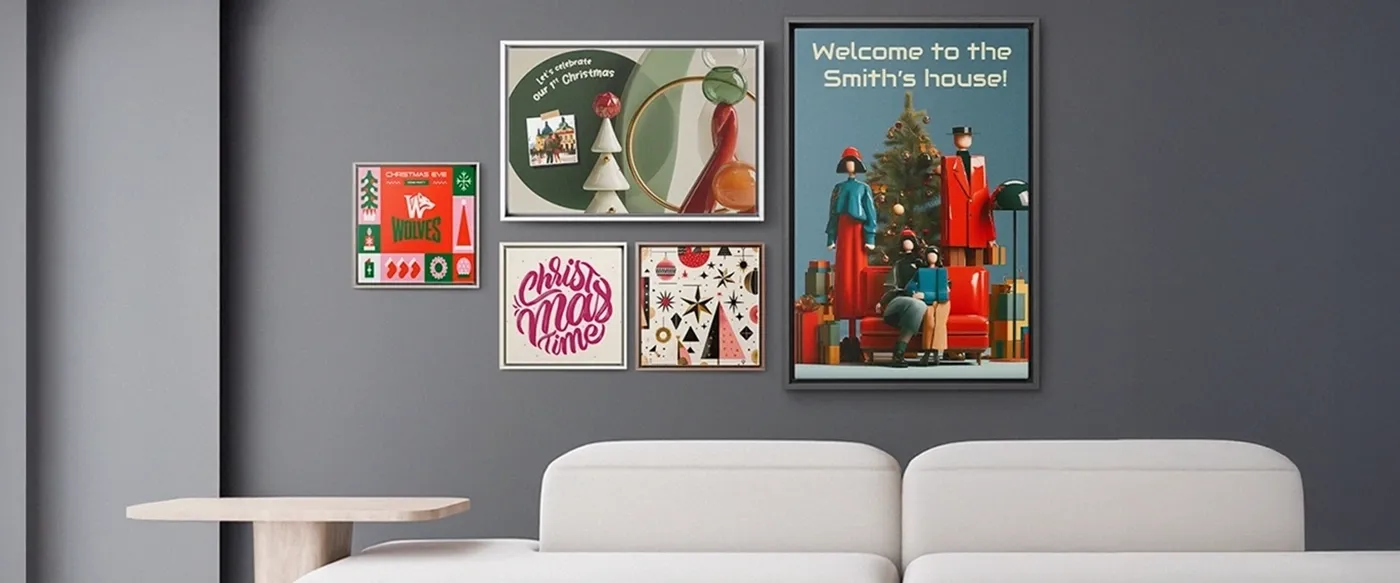
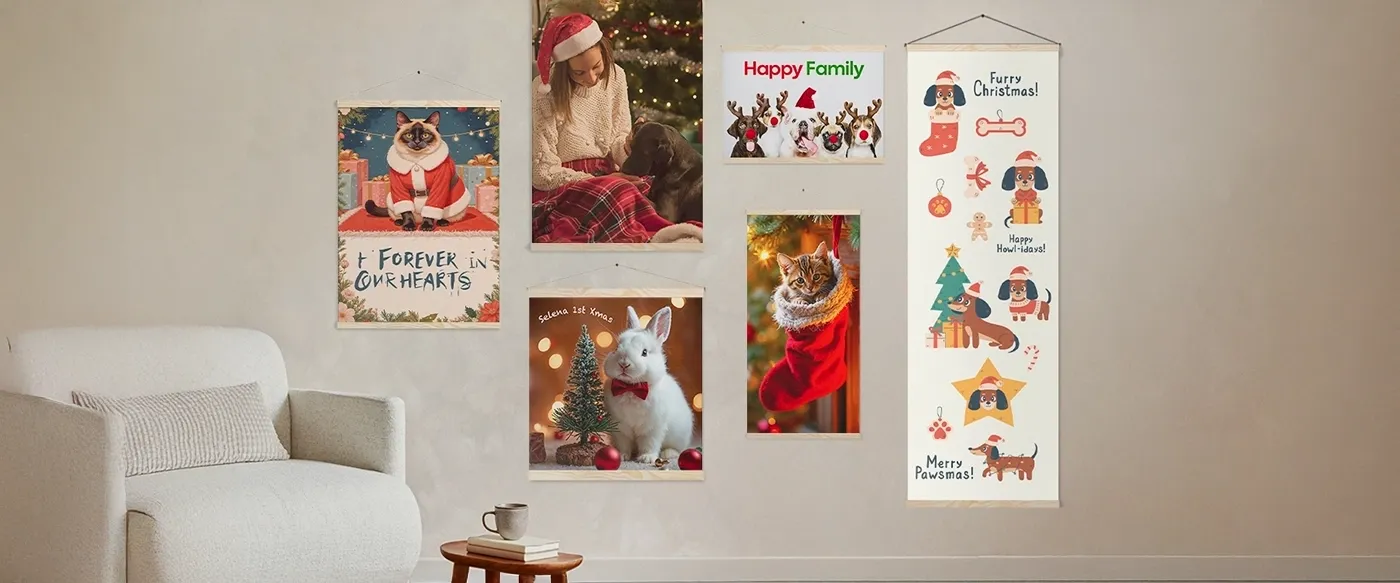
merchOne specializes in wall art and home decor. The catalog includes 24 wall decoration formats — canvas at 2 cm and 4 cm depth, framed canvas, framed posters, metal prints, acrylic prints, acrylic print on metal, wood panels, photo boards, and wall tapestries among them. Materials used across the range include real pine wood frames (rather than MDF), UV-resistant inks, 100% recycled plastic frames on select SKUs, and hand-stretched poly-cotton canvas.
Published base prices for common wall art formats:
| Product | US base price (from) | EU base price (from) |
|---|---|---|
| Canvas (2 cm) | $ 8.9 | € 4.33 |
| Framed Canvas | $ 29.9 | € 11.78 |
| Acrylic Print | $ 16.9 | € 5.73 |
| Framed Poster | $ 46.9 | € 10.7 |
| Metal Print | $ 14.9 | € 5.18 |
| Mixpix | $ 4.9 | € 5.64 |
Shipping is quoted separately and no handling or routing fees are added on top of the base price. Full pricing per size is available in the merchOne catalog after signup.
Retail prices in the wall art category typically sit between $40 and $150+ depending on size, which leaves workable margins on base costs in this range.
Note on pricing flexibility: The figures above reflect standard published rates. For high-volume merchants, agencies, and B2B buyers, pricing is negotiable — bulk orders, sustained monthly volume, and enterprise arrangements typically qualify for custom rates. Merchants operating at scale should reach out directly to discuss tailored pricing rather than relying on the public catalog as a final figure.
US + EU production footprint
merchOne operates a concentrated production footprint rather than a distributed partner network:
- North America: 2 plants (Columbus, Ohio and Phoenix, Arizona) serving US and Canadian demand
- Europe: 3 plants (Poland, Germany, Latvia) serving EU demand
For US-based Shopify sellers, orders fulfilled from the Columbus or Phoenix plants are produced domestically, which means no import step is involved. Because the product does not cross a border to reach the customer, the import tariffs that currently apply to POD goods shipped into the US from China (up to 53% on many product categories) do not enter the cost structure at all. Standard delivery windows within the main US and EU markets typically run 2–5 business days.
Infrastructure for B2B and enterprise use
merchOne’s infrastructure is designed for volume rather than single-creator use. Relevant features for agencies, corporate gifting programs, and high-volume Shopify operators:
- Multi-store management under a single account with centralized billing
- Dedicated account managers for enterprise clients
- Production SLAs defined per product line
- REST API with separate Sandbox and Live environments for integration into custom OMS, PIM, or ERP systems
- Native Customily and Teeinblue integrations for large-scale personalization (including campaigns with thousands of unique SKUs)
The group publicly lists retail partners including Aldi, Lidl, and Fressnapf — references that indicate the platform operates at retail scale.
Sustainability specifics
Sustainability claims in POD vary widely in specificity. merchOne’s public positions are:
- Solar power is used at part of the production facilities
- Frames on certain SKUs (including the classic gallery frame) are made from 100% recycled plastic
- Recycled materials are prioritized in packaging
- Wood supply is traceable through TCG’s forestry operations rather than sourced anonymously
- Local production (US or EU) reduces transport emissions relative to single-origin models
merchOne Wallet
Orders are paid from a prepaid Wallet rather than via per-order credit card charges. Sellers can set an auto-refill threshold so the balance tops up automatically when it falls below a set level. The main operational benefit is that orders are not held in “Pending” status due to failed credit card authorizations, which can otherwise delay fulfillment during traffic spikes.
Specifications
| Item | Detail |
|---|---|
| Owned factories | 5 (Poland, Germany, Latvia, + 2 in the US) |
| Production floor | 30,000 m² across all sites |
| Daily capacity | Up to 2.5M units (group-wide) |
| Parent group | The Customization Group (TCG) |
| Category focus | Wall art, home decor, personalization |
| B2B features | Multi-store management, SLAs, dedicated account managers |
| Pricing model | Transparent base + shipping, no routing fees |
| Integrations | Shopify (native), Etsy (via Order Desk), WooCommerce, Customily, Teeinblue, REST API |
Fit
merchOne is well-suited to Shopify stores in wall art, canvas, home decor, and personalized gifting categories, particularly those selling into US or EU markets where tariff exposure and consistent quality matter. It is less relevant for apparel-led stores, which are better served by apparel specialists.
>> Full documentation in the merchOne Help Center — shipping, taxation, returns, platform setup.
2. Printful
Printful runs its own fulfillment centers worldwide and bundles in a mockup generator, design tools, and white-label add-ons like inside labels and pack-in inserts. It’s most useful for apparel-led brands.
The company offers three plans. The Free plan costs nothing and includes access to 491 customizable products, automated fulfillment, unlimited stores, 10 Quick Stores, the free Design Maker and Mockup Generator, and selling on 20+ ecommerce platforms. The Printful Growth plan runs at $24.99/month — and becomes free once a store hits $12K/year in sales. Growth adds up to 33% off product pricing, 9% off branding, 25% off sample orders, an exclusive large front print on selected items, and free embroidery digitization for sample orders. The Enterprise plan is custom-priced and gives merchants a storefront built, managed, and scaled by Printful’s team, plus a dedicated Success Manager, market intelligence, trend analysis, and the option to visit production facilities.
The branding extras have published per-unit prices: $0.99 for printed inside garment labels, $2.49 for outside labels, $1 per Premium Image (per placement, per item sold), and a one-time embroidery digitization fee of $2.95–$6.50 per design. Sample order discounts are 20% on Free and 25% on Growth, with one sample order per month covering up to 3 items.
Printful states on its homepage that it has been trusted to deliver 131 million items since 2013.
For standard apparel — t-shirts, hoodies, mugs — Printful’s owned production and white-label features fit naturally. In wall art and home decor, base costs run higher than what vertically-integrated specialists offer.
Sources: Printful pricing page and Printful enterprise page.
3. SPOD (Spreadshirt Print-On-Demand)
SPOD is Spreadshirt’s print-on-demand arm, which has been rebranded to Spreadconnect. Production runs in both the US and EU, and the Shopify app now appears under the Spreadconnect name.
According to the brand’s own materials, the catalog covers more than 250 high-quality and sustainable products spanning apparel, drinkware, and accessories. Print and shipment happens within 48 hours, and the operation is backed by Spread Group, which has more than 20 years in print-on-demand. Spreadconnect’s WooCommerce page states the platform is trusted by over 100,000 creators and businesses. Print methods include digital printing, thermosublimation, digital transfer, laser transfer, and special flex, depending on the item. Domestic US shipping starts at $3.65.
The catalog is narrower than the bigger players — apparel is the central focus — covering t-shirts, hoodies, sweatshirts, and tank tops on the apparel side, caps, hats, and dog bandanas in accessories, and mugs, drinkware, and aprons in home and living.
Sources: Spreadconnect homepage at spod.com, Spreadconnect for Shopify on the Shopify App Store, Spreadshop’s Spreadconnect page, and the Spreadconnect Help Center.
4. Printify
Printify is a marketplace aggregator. It doesn’t manufacture anything itself — instead, it connects Shopify stores to a network of third-party print suppliers.
Per Printify’s own pricing page, the network includes 90+ print providers and 140+ print facilities or fulfillment centers, with a catalog of more than 1,300 customizable products. The platform serves over 10 million merchants.
Pricing comes in three tiers. The Free plan is $0/month and supports 5 stores per account with unlimited product designs. The Premium plan starts at $39/month on monthly billing or $24.99/month billed annually, raising the store cap to 10 per account. The Enterprise plan is custom-priced and removes the store cap entirely.
Premium adds up to 33% off products and custom branding, 1:1 mentorship through Sellers Club PRO, order management via Printify Connect, up to 20% off all products, AI Mockups, and early access to new features. Enterprise includes everything in Premium plus additional discounts on all products, custom API integration, a dedicated account manager, and branded customer support.
The strength of the marketplace model is breadth. The trade-offs are structural: output may vary between production partners, pricing varies between providers for similar SKUs, and customer support routes through Printify before reaching the production facility. Sellers should sample key SKUs and lock in preferred providers where the platform allows.
Sources: Printify pricing page and Printify Help Center article on the Premium plan.
5. CustomCat
CustomCat is a US-based, apparel-focused POD platform that fulfills from a single facility in Detroit, Michigan, using its proprietary DIGISOFT® print process.
The brand states that production runs out of Detroit, that DIGISOFT® delivers retail-quality apparel decoration, and that 95% of items dispatch within 3 business days. Support is available 24/7 across phone, email, and chat.
There are three plans. CustomCat Lite is free and includes DIGISOFT printing, unlimited product creation, the mockup generator, product sync, access to a private seller community, and direct fulfillment. CustomCat PRO is $30/month — or $25/month billed annually ($300/year) — and adds 20–40% catalog discounts, exclusive promotions, unlimited stores, volume-tier pricing, and a 60-day free trial. The Enterprise plan is custom-priced and offers higher-tier discounts.
CustomCat is built around apparel. The catalog has limited depth in wall art, home decor, and enterprise multi-brand management compared with category specialists
Sources: CustomCat FAQs at customcat.com/knowledge/faq, the help.customcat.com article on CustomCat PRO, the CustomCat plan comparison page, and CustomCat’s listing on the Shopify App Store.
6. Gooten
Gooten dispatches each order to one of its manufacturing partners using a routing engine built to cut transit time and shipping cost by producing closer to the buyer.
According to Gooten’s own materials and its G2 listing, the network includes more than 30 manufacturing partners across more than 70 production locations. Over 70% of production is U.S.-based. There are no subscription fees and no transaction fees — merchants pay only per item produced. Custom API access is available for centralized billing and store management. Integrations cover Shopify, WooCommerce, BigCommerce, and Etsy.
For higher-volume merchants, Gooten runs a VIM (Very Important Merchant) Loyalty Program that includes annual sample credit, quarterly business reviews, product roadmap reviews, partnership management, and access to office hours with Gooten executives.
As with any routing-based platform, output may vary between partner facilities, so sellers should sample key SKUs and lock in preferred providers where the platform allows
Sources: Gooten on the Shopify App Store, Gooten’s G2 reviews page, and Gooten’s G2 pricing page.
7. Gelato
Gelato runs the largest distributed POD network in the space, sending each order to the partner facility closest to the shipping address.
Per gelato.com, the network covers 140+ local production hubs across 32 countries, with a catalog of 100+ customizable products and over 10 million orders fulfilled to date.
Subscription plans start with the Free plan at $0/month, which gives access to the local production network, integrations, the design editor, and a basic mockup generator. Gelato+ runs at $23.99/month on monthly billing, unlocking up to 25% off products plus AI tools, premium mockups, Magic Mockups, and Instant Collections. The annual version of Gelato+ drops to $19.99/month (billed yearly) and offers up to 35% off products through December 31, after which the discount reverts to up to 25%. Gelato+ Gold sits above that with custom volume discounts, free shipping incentives, and priority support.
Integrations cover Shopify, Etsy, WooCommerce, Wix, Squarespace, and an open API.
The positioning emphasizes local delivery and sustainability, and the Personalization Studio handles automated fulfillment for customized orders.
Sources: Gelato Print on Demand page, Gelato subscription plans page, Gelato Print on Demand for Europe page, and Gelato’s listing on the Shopify App Store.
8. Order Printer Pro
Order Printer Pro handles document automation for Shopify stores — branded invoices, packing slips, credit notes, and customs paperwork. It plugs directly into the Shopify admin.
Per the app’s Shopify App Store listing, it handles automatic delivery of PDF invoices, receipts, and quotes; customizable templates with a no-code visual editor (with HTML/CSS/Liquid available for advanced edits); filtering, exporting, or bulk printing of invoices from the Shopify admin, Point of Sale, and mobile; multi-language and multi-currency support; B2B, VAT, and tax handling; and commercial invoices with HS/HTS codes for international shipping.
There are four plans. Free covers up to 50 orders per month at $0. Starter is $10/month for up to 500 orders. Growth is $20/month for up to 5,000 orders. Scale is $40/month with unlimited orders.
For stores selling internationally, customs invoice support is usually the main reason to upgrade. The app is built and maintained by Shop Circle.
Sources: Order Printer Pro listing on the Shopify App Store and the Order Printer Pro page on shopcircle.co.
9. Klaviyo
Klaviyo is an email and SMS marketing platform built for ecommerce, with deep Shopify integration. Pricing is contact-based — Klaviyo bills on active profiles in the account, not on the number of emails sent.
Per klaviyo.com/pricing, the Free plan covers up to 250 active profiles, 500 monthly email sends, and 150 SMS/MMS credits, with email support included for the first 60 days. The Email plan starts at $20/month for 251–500 active profiles, 5,000 monthly email sends, and 150 SMS/MMS credits. The Email + SMS plan starts at $35/month for the same profile range and includes 1,250 SMS/MMS credits. Above 250,000 profiles, accounts move into custom Enterprise pricing.
The feature set is consistent across all paid tiers — unified customer profiles with full historical data, 350+ platform integrations, predictive analytics, AI-generated segments and content, and the Marketing Agent for campaign and flow creation. Higher tiers don’t unlock new features; they unlock more capacity.
Common automation use cases include welcome flows, abandoned cart recovery, browse abandonment, back-in-stock alerts, post-purchase sequences, and win-back campaigns.
Sources: Klaviyo pricing page at klaviyo.com/pricing.
10. Loox
Loox handles photo and video review collection for Shopify stores — a meaningful trust signal in print-on-demand, where buyers can’t physically inspect what they’re buying.
Per loox.app/pricing, there are four plans. The Beginner plan at $9.99/month covers the basics: review request emails, a discount for photo reviews, and multilingual support. Scale at $39.99/month adds video reviews, Google Shopping, Referrals, and the ability to remove Loox branding. Convert at $49.99/month adds AI-powered features — smart visual sorting, review highlights, auto-translated reviews, and AI review replies. Unlimited at $299.99/month covers unlimited review requests, unlimited Referrals, unlimited Upsells, and priority support.
Order capacity scales with plan. Beginner supports up to 100 monthly orders or 500 total. Scale and Convert use pay-as-you-go beyond their base, and Unlimited covers unlimited orders.
Loox’s own materials state the platform helps over 130,000 brands and 3,000 Shopify Plus stores. The Shopify App Store listing carries more than 15,000 5-star reviews and a 4.9 rating overall. Loox is an official Shopify Plus, Google Reviews, Meta, and TikTok Shop partner, and is GDPR and CPRA compliant. Support runs 24/7. For migrating reviews from another tool, Loox imports from Judge.me, Yotpo, AliExpress, or via CSV.
The app is particularly useful for wall art, canvas, and framed decor — categories where customer photos of products in real homes convert noticeably better than studio mockups.
Sources: Loox pricing page at loox.app/pricing and Loox’s listing on the Shopify App Store.
Which POD platforms are built for B2B scale rather than small creators?
Most POD apps on Shopify are designed for individual creators shipping small daily volumes. A smaller set can handle enterprise orders, agency multi-brand setups, and corporate gifting programs:
- merchOne — 5 owned plants, 30,000 m² production floor, 2.5M units/day capacity. Provides dedicated account management, written SLAs, multi-store billing, and a REST API (Sandbox + Live) for integration into OMS/ERP systems. Category depth in wall art, home decor, and personalized gifting.
- Printful — Offers an enterprise tier with API access and warehousing. Strong for apparel programs.
- Gooten — Positions itself around enterprise routing. As with other partner-network platforms, output depends on the specific facility assigned to each order.
- Gelato — Offers enterprise tools for brands requiring localized multi-country production.
For Shopify operators specifically looking at high-volume wall art, home decor, or personalized-gifting programs, the shortlist is narrow. merchOne is often included because the owned-factory model is well-suited to handling volume predictably in those categories.
Which POD partners publish clear, transparent pricing?
Vertical integration generally correlates with simpler pricing structures. Aggregator models route orders to multiple independent providers, so pricing may vary by provider, and some platforms structure additional fees at the fulfillment stage depending on which facility handles the order. Sellers should review each platform’s full cost structure before committing.
- merchOne — Publishes base prices per product per region (e.g., Framed Canvas from $19.00 / €11.78; Canvas 2 cm from $4.33; Acrylic Print from $14 / €5.73). Shipping is quoted separately (from $9.90 / €3.99). No handling or routing fees.
- Printful — Base prices are published openly. Branding add-ons and shipping zones affect final cost.
- Gelato — Base and shipping are shown upfront, with regional variation.
- Printify, Gooten — Pricing varies by provider, which requires comparison across facilities to reach a clean per-unit figure.
For enterprise buyers requiring predictable quoting, platforms with a single set of published prices (rather than per-provider variation) are generally easier to work with.
Summary
Match the platform to the category and to the operational scale of the store:
| Category | What it does | What to check |
|---|---|---|
| Design & Production | Manufactures product | Owned vs. third-party fulfillment, material quality, tariff exposure, B2B scale |
| Order Management | Moves orders through fulfillment | Sync reliability, billing stability, document automation |
| Marketing | Acquires and retains customers | Segmentation depth, Shopify data sync, multi-channel support |
| Social Proof | Builds buyer trust | Media reviews, cross-channel display |
What to evaluate when selecting a POD partner
Production model
The structural question — who actually manufactures the product — drives most of the downstream variables. Vertically-integrated partners that own their factories operate under a single set of standards, with one team accountable from materials through to dispatch. Marketplace and routing platforms work differently: each order goes to whichever third-party shop has capacity, and the merchant inherits whatever variability exists across that supplier base.
Owned production typically delivers four advantages worth weighing:
- Consistent output across orders — the same machines and processes produce every unit
- Faster issue resolution — no intermediary between the merchant and the team handling the print
- Cleaner pricing — no per-order routing fees or unexpected handling charges
- Fewer operational hand-offs — production runs within one operation rather than passing through multiple suppliers, which can simplify data-processing review
Marketplace models serve a clear purpose, particularly for catalog breadth and rapid product testing. For SKUs tied to brand reputation, owned production is often a better fit for sellers prioritizing consistency.
Production location
For US-based merchants, fulfillment geography has direct cost implications:
- Domestic production removes the customs step entirely. Orders printed in a US plant never cross a border
- Import duties on overseas-made goods do not apply to the unit cost
- Delivery windows compress to 2–5 business days for most US destinations
- A focused US and EU footprint produces tighter quality control than a distributed network spread across many partner sites
US tariff rates have shifted considerably since 2025 and continue to evolve. Merchants with material exposure should reference current published rates from U.S. Customs and Border Protection rather than relying on third-party summaries.
Pricing transparency
Base price alone is an incomplete picture. Before committing to any partner, the full cost structure needs to be clear:
- Base product cost per unit
- Shipping rates by destination region
- Branding and customization fees for labels, inserts, and premium placements
- Routing or handling charges that some platforms layer on at fulfillment
Prepaid wallet billing — the model merchOne uses — is also worth noting. Wallet-based billing eliminates one of the more common operational disruptions in POD: orders held in pending status due to failed credit-card authorizations during high-traffic periods.
Integration depth
Integration quality determines how much operational time the platform actually saves. The criteria worth verifying:
- Native Shopify integration rather than a generic third-party connector
- Documented REST API with separate sandbox and production environments
- Personalization tool support — Customily, Teeinblue, and Order Desk are the established standards
- Multi-store management under a single account, with centralized billing for agency or multi-brand operators
- Written SLAs for high-volume merchants where production delays carry real cost
Sustainability specifics
Environmental claims warrant closer scrutiny than they typically receive. Verifiable indicators include:
- Vertically-integrated supply chains that control inputs upstream of printing
- Traceable sourcing for raw materials such as wood, fabric, and inks
- Recycled packaging as a default, not an upgrade
- Documented energy practices at production facilities
- Owned forestry or raw-material operations — uncommon, but the strongest credential available
Generic “eco-friendly” positioning without underlying detail is a marketing claim, not a sustainability practice. The distinction matters when buyers and regulators are increasingly looking past the surface.
A typical high-volume Shopify POD stack
Few high-volume operators concentrate their entire catalog with a single POD partner. The risk exposure is too high, and no single platform performs uniformly well across every category. A more typical configuration distributes the work:
- merchOne — wall art, canvas, home decor, personalized gifting, and pet products
- Apparel specialist — t-shirts, hoodies, and sweatshirts
- Category-specific provider — jewelry, accessories, or other niche items
- Klaviyo — lifecycle email and SMS marketing
- Loox — photo and video review collection
- Order Printer Pro — invoicing and customs documentation
The logic behind this structure is twofold. It reduces exposure to any single provider’s stockouts or production issues, and it routes each category to the partner best equipped to handle it — rather than asking one generalist to perform adequately across the board.
Where the POD market is heading
Several structural shifts are reshaping print-on-demand on Shopify, and they’re worth understanding before committing to a long-term partner:
- AI-driven personalization is becoming standard. Live preview tools, automated mockup generation, and AI-assisted design are moving from differentiators to baseline expectations
- Domestic production is shifting from preference to requirement. Tariff exposure on overseas-made goods is making US and EU manufacturing a financial decision, not a brand-positioning one
- Retail-grade quality is the new floor. Customers — particularly in home decor and gifting — increasingly benchmark POD products against physical retail rather than against other POD products
- Enterprise capabilities have become baseline expectations. Written SLAs, multi-store management, and dedicated account support no longer sit in premium tiers for serious operators
- Sustainability and data-handling claims face meaningful scrutiny. Vague positioning carries real reputational and regulatory cost
The takeaway for 2026: catalog size has stopped being the deciding factor. What matters is whether a platform’s production infrastructure aligns with the operational scale of the store and the categories it’s serious about selling.
Start today