


How Do Market Taxes in the U.S. and Europe Impact Your POD Business?
Expanding your Print-on-Demand (POD) business internationally unlocks exciting new markets, but navigating the different tax landscapes can feel like deciphering a secret code. While Europe and the US markets offer incredible opportunities, navigating their distinct tax systems requires some in-depth knowledge and preparation.
Disclaimer: This article is provided for general informational and educational purposes only and does not constitute legal, tax, accounting, financial, customs, intellectual-property, regulatory or other professional advice.
The information may not be complete or applicable to your circumstances. Requirements vary by jurisdiction, business structure, transaction, product and sales channel, and may change over time. Third-party products, services, fees, policies and availability are subject to the relevant provider’s current terms.
Readers should verify current requirements with the relevant authority, platform or provider and obtain advice from a suitably qualified professional before making legal, tax, financial or compliance decisions. Nothing in this article modifies any applicable agreement or service terms.

Read on as we’ll break down the key differences between:
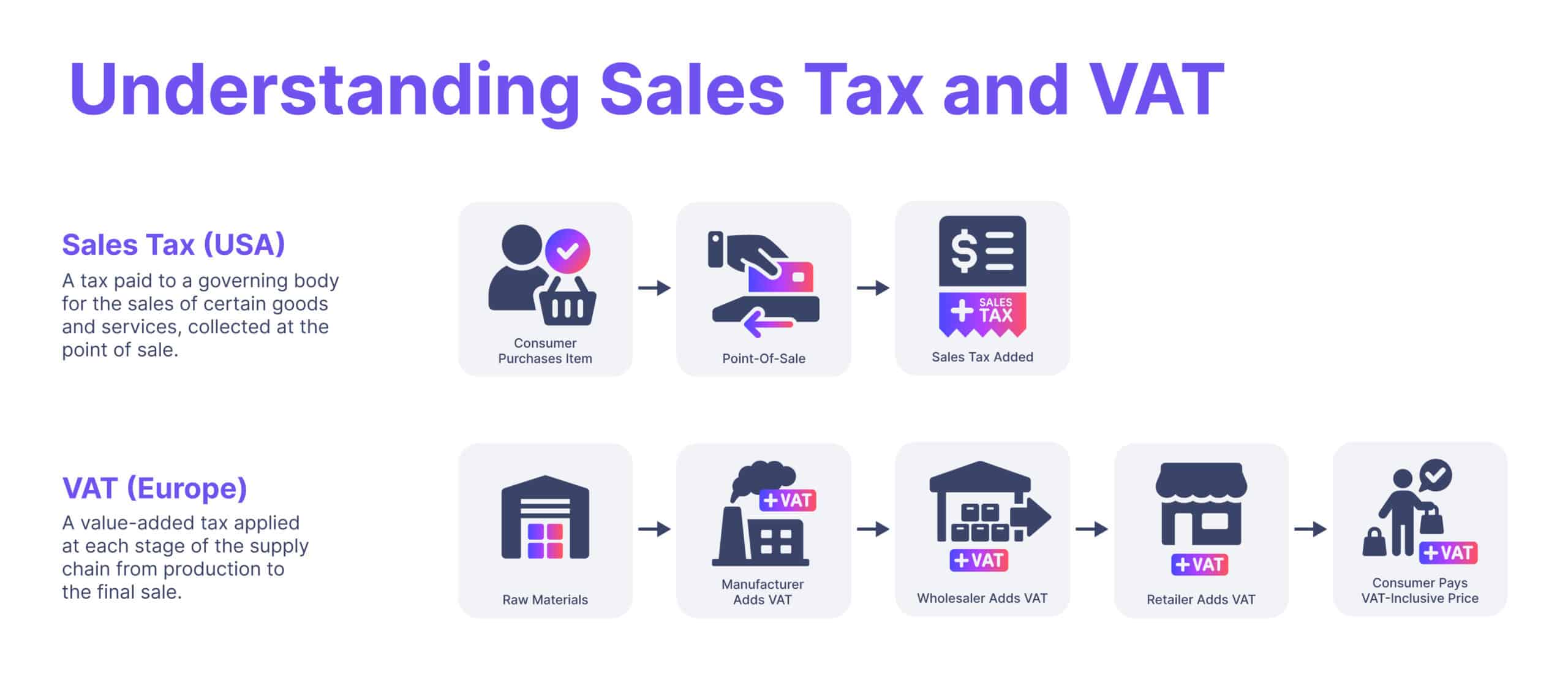
- US Sales Tax: A point-of-sale tax you collect for the state.
- European VAT: A consumption tax applied throughout the supply chain.
We’ll also cover how to deal with:
- Nexus: A tricky concept that determines if you owe sales tax in a particular US state.
- Importance of VAT Registration Thresholds: When your sales in a European country hit a certain point, you must register for VAT.
Plus, we’ll share some practical tips to help you:
- Save on upfront taxes with resellers and exempt certificates in the US and VAT mechanisms in Europe.
- Simplify VAT registration in certain European countries.
US System: A Focus on Sales Tax and Nexus
In the United States, the primary concern for POD sellers is the Sales tax. Unlike income tax, which is levied on your profits, sales tax is a tax applied to the retail price of your goods at the point of sale. It’s important to remember that sales tax is also known as a “pass-through tax.” This means the customer pays the sales tax, and you, the seller, are essentially acting as a collector for the state. You then have the responsibility to collect and remit 100% of this sales tax to the appropriate state authorities.
Sales Tax Complexity and Nexus
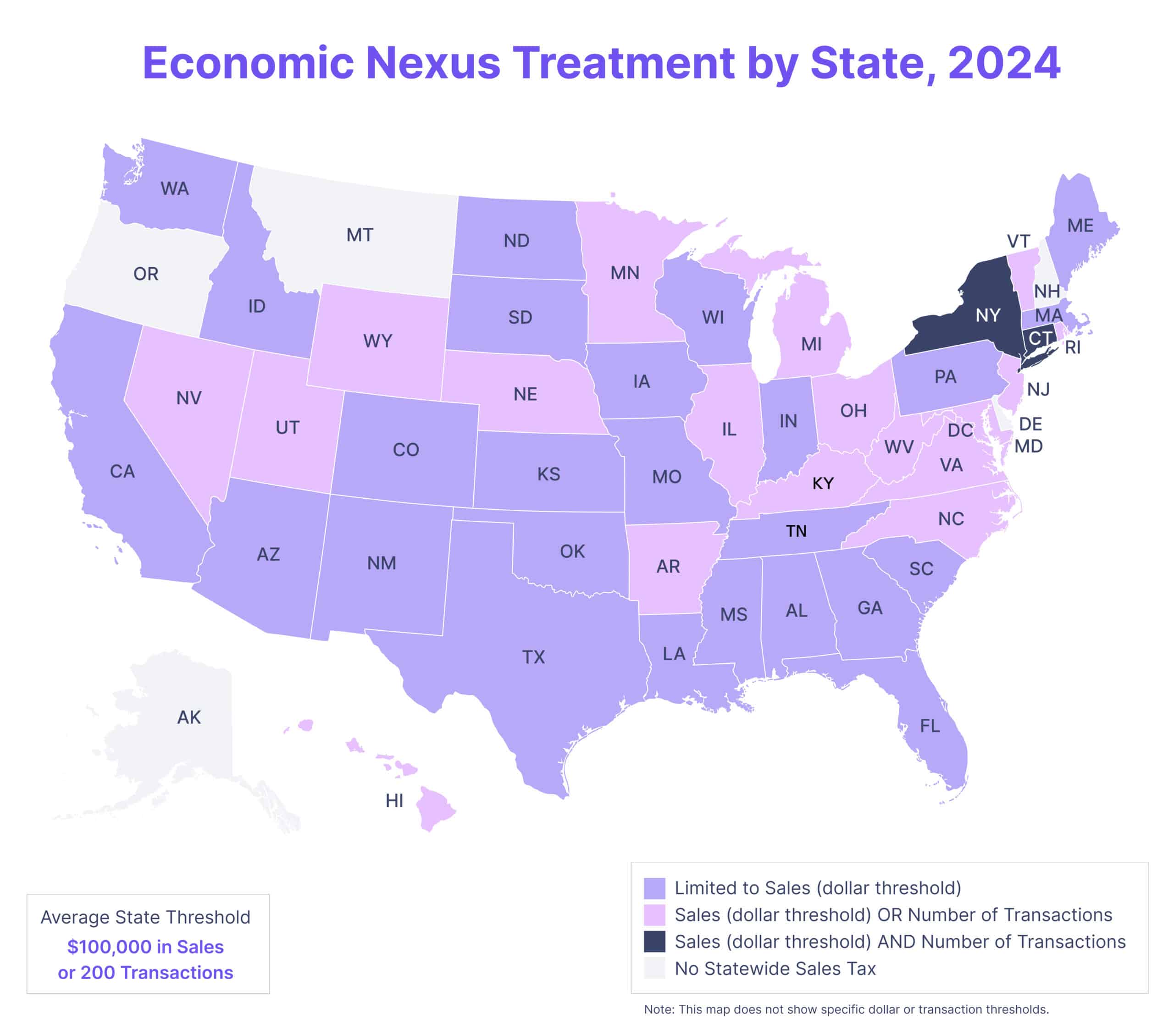
The US does not have a national sales tax. Instead, individual states (and sometimes localities) may levy their own sales taxes, with rates varying significantly depending on your location (sometimes even within the same state or city).
Things get a bit more intricate with the concept of nexus. Nexus refers to a business’s physical or economic presence in a state that creates a sales tax collection obligation. In simpler terms, if you have a certain level of activity within a state (e.g., exceeding a sales threshold or having inventory stored there), you may be required to collect and remit sales tax on your sales in that state, even if you don’t have a physical location there. This can be crucial for POD businesses expanding their reach, as seemingly simple things like exceeding a sales threshold in a particular state can trigger the need to collect and remit sales tax there.
Before collecting sales tax, you’ll need to register for a sales tax permit with the appropriate state tax authority. You can typically find the registration application online on the website of your state’s Department of Revenue (or similarly named agency). The application process may vary slightly by state, but generally requires basic business information like your Employer Identification Number (EIN) and business address.
The frequency of filing sales tax returns also varies by state, ranging from monthly to annually. You’ll need to determine the filing schedule for each state you collect sales tax in. These returns typically require reporting your total sales and the amount of sales tax collected during the filing period.
The collected sales tax needs to be remitted (paid) to the state tax authority along with your return. Most states allow for electronic filing and remittance, simplifying the process.
Tip: See useful information on the TaxJar website for a more thorough understanding of how to register for a Sales Tax permit: https://www.taxjar.com/sales-tax/permits
Reseller’s Certificates: A Potential Cash Flow Boost
For POD businesses operating within the US, obtaining a reseller’s certificate can be a valuable tool. The Reseller’s certificate allows you to purchase goods wholesale without paying sales tax upfront if you intend to resell those items. By utilizing a reseller’s certificate, you can improve your cash flow and potentially simplify your tax calculations by focusing on the sales tax you collect from customers, not the tax you pay on wholesale purchases.
Exemption Certificates: Saving on Tax-Exempt Purchases
Like reseller certificates, exemption certificates offer significant benefits for POD businesses in the US. While reseller certificates focus on tax-free purchases for resale, exemption certificates cater to qualified tax-exempt organizations. If your POD business falls under this category, such as a registered non-profit or charity, an exemption certificate allows you to purchase supplies and materials tax-free. This can translate to substantial cost savings, especially for bulk purchases.
The specific qualifying criteria and types of exemptions vary by state, so be sure to consult your state’s Department of Revenue for details.
Here’s how to obtain Reseller’s or Exemption Certificate:
- Check Your State’s Requirements: Certificate regulations vary by state. Head to your state’s Department of Revenue website or contact them directly to find the specific application form and any additional requirements.
- Gather Necessary Documents: You’ll typically need to provide basic business information like your business license number, Employer Identification Number (EIN), and proof of your business address. Some states might require additional documents, so be sure to check the specific requirements beforehand.
- Submit Your Application: Most states allow online applications, while others might require you to mail in the completed form. Processing times can vary, but it generally takes 2-4 weeks to receive your reseller certificate.
- Maintain Records: Once you have your certificate, it’s crucial to keep proper records of your purchases and sales. You may be required to show these records to a seller to verify your eligibility for the exemption or during a potential tax audit.
Tip: While waiting for your official certificate, some states allow you to provide a completed application form (or a copy of your pending application) to a seller to temporarily hold off on collecting sales tax. However, this is not universally accepted, so always check with the seller before assuming this temporary exemption.
Key Takeaways:
- Sales tax rates and collection requirements in the US can vary significantly by location and level of activity within a state.
- Understanding nexus is crucial to ensure you comply with sales tax collection obligations in different states.
- Resellers or Exemption certificates can be a valuable tool for POD businesses to improve cash flow by deferring upfront sales tax on wholesale purchases.
Important Note: It’s imperative to consult the specific regulations of each state you operate in for accurate and detailed information on sales tax registration, filing deadlines, and remittance procedures.
merchOne: Your Partner in US Tax Efficiency
As a merchOne seller in the US, you benefit from our reseller’s certificate verification. Send your certificate to us, and we’ll verify its validity. This allows you to avoid upfront sales tax on wholesale purchases within the US, improving your cash flow and simplifying your tax calculations.
European Systems: A Continent of VAT
Across the Atlantic, a different tax system takes center stage. In Europe, Value-Added Tax (VAT) reigns supreme. Unlike the US system, which focuses on sales tax at the point of purchase, VAT operates as a consumption tax applied throughout the supply chain.
The core principle of VAT is to tax the value added to a good or service at each stage of production and distribution. By taxing the value added at each stage, VAT ensures that the tax burden is ultimately borne by the final consumer, reflecting the total value of the product.
Navigating the VAT Maze
It is important to note that VAT rates vary across Europe. Most countries have a standard VAT rate, but some essential goods might have a reduced VAT rate. Understanding VAT registration thresholds in your target country markets is crucial, as you may not need to register for and collect VAT until your sales within a particular country reach a certain level. However, exceeding this threshold makes VAT registration mandatory. Failing to register can lead to penalties. Registration involves applying to the relevant tax authority in that country. The specific requirements and timelines can vary. Once registered, you’ll be obligated to file VAT returns periodically (usually quarterly, but sometimes monthly) with the tax authority. These returns report your total sales and purchases subject to VAT, along with the amount of VAT charged and claimed.

Tip: See useful information on the European Commission website for more information about VAT in European countries.
Reducing Upfront Tax Burdens
Similar to a US reseller’s certificate, mechanisms exist in Europe to reduce upfront tax burdens for businesses buying goods for resale. As a VAT-registered business, you can typically reclaim the VAT you pay on purchases (e.g., blank T-shirts) if you collect VAT from your customers. This reduces your overall tax burden. To claim these refunds, you’ll need to maintain proper records of your VAT invoices and include them with your VAT return.
Furthermore, some European countries outside the EU might have a reverse charge mechanism. This means the responsibility for paying VAT shifts from the seller to the buyer (your POD business) if both parties are VAT-registered. This essentially achieves the same outcome as a reseller’s certificate – you don’t pay VAT upfront on the purchase.
It’s essential to research the specific regulations in your target European markets to understand if a VAT refund system or a reverse charge mechanism applies and how to utilize them effectively.
Important Note: VAT regulations can be complex, and it’s highly recommended to consult with a qualified tax advisor familiar with the specific regulations of your target European markets.
Key Takeaways:
- VAT is a consumption tax applied at each stage of production, ultimately paid by the final consumer.
- VAT rates can vary across Europe, with standard and reduced rates. Understanding VAT registration thresholds in your target markets is a priority.
- As a VAT-registered business, you can typically reclaim the VAT you pay on purchases, reducing the overall tax burden.
Sharpen Your European Focus with merchOne
Conquering the European market requires a strategic approach to VAT, but you don’t have to navigate this labyrinth alone. Here at merchOne, we empower POD sellers with the knowledge and tools to thrive internationally.
The first step is identifying your target market. Which European countries hold the most promise for your POD business? Researching consumer preferences, market trends, and competitor analysis will help you pinpoint the most lucrative opportunities. Once you’ve identified your target countries, VAT registration thresholds become crucial. These thresholds determine when you’ll need to register for and collect VAT in each country.
Understanding your EU VAT rate can seem complex, but merchOne is here to simplify. Here’s a breakdown of the key factors with an example of Germany-registered VAT that determine the rate applied to your order:
Your EU VAT ID Number
- No EU VAT ID: If you don’t have a valid EU VAT ID number, the German VAT rate will be applied by default for orders fulfilled and shipped within the EU.
- EU VAT ID (Registered in Germany): If you’re registered for VAT in Germany, the German VAT rate applies to orders shipped within Germany or to any other EU country.
- EU VAT ID (Registered Outside Germany): If you have a valid EU VAT ID registered in a country other than Germany, a 0% VAT rate will be applied to your order if it’s shipped to another EU country (excluding Germany). However, if the order is shipped within Germany, the German VAT rate will still apply.
Right Focus, Smooth Expansion
Both tax systems in Europe and USA involve collecting tax on your sales, yet the US system focuses on a point-of-sale sales tax, while VAT is a consumption tax applied throughout the supply chain. Understanding these distinctions and navigating nexus and registration thresholds is key to ensuring compliance.
Remember, this is just the starting point. International POD opens exciting possibilities, but tax regulations can be complex. While merchOne can’t provide specific tax advice (we highly recommend consulting a qualified professional for your specific situation), we equip you with the resources to navigate the basics.
At merchOne, we understand the complexities of international POD sales. We go beyond just providing a platform, also bringing guidance and knowledge to help you thrive. Our curated content, based on market trends, empowers you to identify lucrative sales opportunities and maximize your growth potential.
Automate your VAT calculations and reporting with our user-friendly tools. Spend less time on paperwork and more time on what fuels your business. With merchOne as your ally, you can confidently explore global markets. We provide the resources and support to navigate complexities while you can focus on what you do best – creating amazing POD products.
Ready to unlock the exciting world of international POD sales? merchOne is your one-stop shop for high-quality POD fulfillment and expert guidance.
Legal disclaimer: This article is for informational purposes only, and merchOne does not constitute as tax advisory on any of the tax-related topics covered.