

Sublimation Printing Explained: What Sellers Need to Know Before Choosing It
If you’ve ever touched a sublimated jersey or mug and noticed the design feels like it’s inside the surface rather than on top of it, that’s exactly the point. Sublimation printing works differently from most printing methods — and understanding how it works helps you make smarter product decisions for your store.
This guide breaks down the sublimation process step by step, explains what it does well (and where it falls short), and shows you how to apply it practically when building a product catalog on merchOne.
Related article: How to Create Sublimation Designs: A Complete Step-by-Step Guide
What Sublimation Printing Actually Is?
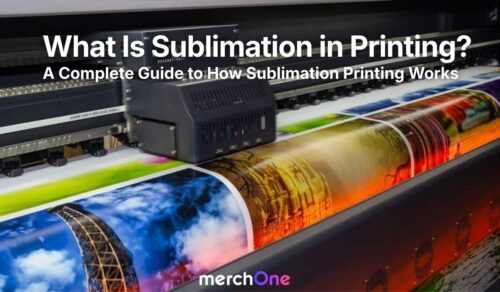
Sublimation printing is a heat-based digital printing method where solid dye converts directly into gas — skipping the liquid phase entirely — and permanently bonds with synthetic fibers or polymer-coated surfaces at the molecular level.
The result is a print that doesn’t sit on top of the material. It becomes part of it.
This is what gives sublimation-printed products their signature qualities: colors that look vivid from every angle, surfaces that feel smooth rather than coated, and prints that don’t crack, peel, or fade after repeated washing.
The chemistry behind it relies on two conditions: high heat (typically 180–205°C) and a substrate that contains polyester or polymer molecules. Without both, the dye has nowhere to bond.
How the Sublimation Process Works, Step by Step?
Understanding the production sequence helps you anticipate how your designs will translate from screen to product.
Step 1 — Digital Design Preparation
Everything starts with a file. Sublimation designs should be created in RGB or sRGB color space at a resolution of 150–300 DPI minimum. Because colors shift slightly when printed onto transfer paper, experienced designers often over-saturate their files slightly to compensate — the final result after heat transfer is always more vibrant than the interim print looks.
Step 2 — Printing onto Transfer Paper
The design is printed onto a special sublimation transfer sheet using dye-sublimation inks. At this stage, the image looks duller than expected. This is temporary. The inks are engineered to activate under heat, not to look finished on paper.
Step 3 — Heat Press Application
Transfer paper is positioned precisely on the substrate. A heat press applies controlled temperature, pressure, and time — usually 30 to 60 seconds depending on the material. This is where the chemical transformation happens.
Step 4 — Sublimation Reaction and Bonding
Under sustained heat, the solid dye converts to gas. That gas penetrates the open polymer pores of the substrate. When heat is removed and the material cools, the pores close around the dye molecules — locking the color permanently inside. There’s no layer, no adhesive, no coating. Just dye embedded in the material structure itself.
Which Materials Work with Sublimation (and Which Don’t)?
This is the single most important practical constraint of sublimation printing, and it determines which products in your catalog can use it.
Polyester and synthetic fabrics are the primary textile application. At 100% polyester, sublimation produces the full color depth and wash durability the method is known for. Drop to a 50/50 poly-cotton blend and colors become noticeably softer and less saturated. On 100% cotton, sublimation dye has almost nothing to bond with — results are extremely faded and unusable for commercial products.
Polymer-coated hard goods expand sublimation well beyond fabric. Ceramic mugs, aluminum panels, metal photo prints, phone cases, and coated keychains all work through the same mechanism: a factory-applied polymer layer gives the dye the bonding surface it needs. Without that coating, hard goods can’t be sublimated.
Color of the substrate matters. Sublimation dye is transparent by nature — it doesn’t include white ink. Printing a yellow design on a white surface works perfectly. Printing the same design on a navy background produces almost nothing visible. Sublimation is strictly a light-substrate technique.
Glass can be sublimated when treated with the appropriate polymer coating, though it’s less common in standard print-on-demand catalogs than mugs or fabric.
Where Sublimation Outperforms Other Printing Methods — and Where It Doesn’t?
The Genuine Advantages
Color permanence is sublimation’s most commercially important trait. Because the dye is inside the material rather than on the surface, it can’t crack or peel regardless of how many times the product is washed. For activewear, sportswear, and everyday-use items like mugs, this matters considerably to end customers.
Full-color, all-over printing without surcharges is another real advantage. Screen printing charges per color and struggles with photographic complexity. Sublimation prints an unlimited color spectrum in a single heat press pass — gradients, photorealistic images, and intricate patterns all cost the same as a simple two-color logo.
For print-on-demand specifically, sublimation requires no screens, plates, or minimum runs. A single custom mug and a 500-unit order use exactly the same process.
The environmental profile is also better than most alternatives — non-toxic water-based dyes, no screens to clean, no excess ink waste, and production only happens when an order is placed.
The Real Limitations
Material restriction is the biggest constraint. If your target audience prefers cotton t-shirts — which represents the majority of casual apparel buyers — sublimation isn’t the right method. DTG or DTF printing serves that segment better.
Dark and mid-tone substrates are not compatible. This limits sublimation primarily to white or very light-colored products, which can feel restrictive if you want design versatility across a full apparel range.
Equipment cost is relevant for in-house operators, though on a print-on-demand platform like merchOne, this cost is absorbed by the production partner — you pay per order, not for equipment.
Sublimation vs. Screen Printing vs. DTG — A Direct Comparison
| Factor | Sublimation | Screen Printing | DTG |
|---|---|---|---|
| Best substrate | Light polyester and coated goods | Cotton, cotton blends | Cotton and natural fibers |
| Color range | Full spectrum, unlimited | Limited per setup | Full spectrum |
| Design complexity | Photorealistic, gradients | Simple, bold shapes | Photorealistic |
| Print durability | Permanent — won’t crack or peel | Fades with washing over time | Comparable to screen printing |
| Minimum order | 1 unit | High (setup costs) | 1 unit |
| Dark fabric | Not compatible | Fully compatible | Compatible |
| Per-unit cost at scale | Stays low | Drops significantly | Stays moderate |
| Eco profile | Low waste, non-toxic | Petroleum inks, overstock risk | Water-based, requires pretreatment |
Use sublimation when: your design is full-color or photographic, your product is polyester or polymer-coated, and durability matters (sportswear, daily-use items, home decor).
Use screen printing when: you’re doing high-volume bulk runs with simple bold graphics on cotton, and per-unit cost is the primary driver.
Use DTG when: your products are cotton-based, you need dark garment compatibility, and you’re producing small batches of complex artwork.
Products That Suit Sublimation Best for Print-on-Demand Sellers
Not every sublimation product is equally profitable or strategically useful. Here’s how to think about the catalog:
High-margin everyday items like mugs, mousepads, and phone cases are the most consistent performers in sublimation POD. They’re low base cost, sublimation quality is clearly visible to buyers, and they photograph well for listings.
Activewear and sportswear are where sublimation’s durability advantage is most commercially meaningful. Buyers of gym apparel and athletic wear specifically care about prints that survive washing — sublimation’s permanent bond is a genuine selling point, not just a technical feature.
All-over print apparel (t-shirts, hoodies, leggings) lets you use the full garment surface as a canvas. No other technique produces edge-to-edge photorealistic prints on fabric at comparable cost and durability.
Home decor sets — pillows, blankets, wall-adjacent textiles — benefit from the ability to extend a single design across multiple product formats. One strong artwork file can populate an entire themed product collection without any additional design work.
How to Build a Stronger Catalog Using Sublimation on merchOne
The sellers who generate the most revenue per design aren’t creating more designs — they’re extending each design across more product formats.
A single landscape artwork created for a canvas print can become a mug, a pillow, a tote bag, and a mousepad within the same listing environment. Each product serves a different buyer intent and price point. The canvas appeals to the decor buyer. The mug appeals to the gift buyer. The tote bag appeals to the everyday-carry buyer. The mousepad appeals to the desk setup buyer.
Because sublimation products share a single design file, this multiplication costs almost nothing operationally. The work is in the initial design — not in the product expansion.
This approach also improves your store’s average order value organically. When a shopper sees coordinated products that clearly belong together, they often add multiple items to a single order. Suggesting complementary sublimation products at the product page or checkout stage is one of the simplest upsell strategies available in print-on-demand.
Frequently Asked Questions About Sublimation Printing
Can sublimation printing be done on dark shirts?
No. Because sublimation dye is transparent and doesn’t include white ink, it requires a white or very light-colored substrate to show accurately. On dark garments, the color of the fabric overpowers the dye and the design becomes invisible or extremely faded. For dark apparel, DTG or screen printing with white underbase are the appropriate alternatives.
How long does a sublimation print last?
Sublimation prints are designed to last the life of the product. Since the dye is embedded inside the material rather than applied as a surface layer, it can’t crack, peel, or wash off. Colors may fade very gradually over many years of heavy use, but sublimation is among the most durable printing methods available for polyester and coated substrates.
Is sublimation printing safe for drinkware?
Yes. Sublimation mugs and other ceramic drinkware products use food-safe, non-toxic dyes. The design is on the exterior surface and doesn’t come into contact with the contents of the mug. Sublimation mugs are also typically dishwasher-safe, though hand washing generally extends the life of the print.
What’s the minimum DPI needed for sublimation printing?
150 DPI is generally considered the acceptable minimum for sublimation, but 300 DPI is the recommended standard for clear, sharp prints — especially on smaller products where detail is more visible. Always design at the final product dimensions or larger, not at scaled-down sizes.
Does sublimation work on 50/50 cotton-polyester blends?
Technically yes, but with significantly reduced quality. On a 50/50 blend, only the polyester fibers accept the dye — the cotton fibers don’t. The result is a visibly faded, washed-out print with a heathered texture. For professional-quality results, 100% polyester substrates are strongly recommended.
Why do sublimation transfer prints look dull before heat pressing?
The inks are designed to activate under heat, not to display color at room temperature. The muted appearance on transfer paper is normal and expected. The full color vibrancy only emerges during the heat press process when the dye converts to gas and bonds with the substrate.
Is Sublimation Printing the Right Choice for Your Store?
Sublimation printing is the strongest option available for full-color, all-over designs on polyester products — and it’s the default method for most hard goods like mugs, phone cases, and coated accessories in print-on-demand catalogs.
Its limitations are real: it doesn’t work on cotton, it doesn’t work on dark surfaces, and it requires polymer-compatible substrates. But within those boundaries, it produces results that other printing methods can’t match — prints that are genuinely permanent, photo-quality, and commercially viable at any order volume.
For sellers building on merchOne, sublimation is less a specialty option and more a foundational technique. Understanding where it excels helps you choose the right products for the right designs — and build a catalog that holds up in real customer use.