








Beyond Borders 2026 Recap: AI and POD Selling | merchOne
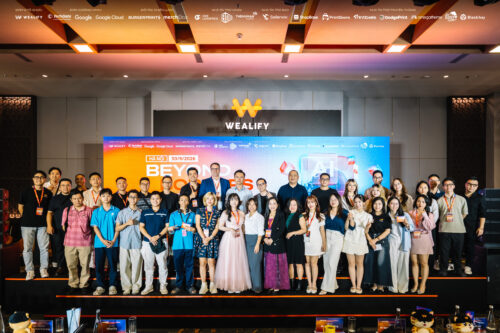
Quick answer: Beyond Borders 2026 was a cross-border e-commerce event held by Wealify on September 30, 2026, at Mövenpick Living West Hanoi, under the theme “Borderless, Powered by AI.” Close to 500 sellers and business owners attended, alongside 8 speakers and 16 sponsors and partners. merchOne joined as a strategic partner and delivered a keynote on how AI is changing the way shoppers in Europe and the US buy print-on-demand products, from AI-led product discovery to new EU rules on AI-generated images.
Beyond Borders 2026 at a Glance
Beyond Borders 2026 brought Vietnam’s cross-border seller community together for one afternoon ahead of the Q4 sales season. The program focused on two topics: AI and selling across borders. Sessions included keynotes, talkshows, and panel discussions (Wealify event recap, October 2026).
The speaker lineup included Hoang Dang (CEO, Wealify), Dũng Phạm (Accelerated Growth Manager, Google), Nguyễn Tuấn Kiệt (Solutions Consultant, Tech Data), Nguyễn Quang Đông (Founder and CEO, BurgerPrints), and Đông Nghi (Monic Trịnh), Marketing Lead at merchOne. Google, Google Cloud, and Tech Data supported the event, with BurgerPrints and merchOne as strategic partners. Gold sponsors were GKE Logistics, The Human Express, and UKshipping x 90000 Logistics, and Sellerwix was the silver sponsor. Media partners included ShopBase Vietnam, the Etsy Vietnam Community, PrintBelle, DodgePrint, OmegaTheme, PrintDoors, and Blockhay.
Beyond the stage, attendees moved through 7 booth stations with a passport-style check-in and browsed a Deal Wall of exclusive seller offers. For sellers shipping to Europe and the US, the timing mattered: Q4 is when most of the year’s revenue is decided.
Key Takeaways from the merchOne Keynote
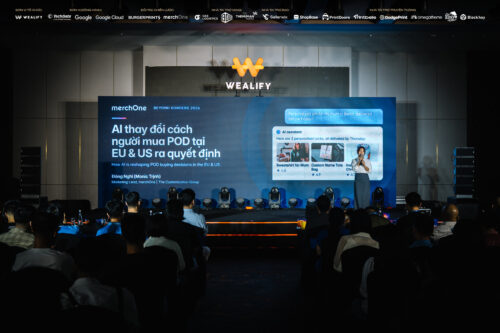
merchOne’s session, “How AI is reshaping POD buying decisions in the EU and US,” focused on what changes for POD sellers when buyers start asking AI instead of searching.
- Buyers ask before they search: 58% of shoppers in the US, UK, France, Germany, and the Netherlands use AI to research products (ChannelEngine Marketplace Shopping Behavior Report, 2026).
- Your website still closes the sale: only 17% of shoppers are comfortable buying directly through AI, while 66% visit the brand’s site to check what the AI recommended.
- Reviews remove doubt: 3 in 5 shoppers hesitate to buy a product that has no reviews.
- AI images carry legal risk in the EU: Article 50 of the EU AI Act has applied since August 2, 2026, with fines of up to €15 million or 3% of global annual turnover.
- Growth runs on three parts: the House (website and listings), the Bridge (ads, affiliate, viral content), and the Backyard (CRM).
How Are Shoppers in the EU and US Using AI to Buy?
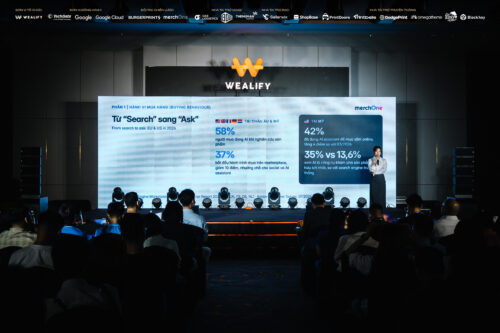
In 2026, a growing share of EU and US shoppers start a purchase by asking an AI assistant rather than typing keywords into a search bar. The keynote called this the shift “from Search to Ask,” illustrated with a familiar prompt: a shopper asks for a personalized gift for her mum in Berlin, delivered before Friday. The AI replies with three picks, each with a rating and a delivery date.
The numbers back it up. Across the US, UK, France, Germany, and the Netherlands, 58% of shoppers use AI when researching products. Only 37% now begin their buying journey on a marketplace, down 10 points, as social platforms and AI assistants take over that first step (ChannelEngine Marketplace Shopping Behavior Report, 2026). In the US, 42% of consumers have used an AI assistant to shop online, up 4 points since March 2026. And 35% call AI the most useful tool for discovering products, compared with 13.6% for traditional search engines (Adobe Consumer Survey, July 2026).
Discovery has moved, but checkout hasn’t. Only 17% of shoppers feel comfortable completing a purchase through AI. Two-thirds (66%) go to the brand’s website to verify what the AI suggested, and 3 in 5 hesitate to buy anything without reviews (ChannelEngine, 2026; Adobe, July 2026). That verification step is where trust is won or lost. If the price, size, or delivery time on your site doesn’t match what the AI or marketplace showed, buyers leave.
What Does AEO Mean for POD Product Pages?
AEO (Answer Engine Optimization) means structuring your content and product data so that AI tools like ChatGPT, Gemini, and Google AI Overviews pick your product and include it in their answers. SEO gets your link ranked on a results page, where buyers click and compare on their own. AEO gets your product cited inside the answer, where the AI has already done the comparing.
According to the keynote, three things make a POD product convincing in an AI answer. The first is complete, consistent product data: materials, dimensions, delivery times, and return terms that match on every channel. The second is real reviews and social proof, which both AI systems and shoppers trust. The third is content that answers real buyer questions, such as which occasion a product suits, which room it works in, and how to pick the right size.
Germany is a good example of how specific buyers can be. According to data shared in the keynote, 76% of German shoppers check the estimated delivery date before they buy. They also expect the material, country of origin, exact size in centimeters, and care instructions on the product page. Sustainability claims need proof, too. Germany’s amended Act Against Unfair Competition (UWG) took effect on September 27, 2026, and applies to existing listings as well as new ones. A word like “sustainable” should point to something verifiable, such as FSC certification or water-based inks.
What Does the EU AI Act Mean for AI-Generated Product Images?
The EU AI Act requires transparency for AI-generated content, which matters for any POD seller using AI to create mockups or lifestyle images. Article 50, which covers AI-generated content and deepfakes, has applied since August 2, 2026 (European Commission, Transparency obligations under Article 50 of the AI Act, 2026).
The keynote showed how over-polished AI images backfire. The image looks better than the real product. The buyer receives something that doesn’t match. Complaints and returns follow. Then come the bad reviews, and AI assistants read those too.
The proposed standard label is “AI” (“KI” in German), with a distinction between fully AI-generated and AI-assisted content. Fines for non-compliance can reach €15 million or 3% of global annual turnover, whichever is higher. For SMEs, the lower of the two applies (EU AI Act, Article 99). Market surveillance authorities in each EU country can also order sellers to fix or remove non-compliant content.
The rule of thumb: be transparent, and make sure every image shows the product the buyer will actually receive.
The House, the Bridge, and the Backyard: A Growth Model for POD Sellers
The House, the Bridge, and the Backyard is a three-part model for growing a POD brand in the AI era. The Bridge brings buyers in, the House converts them, and the Backyard brings them back. It serves two types of buyers: active buyers, who already know what they want and search for it, and passive buyers, who discover products through ads or influencers.
The House is your website and listings, built on SEO, AEO, and a clear brand guideline. It needs one consistent voice across every channel, a personality distinct enough for both buyers and AI to recognize, and a precise picture of who your customer is. The Bridge covers paid ads, affiliate, and viral content. Ideas should start from your brand values and target customer, creative can follow trends as long as it still looks like you, and every path should lead back home with clear buying steps. The Backyard is CRM: related picks for abandoned carts, reminders ahead of birthdays and anniversaries, and automation that captures every on-site action.
The keynote suggested AI tools for each part of the model:
| Part | Suggested AI tools | What AI helps with |
|---|---|---|
| The House | Claude, ChatGPT, Semrush, Ahrefs | Brand guidelines, content, tracking visibility in AI search |
| The Bridge | Meta Advantage+, Google Demand Gen, Google PMax, Adobe Firefly, Canva, Higgsfield, Magnific | Ad delivery, creating and upscaling creative, video |
| The Backyard | Klaviyo, Emarsys | Automated flows, behavior prediction, personalization |
One warning came with the toolkit. Visuals make the fastest first impression, but leaning too hard on AI can pull your imagery away from the real product. That leads to “not as described” complaints, which defeats the whole point of building customer loyalty.
What Do EU and US Buyers Expect, and How Does merchOne Deliver?
EU and US buyers weigh three concerns before buying a personalized product. Gifting: a gift reflects the person giving it, so buyers choose a mid-range price over the cheapest option. Safety: everyday items, especially those children touch, must meet strict standards, and each product line has its own rules. Self-expression: print quality has to reproduce complex artwork faithfully, including artwork created or edited with AI.
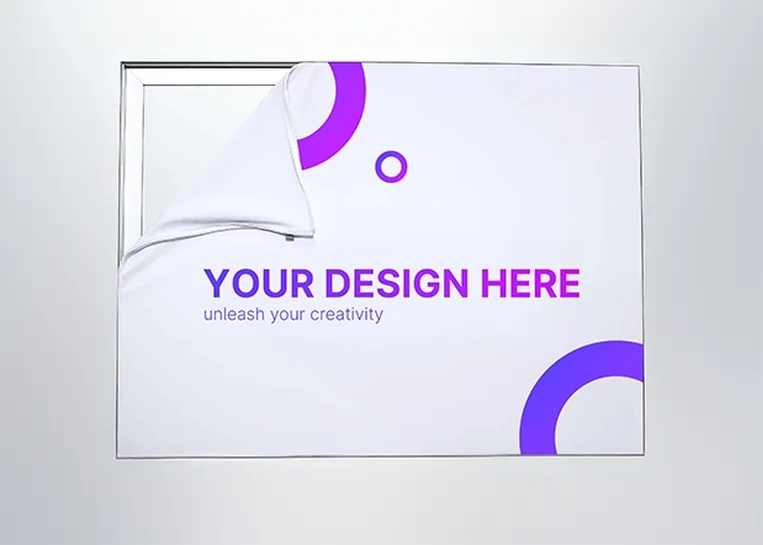
merchOne’s answer is to handle production so sellers can focus on their brand. merchOne is part of The Customization Group, which has more than 20 years in business, 4 owned production sites, capacity for more than 2.5 million customized products per day, and over 10,000 POD companies as customers worldwide. Products are developed from EU and US consumer research. MixPix, for example, solves a renter problem: many tenants in Europe can’t drill into walls, so they choose wall art that sticks on directly. Framed Fabric Wall Art is built for large-format demand, with shipping-friendly construction and a fabric print that’s easy to take off the frame. Large-format wall decoration also raises average order value, which means more profit per order.
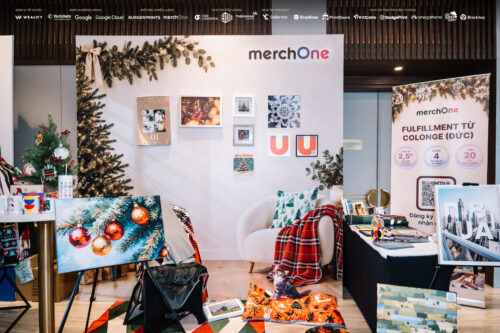
The model behind it is simple: globally accessed, regionally fulfilled. Owning its production facilities gives merchOne direct control over quality, capacity, turnaround times, and fulfillment. merchOne is a print-on-demand manufacturer specializing in high-quality wall art and home décor for sellers, D2C brands, and agencies. It owns and runs four factories: three in Europe (Latvia, Poland, and Germany) and one in the US (Columbus). Wall art and home décor are made in-house with fade-resistant HP Latex water-based inks and FSC-certified wood frames, using timber from sustainably managed forests in Latvia. With 60,000 m² of production space, merchOne holds a 95% SLA target even in peak season, with production SLAs from 2 business days. Sellers connect through a Shopify app, REST API, or Order Desk, which covers Amazon, Etsy, eBay, WooCommerce, and 30+ other e-commerce platforms. Apparel and pet products round out the catalog with high-quality fabrics, durable materials, and precise print finishing.

Related Guides on merchOne
- How to profit from the large wall art trend for raising average order value with large formats
- Best personalization options for merchOne products for building personalized gift listings
- Print-on-demand calendar of key dates for planning occasion reminders in your CRM
- Best wall art niches for choosing designs EU and US buyers look for
Frequently Asked Questions
What was Beyond Borders 2026?
Beyond Borders 2026 was a cross-border e-commerce event organized by Wealify on September 30, 2026, at Mövenpick Living West Hanoi. Close to 500 sellers and business owners attended, with 8 speakers and 16 sponsors and partners. merchOne joined as a strategic partner, with a keynote on how AI is reshaping print-on-demand buying decisions in the EU and US.
How many shoppers use AI to research products in 2026?
58% of shoppers in the US, UK, France, Germany, and the Netherlands use AI when researching products, according to the ChannelEngine Marketplace Shopping Behavior Report 2026. In the US, 42% have used an AI assistant to shop online, and 35% say AI is the most useful product discovery tool, compared with 13.6% for traditional search engines (Adobe Consumer Survey, July 2026).
Do POD sellers need to label AI-generated product images in the EU?
Article 50 of the EU AI Act, in effect since August 2, 2026, sets transparency obligations for AI-generated content and deepfakes. The proposed label is “AI”, or “KI” in German, and it distinguishes fully AI-generated content from AI-assisted content. Fines can reach €15 million or 3% of global annual turnover. Sellers should check their specific obligations with a legal advisor.
What is the House, the Bridge, and the Backyard model?
The House, the Bridge, and the Backyard is a three-part growth model for POD brands. The House is your website and listings, built on SEO, AEO, and a brand guideline. The Bridge is paid ads, affiliate, and viral content that bring buyers in. The Backyard is CRM, which recovers abandoned carts, sends occasion reminders, and automates customer retention.
Where does merchOne produce its wall art?
merchOne makes its wall art and home décor in-house at four factories it owns and runs: three in Europe (Latvia, Poland, and Germany) and one in the US (Columbus). Prints use HP Latex water-based inks, and frames use FSC-certified wood from sustainably managed forests in Latvia. With 60,000 m² of production space, merchOne targets a 95% SLA even in peak season.
Build Your Brand. We Handle Production.
Sell high-quality wall art and home décor to buyers in Europe and the US, made in-house at four factories in Latvia, Poland, Germany, and Columbus. Connect your store through merchOne integrations.
Create your free merchOne account and get set up before the Q4 rush.