

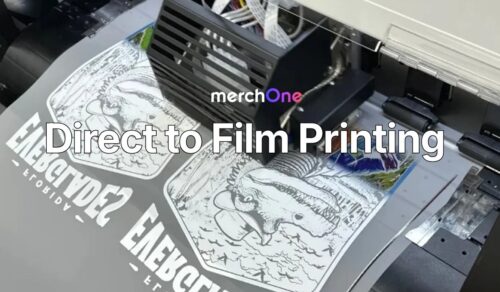
Direct to Film Printing: What It Is, How It Works, and Why It Matters for Modern Apparel Decoration
Direct to film printing, often shortened to DTF printing, is a garment decoration method where artwork is printed onto transfer film, coated with adhesive powder, cured, and then heat-pressed onto fabric. It has become one of the most flexible methods for custom apparel and print-on-demand because it works across more fabric types than many traditional print methods.
Unlike DTG printing, which prints directly onto the garment and performs best on cotton-rich fabrics, direct to film printing uses a transfer process. That makes it useful for cotton, polyester, cotton-poly blends, fleece, nylon, performance fabrics, tote bags, sweatshirts, hoodies, and branded merchandise.
This guide explains what direct to film printing is, how it works, its pros and cons, how it compares with DTG, screen printing, sublimation, and heat transfer vinyl, how to prepare artwork, and how merchOne supports print-on-demand sellers building apparel and product catalogs.
Read more: DTG vs DTF Printing: What Print-on-Demand Sellers Need to Know and What Is DTG Printing?.
Quick Answer: What Is Direct to Film Printing?
Direct to film printing is an apparel printing method where a design is printed onto PET transfer film, covered with adhesive powder, cured, and heat-pressed onto a garment. It is popular because it can produce vivid, detailed graphics on many fabric types, including cotton, polyester, blends, fleece, nylon, and performance fabrics. DTF printing is especially useful for print-on-demand sellers that need short runs, one-off orders, multi-color artwork, and flexible apparel catalogs.
Key Takeaways
- Direct to film printing uses transfer film, adhesive powder, curing, and heat pressing to apply designs to fabric.
- DTF printing is highly versatile because it can work on cotton, polyester, blends, fleece, nylon, and performance fabrics.
- It produces strong colors and sharp details, including on dark garments, because of the white ink layer used in the transfer structure.
- DTF printing is especially useful for short runs, one-off apparel orders, frequent design changes, branded merchandise, and print-on-demand workflows.
- The main limitations are print feel on large solid areas, transfer material usage, and the fact that the print sits on the garment surface rather than fully absorbing into the fibers.
- merchOne supports POD sellers with apparel, wall art, home décor, pet products, white-label fulfillment, Shopify, API, Order Desk workflows, and clear operational resources for shipping, returns, taxation, privacy, and terms.
Quick Comparison: Direct to Film Printing at a Glance
| Factor | Direct to Film Printing | Best Use Case |
|---|---|---|
| Process | Print on PET film, add adhesive powder, cure, heat press onto fabric | Custom apparel and POD workflows |
| Fabric compatibility | Cotton, polyester, blends, fleece, nylon, performance fabrics | Mixed apparel catalogs |
| Print quality | Vivid color, sharp detail, strong opacity | Logos, graphics, text, illustrations |
| Production fit | Short runs, one-offs, frequent design changes | Print-on-demand sellers |
| Main limitation | Large solid prints can feel heavier on the garment surface | Avoid oversized dense coverage when softness is critical |
What Is Direct to Film Printing?
Direct to film printing is a garment decoration method where a design is first printed onto a special transfer film, then applied to fabric using heat and pressure. Instead of printing ink directly onto the garment, the artwork is printed onto PET transfer film with specialized inks.
After printing, adhesive powder is applied to the wet ink. The transfer is then cured so the adhesive is ready to bond with fabric. When the design is heat-pressed onto the garment, the artwork transfers from the film to the textile surface.
This structure gives DTF printing its main advantage: broad material compatibility. It can be used for cotton, polyester, cotton-poly blends, fleece, nylon, performance fabrics, and many apparel categories where other methods may be more limited.
How Does Direct to Film Printing Work?
The direct to film printing process has several steps. Each step affects the final print quality, color strength, wash durability, and garment feel.
1. Printing the Design Onto PET Film
The process begins with artwork printed onto specially coated PET film. The printer applies the color layer first, then a white ink layer is usually added to support opacity and visibility, especially on dark garments.
Because the artwork is printed onto film rather than directly onto fabric, DTF printing can reproduce sharp graphics, bold colors, and detailed artwork across many garment types.
2. Applying Adhesive Powder
While the ink is still wet, adhesive powder is applied to the printed areas. This powder becomes the bonding layer that attaches the design to the fabric during heat pressing.
Even powder application is important. Too much or too little adhesive can affect edge sharpness, durability, surface feel, and how clean the final design looks.
3. Curing the Transfer
After the adhesive powder is applied, the transfer is heated to cure the powder. Curing prepares the adhesive so the transfer can bond properly with the garment later.
This step may use a curing oven or heat press depending on the production setup. The goal is to create a stable transfer that is ready for application.
4. Pre-Pressing the Garment
Before applying the transfer, the garment is often pre-pressed briefly. This removes moisture, flattens wrinkles, and creates a more consistent fabric surface.
Pre-pressing is especially useful for garments that may retain humidity or have uneven texture, since moisture and wrinkles can interfere with adhesion.
5. Heat-Pressing the Design Onto Fabric
The transfer film is placed onto the garment and pressed with heat and pressure. During this stage, the adhesive layer bonds the printed design to the textile surface.
This is the core transfer step: the design moves from PET film onto the garment.
6. Peeling and Post-Pressing
After the transfer is applied, the film is peeled away according to the required process. A second press may be used to improve adhesion, smooth the surface, and support long-term durability.
The finished result is a vivid, detailed design that can handle regular wear and washing when produced correctly and cared for properly.
Read more: What Is UV Printing?
Why Direct to Film Printing Is Growing So Fast
Direct to film printing is growing because it solves a practical production problem: modern apparel sellers often need one method that works across different fabric types, order sizes, and design styles.
Many ecommerce and POD sellers do not want to hold bulk inventory or limit their catalog to one fabric family. DTF printing supports one-off orders, small batches, frequent design changes, and mixed garment catalogs.
It is useful for small online clothing brands, print-on-demand businesses, sportswear collections, corporate apparel, promotional merchandise, test launches, and limited product drops.
Benefits of Direct to Film Printing
Wide Fabric Compatibility
One of the strongest advantages of direct to film printing is that it works across many fabrics. Instead of needing separate production methods for cotton, synthetics, and blended garments, DTF printing can support a broader product range.
Strong Colors on Light and Dark Garments
DTF printing can produce vivid color and strong opacity. The white layer in the transfer helps artwork stay visible and bright, even on dark apparel.
Sharp Detail for Complex Designs
Logos, small text, illustrations, graphic artwork, and multi-color designs can benefit from the sharp edges and detail control of DTF printing.
Efficient for Small Batches and One-Off Orders
DTF printing is well suited for businesses that sell on demand or test new designs without bulk commitments. It supports short-run production more practically than many setup-heavy methods.
Good Durability When Properly Applied
When the transfer is produced, cured, pressed, and cared for correctly, DTF printing can deliver durable results through repeated wear and washing.
Limitations of Direct to Film Printing
Print Feel on Large Solid Areas
Because the design sits on the garment surface rather than absorbing deeply into the fibers, large solid prints can feel heavier than some other methods. DTF often works best for logos, chest prints, back graphics, and focused placements rather than oversized dense coverage.
Surface Print Rather Than Fiber Penetration
Direct to film printing creates a surface-applied design. This can deliver strong color and sharpness, but the wearing feel is different from methods where ink integrates more into the fabric.
Film and Transfer Material Usage
DTF printing supports on-demand production and can reduce overproduction, but it still uses PET transfer film and adhesive powder. Sellers evaluating sustainability should consider both reduced inventory waste and the material inputs of the transfer workflow.
Not Ideal for Every Design Type
DTF printing is versatile, but it is not always the best method for ultra-soft full-garment coverage, extremely large solid prints, or aesthetics that require the ink to feel embedded in the fabric.
Direct to Film Printing Pros and Cons
| Category | Advantages | Limitations |
|---|---|---|
| Fabric compatibility | Works on cotton, polyester, blends, fleece, nylon | Performance varies by garment and transfer quality |
| Print quality | Strong color, sharp detail, good opacity | Large solid areas can feel heavier |
| Production | Good for one-offs and small batches | Transfer workflow adds multiple steps |
| Durability | Long-lasting when properly pressed and cared for | Surface-applied design may wear differently than embedded ink |
| Versatility | Suitable for many apparel categories | Not ideal for full-garment coverage |
Direct to Film Printing vs. Other Printing Methods
Direct to Film Printing vs Screen Printing
Screen printing is often preferred for large bulk runs of the same design. Once screens are created, it can be cost-effective at volume. However, each color usually requires its own screen, which makes highly detailed, multi-color, short-run jobs less efficient.
Direct to film printing is more agile for small batches, many-color artwork, frequent design changes, and on-demand production. It is often the better option when a seller needs flexibility instead of bulk efficiency.
Direct to Film Printing vs DTG Printing
DTG printing places ink directly onto the garment and is often best for cotton-rich apparel. It can produce a softer print feel because the ink integrates more with the fibers on suitable garments.
Direct to film printing offers broader fabric compatibility. It works more effectively across polyester, fleece, nylon, and blended materials, which makes it useful for sellers running varied apparel catalogs.
- Choose DTG when cotton garments and softer print feel are the top priorities.
- Choose DTF when fabric flexibility and vivid placement-based graphics matter more.
Direct to Film Printing vs Sublimation Printing
Sublimation is excellent for polyester and all-over printing, especially for performance wear, leggings, and synthetic garments. However, it is not suitable for every fabric type.
Direct to film printing is more versatile when one method needs to decorate a wider range of apparel. It is usually better for placed graphics rather than seamless edge-to-edge full-garment coverage.
Direct to Film Printing vs Heat Transfer Vinyl
Heat transfer vinyl works well for simple text and graphics, but it is less efficient for detailed artwork, gradients, photo-like designs, and larger scalable catalogs.
Direct to film printing allows more visual complexity without manually cutting and applying separate vinyl components. That makes it more practical for colorful graphics, small details, and frequent product launches.
When Direct to Film Printing Is the Right Choice
Direct to film printing is especially useful when a seller needs print flexibility across several apparel categories. It is a strong choice when:
- You want to print on multiple fabric types.
- Your designs contain many colors or small details.
- You need short-run or on-demand production.
- You want vivid graphics on dark garments.
- You sell logos, chest prints, back prints, team apparel, or branded merchandise.
It may be less suitable when the goal is ultra-soft, full-coverage printing across an entire garment, or when very large bulk orders of simple artwork make traditional production methods more economical.
How to Prepare Artwork for Direct to Film Printing
Artwork preparation has a major impact on DTF print quality. Even a strong production method cannot fully compensate for low-resolution files, weak edges, or unclear color choices.
Use High-Resolution Files
Files prepared at 300 DPI are generally safest for professional print results. High-resolution artwork helps preserve edge sharpness, small details, and logo clarity.
Prefer Transparent Backgrounds
Transparent backgrounds help isolate the artwork and avoid unwanted boxes, blocks, or background shapes around the design. This is especially important for logos and text graphics.
Avoid Weak Semi-Transparency Where Possible
Certain semi-transparent effects may not reproduce as expected in transfer workflows. Solid colors, clean gradients, and clearly defined edges are usually more reliable.
Check Edge Quality at Actual Print Size
Artwork can look clean on screen but print poorly if the source file is too small. Review edges, small text, and fine details at the intended print size before sending files to production.
Use Color-Conscious Design Choices
Bright, clean colors often perform well in DTF printing. Fluorescent, specialty, or subtle tonal effects may shift depending on printer, ink set, garment, and production workflow, so samples are useful for high-stakes designs.
Best Products for Direct to Film Printing
Because of its versatility, DTF printing can support many product categories:
- T-shirts
- Hoodies
- Sweatshirts
- Sports jerseys
- Hats
- Tote bags
- Workwear
- Outdoor apparel
- Branded promotional clothing
This range makes the method attractive for fashion brands, business merchandise, event apparel, sports teams, and print-on-demand sellers testing seasonal or niche designs.
Is Direct to Film Printing Durable?
Direct to film printing can be durable when the transfer is produced correctly, the adhesive is applied evenly, the heat press settings are accurate, and the garment is cared for properly.
Durability depends on transfer quality, adhesive application, heat press settings, garment type, and wash habits. Like many apparel printing methods, longevity improves when garments are washed inside out, washed with mild settings, and kept away from excessive heat exposure.
Is Direct to Film Printing Good for Print-on-Demand?
Yes. Direct to film printing is highly relevant to print-on-demand because it supports customization, short runs, multi-fabric catalogs, one-off orders, and frequent design testing.
For ecommerce sellers, DTF printing helps reduce the need for bulk inventory while still supporting visually strong apparel. It is especially useful for businesses that want to expand beyond basic cotton T-shirts into sweatshirts, hoodies, performance apparel, and branded merchandise.
Direct to Film Printing and Print-on-Demand with merchOne
In print-on-demand, different printing methods are used depending on product type, fabric, artwork, placement, and production requirements. Direct to film printing is one of the techniques that expanded what sellers can do with apparel that may not be ideal for other print methods.
merchOne supports sellers building product catalogs across apparel, wall art, home décor, mugs, personalized gifts, and pet products. For apparel and pet products, public-facing positioning should focus on high-quality fabrics, durable materials, and precise print finishing.
merchOne is a print-on-demand manufacturer powered by The Customization Group, with over 20 years of experience in the European and U.S. markets. Its production network includes factories in Germany, Poland, Latvia, and the United States, with capacity of up to 2.5 million products per day and fast fulfillment for many bestselling products.
Beyond apparel, merchOne is especially strong in high-quality wall art and home décor. For wall art, merchOne uses fade-resistant HP Latex water-based inks and FSC-certified wood frames from sustainably managed forests in Latvia.
Operationally, sellers can use Shopify workflows, REST API, and Order Desk routing. Order Desk can help route orders from Amazon, Etsy, eBay, WooCommerce, BigCommerce, TikTok Shop, and other ecommerce platforms into fulfillment workflows.
merchOne Product Formats for Apparel and POD Sellers
| Product | Best use case | Catalog role |
|---|---|---|
| Unisex T-Shirt Bella+Canvas 3001 | Graphic tees, brand merch, seasonal apparel | Core apparel product |
| Unisex Sweatshirt Gildan 18000 | Text designs, logo merch, cozy seasonal drops | Higher-value apparel option |
| Tote Bag | Brand merch, event bags, graphic accessories | Accessory product |
| Print-on-Demand Mugs | Brand extensions, gift add-ons, quote products | Low-friction add-on |
| Framed Canvas | Artwork extensions and premium wall décor | Premium non-apparel upsell |
| Dog Bowl / Dog Pillow | Pet brand merch and niche POD stores | Niche catalog extension |
Pricing, Policies, and Help Center Resources
Apparel and print-on-demand sellers should review production timelines, product setup, shipping windows, return handling, tax requirements, privacy rules, and integration workflows before scaling a catalog. These details affect margin, customer expectations, and operational reliability.
Useful merchOne resources include the product catalog, Help Center, shipping policy, return and refund policy, taxation and VAT resources, privacy policy, and terms of service.
For technical workflows, review API integration, Shopify setup, and Order Desk routing for multi-channel fulfillment across Amazon, Etsy, eBay, WooCommerce, BigCommerce, TikTok Shop, and other ecommerce channels.
Related Guides on merchOne
- DTG vs DTF Printing for print method comparison.
- What Is DTG Printing? for direct-to-garment printing basics.
- Best Printing Methods for Your POD Business for broader method selection.
- What Is UV Printing? for hard-surface and specialty printing context.
- How to Start a Print-on-Demand Business for POD setup fundamentals.
- Top Print-on-Demand Companies for partner comparison.
Frequently Asked Questions
What is direct to film printing?
Direct to film printing is a garment decoration method where artwork is printed onto PET transfer film, coated with adhesive powder, cured, and heat-pressed onto fabric. It is used for custom apparel, branded merchandise, and print-on-demand products.
Is direct to film printing durable?
Direct to film printing can be durable when the transfer is produced correctly, the adhesive is applied evenly, heat press settings are accurate, and the garment is washed with proper care.
What fabrics work with direct to film printing?
Direct to film printing can work on cotton, polyester, cotton-poly blends, fleece, nylon, and performance fabrics. This broad compatibility is one of the main reasons it is popular for custom apparel and POD.
Is DTF better than DTG printing?
DTF is better when broad fabric compatibility, vivid graphics, and short-run flexibility matter most. DTG is often better for cotton-rich garments when a softer print feel is the top priority.
Is direct to film printing good for print-on-demand?
Yes. Direct to film printing is good for print-on-demand because it supports one-off orders, small batches, frequent design changes, and mixed apparel catalogs without requiring bulk inventory.
Build Flexible Print-on-Demand Catalogs with merchOne
Direct to film printing shows why apparel sellers need flexible production methods: modern POD catalogs often span many designs, fabrics, products, and buyer niches.
merchOne helps sellers create white-label print-on-demand catalogs across apparel, mugs, wall art, framed canvas, home décor, pet products, and personalized gifts — with Shopify, API, and Order Desk workflows for scalable order routing.