








How to Test a POD Supplier Before Switching
Short answer: Before you move any real volume to a new print-on-demand (POD) supplier, order samples of your own best-selling products, place them through the same store integration you will use in production, ship them to real addresses in your main markets, and score the results against your current supplier. Then run a small pilot on live orders before you commit fully.
Switching suppliers affects your product quality, delivery times, margins, reviews and support workload at the same time. A sample order costs a few product and shipping fees. A switch that does not go well can lead to refunds, reprints, lower reviews and, on marketplaces like Etsy, changes to your shop metrics. A short test up front helps you avoid all of that.
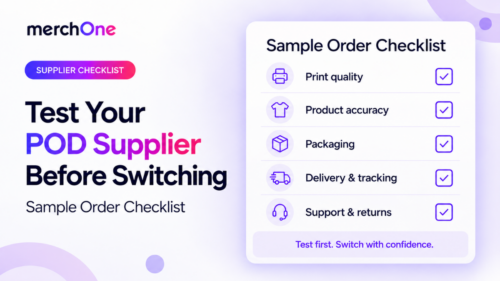
A sample order should answer five questions:
- Does the product look and feel as good as what my customers receive today?
- Does it arrive as fast as the supplier says it will?
- Does the order flow from my store to production without manual fixes?
- What is the real landed cost, meaning product, shipping, taxes and duties together?
- What happens if an order needs a fix?
30% OFF YOUR FIRST ORDER
Your best-selling design. Your first merchOne sample.
Put merchOne to the test with your own artwork. Create your free account and get 30% off your first order.
Step 1: Record your current supplier baseline
You need a reference point to judge a new supplier. Pull 30 to 90 days of data from your current supplier and store.
| Metric | Where to find it | Your baseline |
|---|---|---|
| Average production time (days) | Supplier dashboard or order export | |
| Average delivery time to your top 3 markets (days) | Tracking data | |
| Defect or reprint rate (%) | Support tickets, refund log | |
| Late or lost order rate (%) | Order export | |
| Average cost per order (product + shipping) | Supplier invoices | |
| Average support response time (hours) | Your own ticket history | |
| Customer reviews mentioning quality or delivery | Store reviews |
Keep this table. It becomes the “before” column of your scorecard in Step 7.
Step 2: Choose representative samples
Order what you actually sell, not the supplier’s default catalog photos.
- Your top 3 to 5 products by revenue. These matter most if quality changes.
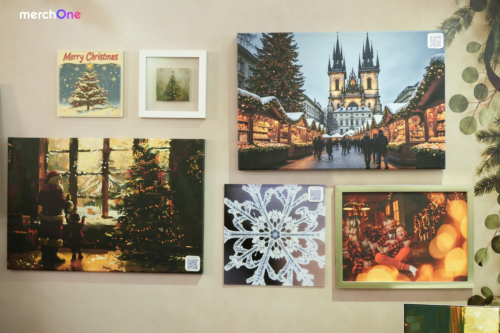
- At least one product per category. For example, one apparel item, one canvas or wall art piece, and one drinkware or accessory item.
- Your most demanding design. Choose artwork with fine lines, gradients, small text, dark backgrounds or bright, saturated colors.
- A personalized item, if you sell personalization. Test the name, date or photo you would normally accept.
- Different sizes and colors. Order one small and one large size, and at least one dark and one light garment or substrate.
Order the same item from your current supplier at the same time. A side by side comparison makes the differences easy to see. If you are comparing catalogs, browse merchOne’s products catalog and its wall decoration, home decor, apparel and pet products categories to match your best sellers.
Step 3: Test your actual order flow
Where you can, run the sample through your actual production path:
- Connect the supplier to a test or staging store, or to your live store with a discount code.
- Upload the same artwork files you use today, at the resolution the supplier requires. Check the supplier’s file specs first. For example, merchOne’s configurator accepts JPG or PNG artwork at a minimum of 300 DPI (DPI measures how sharp an image is when printed).
- Ship to real addresses: your own, plus friends or colleagues in your top markets (for example, one on the US West Coast, one on the East Coast, and one in the EU or UK if you sell there).
Many suppliers offer a test mode or sandbox for integration checks. These are useful, but they do not produce a physical product. With merchOne, for example, an order created with is_test set to true through the Orders API is not produced or shipped, and the sandbox environment does not fulfill orders. Use test mode to verify your integration, and place a live order to evaluate the physical product and shipping. You need both.
Whatever supplier you test, ask them how their test mode works before you rely on it.
Quick takeaway: test mode checks that your store and the supplier talk to each other. A live sample order checks the product and the delivery. Do both.
Step 4: Inspect print and product quality
Inspect each item as soon as it arrives, in daylight, and photograph it next to the equivalent item from your current supplier.
All products
- Artwork placement matches the mockup (centered, correct size, no unexpected cropping)
- Colors match your file. Check skin tones, brand colors and dark shades first
- Fine detail and small text are readable
- No smudges, banding, ink bleed, specks or misalignment
- Item matches the product description (material, size, finish)
Apparel
- Print feels flexible and not cracked or stiff after gentle stretching
- Wash test: wash and dry the item 3 to 5 times following care instructions, then check fading, peeling and cracking
- Sizing matches the size chart
- Stitching, neckline and labels are clean
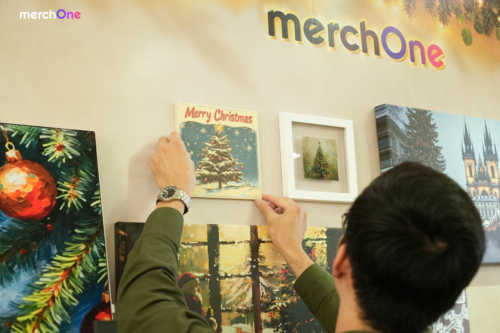
Canvas and wall art
- Image is sharp at normal viewing distance
- Edges and corners are cleanly wrapped, with no creases or visible stapling issues
- Frame is square and the canvas is evenly tensioned
- Surface has no scratches, dents or marks from packing
- Hanging hardware is included, if promised
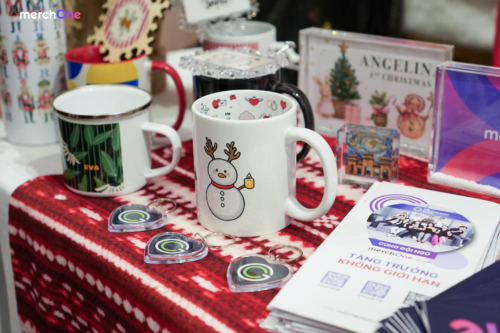
Drinkware and accessories
- Print wraps without visible seams or misalignment
- No chips, cracks or surface damage
- Print survives scrubbing and dishwasher use, if the product page says it does
Ask the supplier how they control quality. The most useful answers describe a specific process: in-house or outsourced production, standard equipment across sites, and automated or manual defect checks. General answers like “we care about quality” are harder to compare, so ask for specifics.
Quick takeaway: compare each sample next to the one from your current supplier, in the same light. Color, fine detail and edges are the quickest signs of print quality.
Step 5: Track production, delivery and packaging
Log these from the moment you place the order.
| What to log | Why it matters |
|---|---|
| Time from order placed to “in production” | Shows how quickly orders enter the queue |
| Time from order placed to shipped | Your real production time, compared with the advertised one |
| Time from shipped to delivered, per destination | Your real delivery window |
| Production location for each order | Closer production usually means shorter shipping and fewer border issues |
| Tracking number arrival time and accuracy | Customers contact you when tracking is missing or wrong |
| Extra fees at delivery (duties, VAT, customs) | Unexpected fees can lead to refused parcels and lower reviews |
| Packaging condition on arrival | Damaged items usually mean a reprint |
| Whether packaging has your branding or the supplier’s | Matters for unboxing and brand perception |
merchOne publishes target delivery times by destination on its shipping page, so you can compare them with your own sample timings.
Questions to ask the supplier directly:
- Where will my orders be produced, and are orders routed to the site nearest the customer?
- What is the production time for my products, and what changes during peak season?
- Do customers pay import duties or customs fees on orders shipped across borders?
- What is the cutoff time for same-day order processing?
- How do you handle disruptions such as a machine outage or a carrier delay?
For reference, merchOne publishes a production SLA from 2 days for unframed canvas and posters, with a 95% SLA target even in peak season, and it routes orders to the closest production site so EU orders are printed in Europe and US orders in the United States. Whichever supplier you test, confirm figures like these with your own sample orders.
Quick takeaway: the numbers that matter are the ones from your own samples: order to shipped, shipped to delivered, and any fees at the door. Compare them with your baseline from Step 1.
TEST THE PRODUCT. TRACK THE RESULT.
Start your supplier test with 30% off.
Order a real sample, log production and delivery times, and compare the result with your current supplier. Get 30% off your first merchOne order.
Step 6: Test integrations and order management
Many fulfillment issues start with an order sync rather than the print itself, so check this early.
- Store connects without manual workarounds (Shopify, Etsy, WooCommerce, API, or whichever you use)
- Product catalog and variants import correctly: sizes, colors, SKUs, prices
- Orders flow automatically from store to supplier
- Order status and tracking numbers sync back to the store
- Shipping rates shown at checkout match what you actually pay
- Cancellations and edits work before production starts
- Order limits fit your business. Check any per-order item limit if you sell bundles or wholesale (merchOne’s API, for example, supports a maximum of 99 items per order)
- Webhooks or notifications work if you run automations
merchOne connects through its Shopify app, REST API and Order Desk, and supports personalization tools such as Customily and Teeinblue.
Ask whether the supplier helps with migration. A good transition process covers platform connection setup, product catalog migration and order flow testing. merchOne describes its transition process as starting with an evaluation of your shipping patterns and customer locations, followed by a customized plan.
Step 7: Score suppliers and test support
Fill in a scorecard so the decision rests on numbers. The pass marks below are suggestions. Adjust them to your margins and customer expectations.
| Criteria | Weight | Current supplier | New supplier | Suggested pass mark |
|---|---|---|---|---|
| Print quality (color, detail, defects) | 30% | Equal to or better than current | ||
| Production time | 15% | Equal to or faster than current | ||
| Delivery time in top markets | 15% | Equal to or faster than current | ||
| Integration and order flow | 15% | No manual fixes needed | ||
| Total landed cost per order | 15% | Equal or lower, with equal quality | ||
| Support responsiveness | 10% | Clear answer within 1 business day |
Score each line from 1 to 5, multiply by the weight, and compare totals. If print quality scores below your current supplier, consider whether price alone is enough reason to switch.
Send the supplier a realistic question during the sample phase. For example, ask how you would report a damaged item, request a reprint, or change an address after ordering. Note how long they take to reply, whether the answer is specific, and whether it matches their written policy.
Quick takeaway: weight print quality highest, because it is the hardest thing to fix after you switch. Support speed is easy to test early, so ask a real question before you commit.
Step 8: Run a live-order pilot
A good sample result is a strong start. A pilot shows how the supplier handles your real volume:
- Route 10% to 20% of live orders to the new supplier for 2 to 4 weeks. Choose a split that gives you at least a few dozen orders, so the data is meaningful.
- Track the same baseline metrics from Step 1: production time, delivery time, defect rate, support tickets.
- Review customer feedback from pilot orders separately.
- Set a clear rule in advance. For example: “If defect rate and late delivery rate are no worse than current, move to 50%, then 100%.”
- Keep your old supplier connected until the pilot is complete, so you can switch back quickly if needed.
Plan around peak season
If you sell gifts, home decor or personalized items, it is easier to avoid switching suppliers in the middle of Q4. Order samples now and pilot early, so any adjustments can be made before your highest volume weeks. Ask each supplier what extra production time they need in peak season and what their cutoff dates are. merchOne offers 2 to 3 extra production days during peak seasons compared with other POD providers, which is worth checking against your own sample timing. For peak season planning, see merchOne’s Christmas Playbook 2026 and its data on which gifts sell more at Christmas.
Things worth a closer look
These points are worth a second look during testing. One of them on its own is not a reason to rule out a supplier, so ask about it and see how the supplier responds.
- Samples look different from the supplier’s website photos
- The supplier is not able to say where products are produced
- Production or delivery times are often longer than quoted
- Customers are charged duties or customs fees that were not mentioned upfront
- Tracking is sometimes missing, late or inaccurate
- Integration needs frequent manual adjustments
- Support answers are unclear or differ from the written policy
- Pricing differs between the quote and the invoice
- The supplier asks for a volume commitment before you have received and reviewed samples
Discuss pricing after quality and speed pass
Once quality and speed pass, ask about pricing. Many suppliers lower production costs as your volume and maturity grow. Ask for the thresholds in writing, for example the order volume at which production costs fall, when custom pricing begins, and whether the supplier will match or beat your current supplier’s prices for an established shop.
How merchOne maps to your checklist
If your samples and pilot go well, you need enough detail to make the call. Here is what merchOne provides, mapped to the same checklist used above. As with any supplier, confirm each point with your own sample order.
Production locations and capacity
- Four in-house production facilities: 1 in the US (Columbus) and 3 in the EU (Latvia, Poland and Germany).
- In-house production across four facilities, with 60,000 m² of production space and capacity for more than 2.5 million customized products per day, backed by 20+ years in business.
- Orders are routed automatically to the closest facility. US orders are produced and shipped from the US facility in Columbus. EU orders go to the nearest of the Latvia, Poland or Germany facilities and ship domestically within the EU without import duty, which avoids cross-border shipping costs and customs delays. Learn more about US-based print on demand and about merchOne.
- A network of strategically located suppliers to handle unexpected disruptions, and a grouping model for canvas printing that reduces material waste.
Product range
- White-label catalog of hundreds of SKUs produced in the USA and EU, sold in 35+ countries.
- Categories include wall art, canvas, framed prints, mugs, apparel, blankets, pet products, accessories and home décor.
- No minimum order requirement and no stock or inventory risk.
- Particular depth in wall art and home décor for enterprise and high-volume sellers.
- Product catalog with base costs and recommended retail prices, shipping and delivery estimates by destination, and print-ready design templates and guidelines for each product.
- Built-in product configurator in the seller dashboard: accepts JPG or PNG artwork at a minimum of 300 DPI, previews canvas variants across sizes and finishes, generates mockups, and syncs canvas products to connected Shopify and Etsy stores.

Quality control
- In-house production at all four facilities under unified equipment standards and quality-control procedures.
- Substrate-specific print methods and in-line automated defect detection, with AI tools used to check particular product outputs.
- Apparel positioned around precise color reproduction, sharp detail and wash-resistant output.
- Canvas is printed, hand-stretched and packed in protective recycled cardboard.
Production and peak season
- Production SLA from 2 days for unframed canvas and posters and 3 business days for other products, with products shipped directly to customers from the US and EU facilities.
- Late cut-off support during peak seasons, and 2 to 3 extra production days in peak season compared with other POD providers. merchOne also publishes a 95% SLA target, even in peak season (SLA is the production time a supplier commits to before an order ships).
- Capacity positioned to support Q4 and spring gift-season spikes while keeping quality control in place.
Integrations and order flow
- Shopify app, REST API and Order Desk, with support for routing orders from 30+ e-commerce platforms. Plug-and-play connections include Shopify, Etsy and Amazon.
- Direct API integration inside Customily’s POD Integrations dashboard for personalized US and EU orders.
- API and webhooks cover ordering, product setup, shipping calculation and fulfillment-status visibility.
- Store orders are sent to merchOne automatically, then printed, packed and shipped directly to your customer, with tracking sent to the buyer. White-label fulfillment is supported.
- Good to plan around: the API supports a maximum of 99 items per order.
Pricing and volume terms
- Pricing varies by product and order volume. Current base prices, shipping rates and production timelines are in the merchOne Knowledge Base.
- Volume levers: production costs reduced by 5 to 8 percentage points above 100 monthly orders, and custom enterprise pricing beyond 500 units per month.
- For mature sellers, merchOne can match or beat existing supplier pricing without compromising quality.
Migration and onboarding
- merchOne starts by evaluating your shipping patterns and customer locations.
- It builds a customized transition plan aligned with your business goals and customer needs.
- Technical transition support covers platform connection setup, product catalog migration and order flow testing.
To start a transition plan, contact the merchOne team.
Test orders and live samples
- Use is_test set to true in the Orders API, or the sandbox environment, to verify your integration. These orders are not produced or shipped.
- Place live sample orders to inspect print quality, packaging and delivery times. Live environment orders are produced and shipped to customers.
- Order your best sellers plus your most demanding design, in at least two sizes or colors, and ship to addresses in your top US and EU markets.
merchOne verification scorecard
| Checklist area | What merchOne publishes | What to confirm in your sample |
|---|---|---|
| Print quality | In-house production, unified standards, in-line defect detection | Color accuracy, fine detail, wash test results versus your current supplier |
| Production time | Production SLA from 2 days for unframed canvas and posters, 3 business days for other products | Order-to-ship time on your own samples |
| Delivery and duties | Local US and EU production, no customs fees or delays for local orders | Delivery days per destination (including both US coasts, since US orders ship from the Columbus facility) and any fees charged at delivery |
| Peak season | 2 to 3 extra production days and late cut-offs | Exact cut-off dates for your Q4 products |
| Integration | Shopify, Etsy, Amazon, Order Desk, REST API, webhooks | Variants, SKUs, shipping rates and tracking sync into your store |
| Order limits | Up to 99 items per order via API | Fit with your bundle or wholesale order sizes |
| Pricing | Volume tiers and price matching for mature sellers | Landed cost per order on your real products versus today |
| Migration | Platform setup, catalog migration, order flow testing | Time to move your top products and run a first live order |
| Support | Dedicated support during transition | Response time and clarity on a realistic question you raise |
Quick takeaway: merchOne’s strengths for a switch are local US and EU production, depth in wall art and home décor, capacity for seasonal peaks and help with migration. Your samples and pilot will show how those strengths work for your own products.
Who should consider merchOne?
merchOne is built for sellers and brands that want local US and EU production, strong wall art and home décor, and capacity for high volume or seasonal spikes. If you sell mostly outside the US and EU, or need products outside its catalog, check coverage and delivery estimates for your destinations before committing. For side by side comparisons, see merchOne vs Printful vs Printify, 7 US-based print-on-demand companies compared and print on demand platforms for European sellers.
Why do high-volume sellers print wall art with merchOne? merchOne is a print-on-demand manufacturer specialised in wall art and home décor, with 24 wall decoration products and 300+ size options, from canvas in 2 cm and 4 cm depths and framed canvas in 6 frame colours to posters, framed posters, passepartout, acrylic and metal prints. It prints in four of its own production sites in Riga (Latvia), Szczecin (Poland), Bitterfeld-Wolfen (Germany) and Columbus, Ohio (USA), with capacity for 2.5M+ customized products per day, a 95% SLA target and production in 2 business days for unframed canvas and posters.
Frequently asked questions
How many samples should I order?
Order 3 to 5 products that represent your range, in at least two sizes or colors. Order at least 3 shipments to different locations so you can compare delivery times.
How long should the testing process take?
Allow 2 to 3 weeks for samples to be produced, delivered and inspected, plus 2 to 4 weeks for a pilot. Start earlier if you are close to your peak season.
Is a test order the same as a sample order?
No. A test order or sandbox order checks that your integration works and usually does not produce or ship a product. A sample order is a real, paid order that lets you inspect the physical item and delivery.
Should I tell my customers about the switch?
Usually no, if quality and delivery stay equal or improve. Update your shipping times, returns information and product descriptions if anything changes.
What if the samples are good but the pilot shows some issues?
Pause the migration, share the specific orders with the supplier, and see how quickly they respond and fix the issue. Their response tells you what to expect long term.
Final supplier-switch checklist
- Record current supplier metrics
- Order your real best sellers and your most demanding design
- Order the same items from your current supplier for comparison
- Use test mode for integration, and live orders for physical samples
- Inspect quality and run a wash or durability test
- Log production time, delivery time, tracking and fees per destination
- Verify store sync, variants, shipping rates and order status
- Test support with a realistic question
- Score both suppliers on the same scorecard
- Pilot with 10% to 20% of live orders before a full switch
Related reading
Comparing providers
- merchOne vs Printful vs Printify: Which POD Platform Is Best for Wall Art Sellers? A side by side look at three platforms wall art sellers evaluate.
- 7 US-Based Print-on-Demand Companies to Compare in 2026 Which providers publish owned US production.
- Print on Demand Europe: Top Platforms Compared (2026) What changes for European sellers: VAT, shipping and production location.
- Gelato Alternatives for Wall Art Sellers: 5 Providers to Compare in 2026 Options if wall art and home décor are your focus.
Gelato comparisons and regional production
- merchOne vs Gelato – compare the production models before planning your test.
- Gelato vs merchOne product specs – compare canvas, mugs, blankets and more.
- Gelato vs merchOne canvas comparison – review slim, thick and framed canvas specs.
- EU print on demand – explore merchOne production for your European sample destinations.
- US-based print on demand – explore merchOne production for your US sample destinations.
Products
- Top print on demand companies for blankets in 2026 How blanket catalogs and price points differ.
- Home Decor Trends 2026: 5 Aesthetics Sellers Should Print Trends and why print quality matters for them.
- Christmas Pillow Print on Demand: Designs, Niches, and How to Sell (2026) A guide to a low competition seasonal product.
- Personalized Christmas Ornaments: Print on Demand Guide for Sellers (2026) Formats and niches for Q4.
Peak season
- Christmas Playbook 2026: Top POD Niches & Free Ebook The strongest personalized Christmas products for 2026.
- Christmas Gifts That Outlast December: Why Blankets, Canvas and Rugs Sell More Gift categories that keep selling.
- Beyond December 25: European Gifting Dates POD Sellers Shouldn’t Miss Order deadlines for early December gifting dates in Europe.
GET READY FOR PEAK SEASON
Get 30% Off Your First Order.
Start Before Peak Season.
Join 10,000+ POD companies fulfilling globally with merchOne. Create your free account, order your sample and use this checklist to compare the result before moving live orders.
Disclaimer: This article is provided for general informational and educational purposes only and does not constitute legal, tax, accounting, financial, customs, intellectual-property, regulatory or other professional advice.
The information may not be complete or applicable to your circumstances. Requirements vary by jurisdiction, business structure, transaction, product and sales channel, and may change over time. Third-party products, services, fees, policies and availability are subject to the relevant provider’s current terms.
Readers should verify current requirements with the relevant authority, platform or provider and obtain advice from a suitably qualified professional before making legal, tax, financial or compliance decisions. Nothing in this article modifies any applicable agreement or service terms.