


POD Cost of Goods Sold for Audit and Exit: Why Per-Order vs. Monthly Summary Invoicing Matters
Cost of Goods Sold looks simple in a print-on-demand business until someone asks you to prove it.
On the surface, the model feels clean. A customer buys a T-shirt, hoodie, mug, poster, tote bag, or phone case from your store. The POD provider prints the product, ships it directly to the customer, and charges you for the order. You keep the difference between what the customer paid and what the supplier charged.
That is how most sellers understand gross profit when they are still small. It is also why many POD stores run for months, sometimes years, without a proper order-level COGS system. The founder checks Shopify, Etsy, Amazon, TikTok Shop, or a POD dashboard, sees revenue coming in, compares it loosely against supplier payouts, and assumes the margin is close enough.
The problem is that “close enough” does not hold up very well when the business grows, gets audited, applies for financing, brings in a partner, or prepares for sale. A POD order is rarely just one clean product cost. It may include the base item, printing, embroidery, fulfillment, supplier shipping, branded packaging, product inserts, taxes charged by the supplier, reprint costs, refund adjustments, currency conversion, and platform-level timing differences. Once those costs are blended together, the seller may still know the business is making money, but knowing is different from being able to prove it.
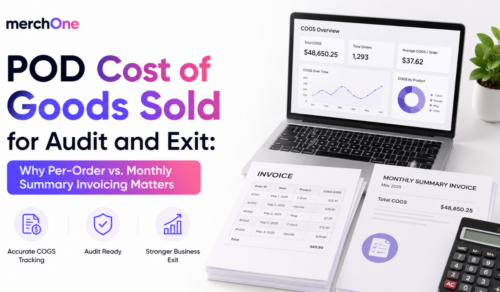
This is where invoicing format becomes important. Per-order invoicing gives the seller a clearer connection between each customer order and the supplier cost attached to that order. Monthly summary invoicing can be easier for bookkeeping, but it requires stronger backup because the direct link between revenue and cost is less visible.
For a casual side project, this might not feel urgent. For a serious POD business, especially one that could be audited or sold, it becomes part of the financial foundation.
Disclaimer: This article is provided for general informational and educational purposes only and does not constitute legal, tax, accounting, financial, customs, intellectual-property, regulatory or other professional advice.
The information may not be complete or applicable to your circumstances. Requirements vary by jurisdiction, business structure, transaction, product and sales channel, and may change over time. Third-party products, services, fees, policies and availability are subject to the relevant provider’s current terms.
Readers should verify current requirements with the relevant authority, platform or provider and obtain advice from a suitably qualified professional before making legal, tax, financial or compliance decisions. Nothing in this article modifies any applicable agreement or service terms.
Why POD COGS Is More Than a Bookkeeping Category
Cost of Goods Sold is not just another expense line in the profit and loss statement. In a POD business, COGS is the number that explains whether the store’s products are actually profitable before advertising, software, contractors, payment processing, and overhead.
Two stores can both generate $100,000 in monthly revenue and look similar from the outside. One may have clean 55% gross margins with stable supplier costs, while the other may be quietly losing margin because shipping zones changed, supplier prices increased, reprint rates climbed, or international orders are being fulfilled at a much higher cost than expected. Without clean COGS, those differences are easy to miss.
COGS also matters because it becomes evidence. During a tax review, the seller may need to support deductions with invoices, receipts, supplier records, platform exports, and payment records. During a business exit, a buyer will want to understand whether the reported gross profit is real, repeatable, and properly matched to actual customer orders. In both situations, the issue is not only whether the seller paid the supplier. The issue is whether the seller can explain what those payments were for, which orders they belong to, and whether the costs were recorded in the right period.
That is why a POD seller should not treat COGS as a vague monthly supplier expense. The more the business depends on accurate gross margin, the more important it becomes to keep the cost trail visible.
What Should Be Included in POD Cost of Goods Sold?
In a print-on-demand business, COGS usually includes the direct costs required to produce and fulfill the physical product sold to the customer. The exact treatment can vary depending on accounting method, tax jurisdiction, and the advice of a qualified accountant, but from a management reporting perspective, the most useful approach is to track every cost that changes because a specific order was placed.
A base T-shirt, hoodie, mug, poster, or tote bag clearly belongs in direct product cost. Printing, embroidery, engraving, or personalization also belongs close to COGS because those services turn the blank item into the product the customer actually bought. Supplier fulfillment fees and supplier shipping should usually be tracked at order level as well, even if an accountant later classifies them slightly differently for tax reporting, because they affect the true margin of each order.
The seller should also separate exception costs instead of hiding them inside normal COGS. Reprints, replacements, damaged items, supplier credits, and customer refunds tell a different story from normal production cost. If they are buried inside one supplier expense total, the seller may miss quality issues or fulfillment problems that are quietly lowering profit.
A practical POD COGS structure may look like this:
| Cost Type | How to Think About It | Why It Matters |
|---|---|---|
| Base product cost | The blank item or base product being sold | This is the core physical product cost |
| Printing, embroidery, or customization | The service that creates the finished POD product | It changes by product type, design, and supplier |
| Supplier fulfillment fee | A direct cost attached to getting that order fulfilled | It affects order-level profitability |
| Supplier shipping charge | The shipping amount charged by the POD provider | It can vary heavily by destination and product size |
| Branded packaging or inserts | Direct cost if charged per order | It should be included when measuring true margin |
| Reprints and replacements | Exception cost, ideally tracked separately | It reveals quality issues, customer service cost, or supplier problems |
| Supplier tax charged | Should be tracked separately from product cost | It prevents tax from being mixed into margin analysis |
| Platform fees and payment fees | Usually tracked outside COGS | These reduce contribution margin but are not product production cost |
| Advertising and software | Operating expenses | Important for profit, but not part of direct product cost |
The cleanest habit is to keep direct order costs close to the customer order and keep general business expenses separate. That way, gross margin shows how profitable the product is, while net profit shows how profitable the business is after sales channels, marketing, tools, people, and overhead.
Per-Order Invoicing Creates the Cleanest Cost Trail
Per-order invoicing is the most transparent setup for a POD seller because each supplier charge can be tied back to a specific customer order. A good per-order record usually includes the customer order ID, supplier order ID, product title, SKU, variant, quantity, production cost, shipping cost, tax charged by the supplier, refund or reprint status, and payment date.
This level of detail may feel excessive when order volume is low, but it becomes extremely useful once the business starts making real money. If a hoodie sells for $58, the seller should be able to find the matching POD record showing what the supplier charged to produce and ship that hoodie. If the product cost was $21.50 and supplier shipping was $7.95, the gross margin is no longer a rough dashboard estimate. It becomes a number the seller can trace, explain, and defend.
That kind of traceability changes the tone of a financial review. Instead of saying, “Our COGS is about 45% based on supplier bills,” the seller can show the actual order-level file behind the number. An accountant can sample transactions more easily. A buyer can test the margin on bestsellers. A founder can see which products are carrying the business and which ones only look profitable because shipping, replacements, or supplier adjustments are being ignored.
Per-order invoicing also helps identify problems earlier. If a framed poster used to cost $14 to fulfill and now costs $18.60, the seller can catch the change at product level instead of discovering months later that overall gross margin has slipped. If international hoodie orders are profitable in the United States but weak in Europe because shipping is too high, the seller can adjust pricing, shipping rules, product mix, or supplier routing before the issue becomes expensive.
For POD sellers preparing for an exit, this is especially valuable. Buyers do not just want to hear that the store is profitable. They want to understand why it is profitable and whether that profit will continue after the acquisition. Per-order COGS makes that conversation much easier.
Monthly Summary Invoicing Is Convenient, But It Needs Strong Backup
Monthly summary invoicing is common because it makes bookkeeping look cleaner. Instead of handling hundreds or thousands of small supplier records, the seller receives one invoice or billing statement for the month. That summary may show total production charges, total shipping, taxes, credits, discounts, refunds, and the final amount charged to the payment method.
There is nothing automatically wrong with monthly summary invoicing. For high-volume stores, it can reduce administrative clutter and make bank reconciliation easier. The risk appears when the monthly summary becomes the only record the seller keeps.
A monthly invoice might show that the POD supplier charged $42,700 in May, but that number alone does not explain very much. It does not show which SKUs drove the cost, which products had the weakest margins, how much was caused by reprints, whether shipping increased because of international orders, or whether supplier credits were applied to the correct month. If the seller has only one monthly total, every deeper question becomes harder to answer.
Monthly summary invoicing works best when it is supported by a detailed order export. The seller should still be able to break the monthly total down by order, product, SKU, variant, shipping destination, production cost, supplier shipping, tax, credit, refund, and replacement. Without that detail, the summary invoice may be acceptable for basic bookkeeping, but it becomes weak for audit support, margin analysis, and exit due diligence.
A strong monthly backup file should include at least these fields:
| Field | Why It Matters |
|---|---|
| Customer order ID | Connects revenue to the customer transaction |
| Supplier order ID | Connects the POD charge to the supplier record |
| Product title and SKU | Supports product-level margin analysis |
| Variant details | Size, color, frame type, material, or personalization can change cost |
| Quantity | Prevents incorrect unit cost assumptions |
| Product cost | Shows the direct production cost |
| Supplier shipping | Shows the true fulfillment cost of the order |
| Supplier tax | Keeps tax from being blended into product margin |
| Refunds and reprints | Separates normal COGS from exception costs |
| Credits and adjustments | Explains why supplier totals may not match order totals exactly |
| Currency | Important for international suppliers or multi-currency stores |
| Invoice date and payment date | Helps reconcile books to bank or card statements |
The point is not to avoid monthly invoices. The point is to avoid blind monthly totals. A seller can use monthly invoices for payment reconciliation while still keeping order-level detail as the operating truth behind the numbers.
The Real Difference Between Per-Order and Monthly Summary Invoicing
The difference between per-order and monthly summary invoicing is not simply about format. It is about how easily the business can explain its profit.
Per-order invoicing gives the seller a direct line from the sale to the cost. Monthly summary invoicing gives the seller a total that must be unpacked. Both can work, but they do not create the same level of confidence unless the monthly summary is backed by clean exports and consistent reconciliation.
| Area | Per-Order Invoicing | Monthly Summary Invoicing |
|---|---|---|
| Audit trail | Stronger because each cost connects to a specific order | Weaker unless detailed order exports are retained |
| Bookkeeping workload | More detailed and sometimes heavier without automation | Simpler on the surface |
| Margin analysis | Strong by product, SKU, channel, country, and supplier | Limited unless broken down behind the scenes |
| Refunds and reprints | Easier to isolate and explain | Often hidden in credits or adjustments |
| Buyer due diligence | More buyer-friendly because costs are testable | Acceptable only if reconciled to order-level data |
| Error detection | Faster because abnormal costs stand out by transaction | Slower because issues are blended into totals |
| Best use case | Growing stores, multi-channel sellers, exit preparation | Sellers with strong backend reporting and disciplined monthly reconciliation |
For most growing POD sellers, the best system is not purely one or the other. A hybrid setup is often strongest. The seller can keep monthly summary invoices for accounting and payment reconciliation, while also preserving detailed order-level data for gross margin analysis, tax support, and buyer review.
That hybrid approach gives the business the administrative convenience of monthly billing without sacrificing the proof needed when the numbers are challenged.
Why This Matters During a Tax Review or Audit
A tax review is a bad time to discover that COGS was built from vague supplier totals. The records should already tell the story before anyone asks.
If a POD seller reports $320,000 in annual COGS, the question is not only whether $320,000 left the bank account. The more important question is whether those payments were tied to products sold, whether the amounts were recorded in the right period, whether refunds and replacements were handled correctly, and whether any non-resale or personal-use items were mixed into business costs.
Per-order invoicing makes this easier because it turns COGS from a broad expense category into a traceable cost trail. The goal is not to build a perfect spreadsheet for its own sake. The goal is to make each gross profit number defensible.
For example, when a $58 hoodie sale appears in Shopify, the matching supplier record should show what the POD provider charged to print and ship that hoodie. If the product cost was $21.50 and shipping was $7.95, the margin is no longer a rough estimate from a dashboard. It becomes a number the seller can explain during tax review, bookkeeping cleanup, or any serious financial examination.
Monthly summary invoicing can still support the seller’s records, but the seller needs a bridge between the summary invoice and the actual orders. That bridge is usually a reconciliation file showing that the monthly supplier invoice equals the sum of all order-level charges for that month, adjusted for refunds, reprints, credits, chargebacks, taxes, currency conversion, and timing differences.
Without that bridge, the seller may still have the right total, but proving the total becomes more stressful and less efficient.
Why COGS Clarity Matters When Selling a POD Business
When someone buys a POD business, they are not only buying the store, products, domain, designs, email list, supplier relationships, and sales history. They are buying future cash flow. That means they will care deeply about whether the reported profit is real.
Revenue gets attention in a listing, but gross margin builds trust during due diligence. A buyer wants to know whether product costs are stable, whether shipping is predictable, whether refunds are normal, whether reprints are under control, and whether bestselling products will remain profitable after the handover.
Clean COGS records help answer those questions quickly. The seller can show margin by SKU, sales channel, supplier, region, product type, and month. They can explain why a product line improved, why another declined, and whether any margin change came from pricing, supplier costs, shipping, discounts, or fulfillment issues.
Messy COGS creates the opposite effect. If the seller cannot show which supplier costs belong to which orders, the buyer may treat part of the profit as unverified. That does not always kill a deal, but it can reduce leverage. A buyer may ask for a lower price, a longer due diligence period, a holdback, more seller support, or additional representations around financial accuracy.
This is one of the most overlooked exit issues in small ecommerce and POD businesses. Sellers often focus on growing revenue before a sale, but a buyer may value clean, believable profit more than flashy top-line numbers. A POD store with lower revenue and well-documented margins can feel safer than a larger store with unclear costs.
Timing Differences Can Distort Monthly Profit
One of the easiest ways for POD profit reports to become misleading is timing.
A customer may place an order on March 31. The POD supplier may charge the seller on April 1. The payment processor may deposit the customer payment on April 3. If the seller reports purely from monthly cash activity, March may show revenue without the matching COGS, while April may show supplier cost without the matching sale.
In daily operations, this may not seem like a big issue. Over a full year, the timing differences may partially even out. But during monthly performance reviews, financing discussions, or buyer due diligence, the distortion can create confusion. One month may look unusually profitable, and the next may look weaker than it really is, even though nothing meaningful changed in the business.
Per-order records reduce this problem because the seller can match the cost to the sale regardless of the payment date. Monthly summary invoicing can still work, but only if the seller understands timing differences and reconciles them properly.
This is especially important when preparing exit-ready financials. Buyers usually want to understand the economics of the business by month, not only across the full year. If March, April, and May look inconsistent because costs and revenue are not matched correctly, the seller may spend unnecessary time explaining accounting noise instead of discussing the strength of the business.
How to Build an Audit-Ready and Exit-Ready POD COGS System
A strong POD COGS system does not need to be complicated, but it does need to be consistent. The goal is to make every reported gross margin number traceable back to source data.
At a minimum, the seller should keep four layers of records. The first layer is the sales channel export from Shopify, Etsy, Amazon, TikTok Shop, WooCommerce, or any other storefront. The second layer is the POD supplier export with order-level production costs, shipping, taxes, credits, refunds, and replacements. The third layer is the actual supplier invoice or billing statement. The fourth layer is the payment record from the bank account, credit card, or payment wallet used to pay the supplier.
Those four layers should agree with one another. The order export should explain the supplier invoice. The supplier invoice should explain the payment. The payment should match the bank or card statement. If there are differences, the seller should be able to explain them through timing, refunds, credits, tax, or currency conversion.
A practical monthly process may look like this:
| Step | What the Seller Does | Why It Matters |
|---|---|---|
| Export customer orders | Pull orders from all sales channels for the month | Establishes revenue and order volume |
| Export supplier charges | Pull POD production, shipping, tax, refund, and credit data | Establishes direct order cost |
| Match order IDs | Connect customer order IDs to supplier order IDs | Creates the cost trail |
| Separate cost categories | Split product cost, shipping, tax, refunds, reprints, and credits | Prevents margin distortion |
| Reconcile to supplier invoice | Confirm that order-level charges tie to the monthly bill | Makes summary invoicing defensible |
| Reconcile to payment record | Match the invoice total to bank, card, or wallet activity | Confirms the bill was actually paid |
| Lock the month | Save the final version of the report | Prevents silent changes later |
The final step matters more than many sellers realize. POD platforms and suppliers may update order statuses, issue late credits, change exports, or adjust historical records. Those changes may be legitimate, but the seller should preserve a final monthly version and note any later adjustment separately. Version control makes the records easier to trust.
What a Good POD COGS File Looks Like
A good POD COGS file should be easy to understand without the founder sitting beside the buyer, accountant, or bookkeeper to explain every column. The file does not need to be beautiful. It needs to be clear, consistent, and traceable.
A useful order-level file may include the order date, sales channel, customer order ID, supplier order ID, SKU, product title, variant, quantity, customer revenue, product cost, supplier shipping, supplier tax, refund or reprint cost, and gross profit.
| Date | Channel | Customer Order ID | Supplier Order ID | SKU | Revenue | Product Cost | Supplier Shipping | Reprint / Refund Cost | Gross Profit |
|---|---|---|---|---|---|---|---|---|---|
| 2026-05-03 | Shopify | #10452 | SP-88412 | HD-BLK-M | $58.00 | $21.50 | $7.95 | $0.00 | $28.55 |
| 2026-05-04 | Etsy | E-99124 | SP-88418 | POST-A3 | $24.00 | $6.20 | $5.25 | $0.00 | $12.55 |
| 2026-05-05 | TikTok Shop | TT-5521 | SP-88444 | MUG-WHT | $19.00 | $4.75 | $6.10 | $0.00 | $8.15 |
| 2026-05-06 | Shopify | #10478 | SP-88502 | TS-NVY-L | $32.00 | $10.80 | $4.95 | $0.00 | $16.25 |
This kind of file does more than support bookkeeping. It gives the seller a practical operating tool. If a product is popular but weak on margin, the seller can decide whether to raise price, change supplier, adjust shipping rules, bundle it differently, or stop pushing it in ads. If a supplier’s shipping cost increases, the seller can see the impact before it damages the entire month.
The same file also becomes valuable during an exit. A buyer can sample orders, test margins, review trends, and build confidence that the business can be transferred without losing financial visibility.
Common Mistakes POD Sellers Make With COGS
One common mistake is treating every supplier charge as one simple expense. This may work for very small stores, but it becomes messy as soon as the seller has multiple products, variants, sales channels, suppliers, or countries. A single supplier expense account does not explain which products are profitable.
Another mistake is mixing normal production costs with reprints, replacements, and refunds. Those costs should be visible because they often point to quality problems, customer expectation issues, supplier defects, or weak product descriptions. If replacement costs are rising, the seller should know before a buyer notices it in diligence.
A third mistake is ignoring supplier shipping. Many POD sellers price products based on base cost and retail price, then underestimate the effect of shipping zones, product weight, international delivery, or split shipments. A product can look profitable before shipping and become mediocre once fulfillment is included.
Sellers also create problems when they rely only on dashboards. Platform dashboards are useful for quick checks, but they are not a substitute for preserved records. Apps can change, integrations can break, suppliers can update exports, and historical access may become limited. If the business may be sold later, the seller should keep independent monthly files.
The last mistake is waiting too long. Rebuilding COGS after two years of sales is much harder than maintaining a clean system month by month. By the time a buyer asks for financial support, old SKUs may be deleted, suppliers may have changed, and exports may no longer match the current store structure.
FAQ: POD COGS, Invoices, Audits, and Exits
What is COGS for a print-on-demand business?
COGS for a print-on-demand business usually means the direct cost of producing and fulfilling the product sold to the customer. This often includes the base product, printing or customization, fulfillment charges, supplier shipping, and certain order-level packaging costs. The exact tax treatment should be confirmed with an accountant, but for management reporting, sellers should track any cost that changes because a customer order was placed.
Is per-order invoicing required for POD sellers?
Per-order invoicing is not always required, but it is usually the cleanest format for proving order-level COGS. If a seller uses monthly summary invoices, they should still keep detailed order-level exports that connect each customer order to the supplier cost behind it.
Are monthly summary invoices acceptable?
Monthly summary invoices can be acceptable if they are supported by detailed backup. The seller should be able to reconcile the monthly invoice to all order-level supplier charges, including production, shipping, tax, refunds, credits, and reprints. A summary invoice without that backup is much weaker during audit or buyer due diligence.
Why does COGS matter when selling a POD business?
COGS matters because it directly affects gross profit, net profit, and business valuation. Buyers want to know whether the reported margin is real, stable, and transferable. If product costs cannot be verified, buyers may reduce the valuation, ask for more documentation, delay closing, or renegotiate the deal.
Should supplier shipping be included in POD COGS?
For management reporting, supplier shipping should usually be tracked as a direct order cost because it affects the true profitability of each order. For tax reporting, classification can depend on the business structure and accounting method, so the seller should confirm the final treatment with a qualified accountant.
How should reprints and replacements be handled?
Reprints and replacements should be tracked separately from normal product cost whenever possible. They may still affect gross margin, but they tell a different story from standard fulfillment cost. A rising replacement rate can reveal product quality issues, supplier problems, shipping damage, or customer expectation gaps.
What records should a POD seller keep for audit or exit?
A POD seller should keep sales channel exports, supplier order exports, supplier invoices, payment records, refund records, reprint records, and monthly reconciliation files. For exit preparation, the seller should organize these records by month and make sure revenue, COGS, refunds, and supplier payments can be traced without relying only on dashboard screenshots.
Key Takeaway
For a POD seller, clean COGS is not just an accounting detail. It is the difference between estimating profit and proving profit.
Per-order invoicing gives the strongest trail because each supplier charge can be matched to a specific customer order. Monthly summary invoicing can still work, especially for high-volume stores, but only when the seller keeps detailed order-level exports and reconciles them every month.
This matters during tax review because deductions need support. It matters during daily operations because weak COGS hides margin problems. It matters even more during an exit because buyers pay more confidently for profit they can verify.
A POD business with clean COGS records is easier to manage, easier to explain, and easier to sell. A business with messy supplier invoices may still be profitable, but the seller will spend more time defending the numbers and may have less leverage when the business is being evaluated.
For growing POD sellers, the best habit is to build the cost trail early. Do not wait until tax season, an audit notice, or a buyer due diligence request to organize the numbers. By then, the work is harder, the data is older, and the story behind the profit is much less clear.
Connect COGS Tracking With Your POD Operations
Clean order-level records work best when product setup, store integrations, supplier charges, and shipping data are organized from the start. Sellers can review merchOne resources on product catalog planning, API integration, POD profitability, and shipping when building a more reliable reporting workflow.
Disclaimer: This content is for general education only and is not tax, legal, accounting, or valuation advice. POD sellers should confirm COGS classification, tax reporting, and exit preparation with a qualified accountant or tax professional.