

Setting Up Print on Demand on Etsy: 2026 Step-by-Step Guide
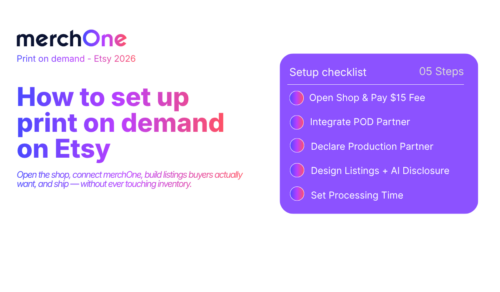
Quick answer: Setting up print on demand on Etsy in 2026 follows five steps: open a shop and pay the one-time $15 seller verification fee, connect a print-on-demand fulfillment partner, declare that partner inside Etsy Shop Manager under Settings → Production Partners, publish original listings with accurate disclosure language, and set processing times that reflect real production windows — not best-case estimates. Most stores that struggle with Etsy POD skip step three entirely or set step five to the fulfillment partner’s fastest possible turnaround instead of a realistic buffer.
Etsy’s 2024 Creativity Standards update made production partner disclosure mandatory for applicable listings — not a recommended best practice. Sellers who miss it face listing removal rather than a warning. At the same time, Etsy’s buyer base skews heavily toward gift and personalization intent: 79% of Etsy shoppers say they use the platform specifically to find unique or customized items (Etsy Seller Handbook, 2024). That combination of tighter compliance and strong personalization demand means the setup sequence matters more on Etsy than on Shopify or Amazon.
This guide covers each step with the specifics that keep Etsy POD accounts healthy: production partner declaration mechanics, AI design disclosure language, processing time buffers by fulfillment tier, niche focus strategy, and the six operational mistakes that stall most stores under $10K/year.
Key Takeaways
- Production partner disclosure is mandatory: Etsy’s 2024 Creativity Standards require sellers to declare POD partners for applicable listings before publishing — skipping this step risks listing removal, not just a warning.
- Setup sequence determines compliance: add the production partner in Shop Manager, then publish listings — never in reverse.
- AI-assisted design requires explicit disclosure: Etsy’s current policy requires a statement in the listing description when AI image generation tools contributed meaningfully to the artwork.
- Processing time buffers protect Star Seller status: Etsy’s Star Seller program requires on-time shipping on 95% or more of orders — setting processing time to the partner’s average rather than their 75th-percentile turnaround is one of the most reliable ways to fall below threshold.
- Niche depth beats catalog width: Etsy’s algorithm weights listing relevance and conversion rate — a focused 30-listing niche store consistently outranks a 300-listing generalist store in its target searches.
- Personalized products reduce direct price comparison: custom names, photos, dates, and family details make each product unique — buyers price-compare generics, not one-of-ones.
How Etsy Print on Demand Works in 2026
Etsy print on demand is a fulfillment model where a production partner manufactures and ships each order after checkout, under the seller’s brand. The seller creates the design, builds the listing on Etsy, sets the price, and manages customer communication. The POD partner — companies like merchOne, Printful, Printify, Gelato, or Prodigi — handles production and shipping after each sale, without the seller holding any inventory.
Three things make Etsy POD structurally different from running a Shopify POD store. First, Etsy charges a layered fee structure — $0.20 listing fee, 6.5% transaction fee, payment processing fees that vary by seller country, and Offsite Ads attribution fees of 12–15% on qualifying sales — that compresses margins if prices aren’t modeled with the full cost stack in mind. Second, Etsy’s review system is a direct ranking signal: a listing at 4.8 stars ranks above an identical listing at 4.3 stars, so fulfillment quality and delivery accuracy affect discoverability, not just customer satisfaction. Third, Etsy’s buyer base is dominated by gift and personalization intent — which rewards sellers who build around emotional occasions over sellers competing purely on lowest price.
Etsy POD Setup: The 5-Step Sequence
| Step | What to do | Why it matters |
|---|---|---|
| 1 | Open the Etsy shop and pay the $15 seller verification fee | Activates the selling account and Etsy Payments |
| 2 | Connect the POD fulfillment partner or workflow | Routes orders, production, shipping, and tracking automatically |
| 3 | Declare the production partner in Shop Manager | Required for compliance — listing removal risk if skipped |
| 4 | Publish original listings with accurate disclosure language | Reduces IP risk, handmade misrepresentation, and AI disclosure violations |
| 5 | Set processing time with a realistic buffer | Protects delivery expectations, Star Seller status, and review scores |
Step 1: Open Your Etsy Shop and Pay the Verification Fee
Etsy introduced a mandatory $15 one-time seller verification fee in 2024 to reduce fraudulent and reseller storefronts. The fee is charged during setup and is non-refundable. Beyond the fee, the opening sequence is standard: shop language, country, and currency selection; a shop name; and at least one published or draft listing before the shop goes live.
Shop name selection is more consequential than it looks. Etsy’s search algorithm uses the shop name as a relevance signal — a shop named PetPortraitStudio ranks more naturally for pet portrait canvas searches than DesignsByAlex. Narrow niche names help early discovery. They can constrain product expansion later. Sellers planning to move across multiple product categories within 12–18 months should choose a name broad enough to accommodate that range without sounding generic.
- Go to etsy.com/sell and begin the shop setup flow.
- Choose shop language, country, and currency — these determine Etsy Payments eligibility.
- Select a shop name that reflects the niche or broader brand direction.
- Complete identity verification and pay the $15 seller fee.
- Create at least one listing or draft to activate the shop.
Step 2: Connect Your POD Fulfillment Partner
The fulfillment integration is what connects an Etsy order to production. When a buyer checks out, the integration passes the order — including any personalization details — to the POD partner, which handles printing, packaging, and shipping. Without a working integration, every order requires manual forwarding. That fails at any meaningful volume.
Three integration paths exist for Etsy POD in 2026. Direct Etsy app integrations are the simplest — Printful, Printify, Gelato, Gooten, Prodigi, and CustomCat all offer native Etsy connections that sync listings and automate order forwarding. Order Desk is the stronger option for sellers running multi-channel operations across Etsy, Shopify, Amazon, and WooCommerce simultaneously — it routes orders to the appropriate fulfillment partner based on rules the seller configures. For personalized products with custom photo uploads or name fields, Customily and Teeinblue automate the file preparation step, reducing manual handling errors as order volume grows.
For wall art, canvas prints, framed posters, mugs, premium pillows, and home décor categories, merchOne connects through Order Desk, REST API, Customily, and Teeinblue — covering both automated order routing and personalized product file workflows. merchOne is a print-on-demand manufacturer specializing in high-quality wall art and home décor, produced in-house at four facilities — three in Europe (Latvia, Poland, and Germany) and one in the US (Columbus). For Etsy sellers targeting both North American and European buyers, that dual-region production setup means shorter shipping windows and no cross-border customs delays on EU orders.
Before scaling: Order one sample of each hero product before publishing listings. Verify print color accuracy against the mockup, check packaging condition on arrival, and confirm that tracking updates appear correctly in the Etsy order timeline. One test order prevents the review problems that 50 rushed orders create.
Step 3: Declare Your Production Partner — The Step Most Sellers Skip
Etsy’s production partner declaration is a compliance requirement under the 2024 Creativity Standards. Sellers using a third party to manufacture products must add that partner in Shop Manager and attach it to applicable listings. Failing to do so can result in listing removal. The declaration doesn’t expose the supplier’s identity to buyers unless the seller chooses — Etsy allows sellers to display a generic label like “a print shop” rather than the partner’s actual company name.
How to add a production partner in Etsy Shop Manager
- Open Etsy Shop Manager and go to Settings.
- Find the About Your Shop section and select Production Partners.
- Click Add a Production Partner.
- Enter the partner’s location and describe the division of work: the seller designs, the partner manufactures and fulfills.
- Choose whether to show the partner’s name publicly or use a generic description.
- Save the entry.
- Open each applicable listing, go to the production section, and attach the saved partner.
Sellers using more than one POD partner — for example, merchOne for wall art and home décor, and Printful for apparel — should add each partner separately and attach each to the correct product listings. Etsy does not limit the number of production partners a shop can declare.
Step 4: Publish Original Listings With Accurate Disclosure
Etsy’s 2024 Creativity Standards cover four compliance areas for POD sellers. Each affects listing survival differently, and each is specific enough that vague compliance isn’t sufficient.
Originality: what Etsy’s detection systems flag
Listings using unchanged stock graphics, resold design bundle files, or designs that appear across many unrelated shops are increasingly caught by Etsy’s image-matching and listing-similarity systems. The practical standard: the design must be the seller’s original creative work or a substantial adaptation — not a template dropped onto a product. Commercial-license design packs are starting points for original work, not finished listings.
AI-assisted design: what Etsy requires sellers to state
When AI image generation tools — Midjourney, DALL-E 3, Adobe Firefly, Stable Diffusion — contribute meaningfully to the artwork, Etsy’s current policy requires disclosure in the listing description. A specific disclosure outperforms a vague one. “This design was created with the assistance of AI image generation tools and further refined by the seller” is clearer than “AI-assisted” alone, because it signals the seller’s role in the creative process rather than suggesting the listing was fully automated.
Handmade language: where misrepresentation risk sits
Phrases like “handcrafted in our studio,” “made by hand,” or “handmade with love” in a POD listing description are factually inaccurate — a production partner manufactured the product. More accurate alternatives: “designed by our shop and printed to order,” “custom-made for you by our production partner,” or “made to order.” These are accurate and commercially effective.
Intellectual property: what disqualifies a listing immediately
Brand logos, sports team marks (NFL, NBA, Premier League), entertainment characters (Disney, Marvel, Nintendo), celebrity names and likenesses, and song lyrics are all protected under copyright and trademark law. Etsy’s IP policy and the DMCA both apply — a rights holder takedown notice removes the listing and adds a strike to the shop account. POD provides no legal protection for the seller when protected IP is used without a license.
Step 5: Set Processing Time With a Realistic Buffer
Processing time is the number of business days between an order being placed and the package leaving the production facility. Etsy displays this to buyers as part of the estimated delivery date — which directly influences whether a buyer purchases or keeps browsing. Setting processing time too short is one of the most reliable ways to collect negative reviews: Etsy calculates an arrival estimate from the listed processing time, and when the package arrives later, the buyer reviews against that expectation rather than the actual transit time.
The safe approach is to set processing time at the fulfillment partner’s 75th-percentile turnaround — not their stated average — then add further buffer during Q4 (November through December), Mother’s Day week (first week of May for the US, mid-March for the UK and Ireland), and Valentine’s Day (first two weeks of February). Most POD partners publish their peak-season production times. Sellers should update Etsy processing times before those windows open, not after the first delayed orders arrive and the review damage is done.
| Partner turnaround | Safer Etsy processing time | Peak season adjustment |
|---|---|---|
| 1–2 business days | 2–3 business days | 3–5 business days |
| 2–3 business days | 3–5 business days | 5–7 business days |
| 3–5 business days | 5–7 business days | 7–10 business days |
Shops with large catalogs should manage processing time through Etsy shipping profiles rather than updating individual listings. One profile update applies across every listing attached to that profile — essential for peak-season adjustments when time is short.
Why Niche Depth Outperforms Catalog Width on Etsy
Etsy’s search ranking algorithm weights listing relevance, conversion rate, and review score above listing volume. A shop with 30 tightly focused listings in the pet memorial niche — where every title, tag, and description reinforces a consistent set of buyer intent signals — typically outranks a 300-listing generalist store in those specific searches. The reason is signal clarity: Etsy can confidently classify what the focused shop sells and route the right buyers to it.
The practical application is to go deep in one buyer intent before expanding. A pet portrait shop can test canvas, framed prints, mugs, keyrings, premium pillows, ornaments, and memorial products without leaving the niche. That’s meaningful product breadth without the search signal dilution that comes from crossing into unrelated categories — wedding products, teacher gifts, Christian décor — within the same shop before the core niche has traction.
Etsy POD categories with strong personalization demand in 2026
- Pet memorial and pet portrait products: canvas prints, framed prints, mugs, keyrings — driven by year-round emotional purchase intent, not seasonal spikes alone.
- Wedding and anniversary personalization: venue maps, vow display art, couple name canvas, first anniversary keepsakes — repeat buying occasions at 1, 5, and 10-year milestones compound lifetime value.
- Family heritage signs and surname art: strong housewarming and Q4 gifting demand, low price sensitivity because the product is by definition one-of-one.
- Nursery and new-baby décor: birth stat canvas, baby name prints, milestone art — multiple buyers per birth (parents, grandparents, friends) with urgency driven by the arrival date.
- Christian and faith-based wall art: scripture prints, baptism gifts, confirmation keepsakes — verse-level and occasion-level search intent that reduces competition with generic “inspirational wall art” listings.
- Teacher appreciation products: subject-specific and role-specific mugs, framed prints — demand renews each school year, making the category self-refreshing without new niche research.
Why Personalization Raises AOV and Reduces Price Sensitivity
A generic canvas print competes on price. A canvas print with a buyer’s dog’s name, breed, and portrait date competes on uniqueness — and uniqueness doesn’t have a direct price comparison. This structural difference is why personalized POD products consistently achieve higher average order values than equivalent non-personalized products in the same category.
Etsy’s own data shows that shoppers spend an average of 22% more on personalized items compared to non-personalized equivalents in the same product category (Etsy Seller Handbook, 2023). For sellers, this means the investment in personalization workflows — Customily, Teeinblue, or structured manual file prep — typically pays back in margin per order, not just in volume. The most commercially durable personalization formats are names, photos, dates, family roles (Nana, Dog Mom, Bonus Dad), and location-specific details like coordinates or city names. Each one makes the product impossible to substitute with a cheaper generic listing.
Why merchOne Fits Etsy Sellers in Wall Art, Mugs, and Home Décor
For Etsy shops building around wall art, canvas prints, framed posters, mugs, premium pillows, and personalized home décor, the fulfillment partner’s production consistency is a ranking signal — not just an operational cost. A framed canvas that arrives with color shift or warping generates a buyer photo review. That review attaches to the listing, reduces conversion rate, and by extension reduces Etsy search ranking. Quality at the production level is quality in the algorithm.
merchOne is a print-on-demand manufacturer specializing in high-quality wall art and home décor, produced in-house at four facilities — three in Europe (Latvia, Poland, and Germany) and one in the US (Columbus). Wall art and home décor are made using HP Latex water-based inks and FSC-certified wood frames, with timber sourced from sustainably managed forests in Latvia. With 30,000 m² of production space and capacity for 2.5 million units per day, merchOne targets 95% on-time shipping — 2 business days for unframed canvas and posters, 3 business days for other products.
The wall decoration catalog covers canvas, framed canvas, framed poster, acrylic print, metal print, wood panel, wall tapestry, photo board, MIXPIX®, and framed MIXPIX®. The home décor accessories range includes classic mug, magic mug, heart mug, travel mug, premium pillow, premium blanket, puzzle, tote bag, acrylic heart, heart keyring, and glitter picture frame. Pet products — dog bowl, dog pillow, paw rug — and apparel featuring high-quality fabrics, durable materials, and precise print finishing round out the catalog. White-label packaging on every order keeps the buyer experience tied to the seller’s brand, not the production partner.
Category fit: merchOne’s production model is best matched to Etsy shops where primary revenue comes from wall art, framed prints, mugs, home décor, pet products, and personalized gifts — not commodity apparel where the lowest base price drives most purchasing decisions.
Six Mistakes That Keep Etsy POD Stores Under $10K/Year
Most Etsy POD stores that plateau below $10K/year have a structural problem, not a design problem. The listings may look attractive. The product quality may be fine. The stall almost always comes from one of these six operational or positioning failures.
1. Processing time set to the partner’s best-case turnaround
If a fulfillment partner states “2–3 business days” and the seller lists 2 business days in Etsy, any order taking 3 days registers as a late shipment. Etsy’s Star Seller program requires on-time shipping on 95% or more of orders over a rolling 3-month window. One period of under-buffered processing times — particularly during Q4 or Mother’s Day week — can drop the rate below threshold, removing Star Seller status and reducing search visibility until the rate recovers.
2. One design split across too many separate listings
Splitting a single design across 15 separate listings by size, color, or material fragments the review history and conversion data Etsy uses to rank. A listing with 47 reviews at 4.9 stars consistently outranks 15 listings with 3 reviews each. Etsy’s variation system lets sellers consolidate size and color options under one listing — concentrating social proof rather than diluting it.
3. Pricing that doesn’t account for Offsite Ads fees
Etsy automatically enrolls shops exceeding $10,000 in annual sales revenue in Offsite Ads — a program that promotes listings on Google, Facebook, and Pinterest. When a sale results from an Offsite Ad click, Etsy charges an additional 12% or 15% fee on top of the standard transaction fee. Sellers who price without this built in lose money on every Offsite Ad-attributed sale. The full cost model before setting prices: production cost + shipping + $0.20 listing fee + 6.5% transaction + ~3% payment processing + 12–15% potential Offsite Ads fee.
4. Mockups that don’t place the product in a real context
Lifestyle images — a canvas on a living room wall, a mug on a morning coffee table, a pillow on a sofa — convert significantly better than plain white-background product renders for wall art and home décor. The buyer needs to see the product in the space it will occupy to feel confident enough to personalize and purchase. Shops relying exclusively on the POD partner’s default white-background mockups compete at a disadvantage against listings with real-environment photography or professionally staged room scenes.
5. Manual personalization handling past low volume
Manual order handling — reading the buyer’s personalization note, opening design software, adjusting the file, uploading to the production partner — takes 8–15 minutes per order. At 10 orders per day, that’s 80–150 minutes of production admin daily. Customily and Teeinblue both integrate with Etsy and the POD partner to handle file preparation automatically when the buyer submits a name, photo, or text at checkout. The setup investment is typically recovered within the first month of meaningful order volume.
6. Skipping production partner declaration before the first listing
Etsy’s production partner declaration must be in place before publishing POD listings — not added retroactively when a review or report flags the shop. Retroactive declaration still works mechanically, but any listings already reported under review remain flagged. Adding the partner during initial setup and attaching it to every applicable listing takes under 10 minutes and eliminates the compliance risk entirely.
Pricing, Policies, and Help Center Resources
Before scaling an Etsy POD catalog, sellers should confirm production costs, shipping windows, print file specifications, return handling, taxation requirements, and platform integration details. The merchOne product catalog covers all available formats and base pricing across wall art, mugs, home décor, apparel, pet products, and personalized gifts. The shipping policy and Help Center are the most efficient starting points for production region, delivery window, and order handling questions.
For more specific documentation: product setup and print files covers RGB versus CMYK, bleed requirements, and resolution standards. Shipping and tracking covers delivery partners, parcel types, and transit windows by region. Order creation and returns covers cancellations, complaints, and the return policy in full. Billing and invoices covers payment methods and customs fees. Taxation and VAT covers seller tax documentation for EU and US markets. Sellers building custom order routing can review the REST API integration documentation. The privacy policy and terms of service cover data handling and platform rights.
Related Guides on merchOne
- Etsy POD Fees & Pricing Math 2026 — full breakdown of listing fees, transaction fees, Offsite Ads attribution, and margin modeling for Etsy POD stores.
- Best Etsy Print on Demand Companies in 2026 — comparison of merchOne, Printful, Printify, Gelato, Prodigi, Gooten, CustomCat, and Inkthreadable by category fit and production model.
- Top Print on Demand Mug Companies 2026 — mug-specific provider comparison for Etsy sellers.
- 12 Best Niches for Selling Canvas Prints in 2026 — canvas and wall art niche strategy with demand and competition analysis.
- The Best Wall Art Niches for Print on Demand Sellers — Etsy-ready wall art niches ranked by buyer intent strength.
- Best Personalization Options to Add to merchOne Products — photo, name, date, map, and text customization formats across wall art and home décor.
- 15 Most Profitable Print on Demand Niches in 2026 — niche selection ranked by AOV, gross margin, and demand stability.
- How to Avoid Copyright Infringement with Wall Art — IP risk reduction and design sourcing guidance for POD sellers.
Frequently Asked Questions
Is print on demand allowed on Etsy in 2026?
Yes. Etsy allows print on demand when the seller is responsible for the design and correctly declares the production partner in Etsy Shop Manager under Settings → Production Partners. The partner must be attached to each applicable listing before it’s published. Sellers must also follow Etsy’s 2024 Creativity Standards: original or substantially adapted designs, accurate AI disclosure when AI tools contributed to the artwork, and no handmade language for POD-fulfilled products.
How do I declare a production partner on Etsy?
Go to Etsy Shop Manager → Settings → About Your Shop → Production Partners. Click Add a Production Partner, enter the partner’s location and describe the work split (seller designs, partner manufactures and fulfills), then choose whether to show the partner’s name publicly or use a generic label like “a print shop.” Save the entry, open each applicable listing, and attach the partner in the production section. This step must be completed before publishing POD listings — not retroactively after the first listing goes live.
Do I need to disclose AI-generated designs on Etsy?
Yes. Etsy’s current policy requires sellers to state in the listing description when AI image generation tools — such as Midjourney, DALL-E 3, or Adobe Firefly — contributed meaningfully to the artwork. A specific disclosure works better than a generic one: naming the tool used and describing the seller’s creative role (refining, compositing, directing the output) signals genuine involvement rather than fully automated generation, which Etsy’s enforcement increasingly targets.
What processing time should I set for Etsy POD listings?
Set processing time at the fulfillment partner’s 75th-percentile turnaround — not their stated average — and add two to three further business days as buffer. During Q4 (November through December), Mother’s Day week, and Valentine’s Day peak windows, add another two to three days. Etsy’s Star Seller program requires on-time shipping on 95% or more of orders over a rolling 3-month window. One under-buffered peak period can drop the rate below threshold and suppress search ranking until the rate recovers.
Which POD products perform best on Etsy?
The strongest Etsy POD categories in 2026 are pet memorial and portrait products, wedding and anniversary personalization, family heritage signs, nursery and new-baby décor, Christian and faith-based wall art, and teacher appreciation gifts. These categories share three traits: emotional purchase intent that reduces price sensitivity, repeat buying occasions tied to milestones, and personalization that makes each product irreplaceable by a generic alternative. Etsy data shows shoppers spend 22% more on personalized items than on non-personalized equivalents in the same product category (Etsy Seller Handbook, 2023).
Can one Etsy shop use multiple POD suppliers?
Yes. Many high-volume Etsy stores use two or three POD partners: a wall art and home décor specialist like merchOne for canvas, framed prints, mugs, and pillows; an apparel-focused provider like Printful or CustomCat for T-shirts and hoodies; and sometimes a third for niche formats. Each supplier must be declared separately in Etsy Shop Manager and attached to the correct listings. Etsy does not cap the number of production partners a shop can register.
Should Etsy POD sellers order samples before launching?
Yes — before the first listing goes live, not after the first review. A sample order verifies print color accuracy against the listing mockup, packaging condition on arrival, tracking notification timing in the Etsy order view, and whether white-label packaging is working correctly (no supplier branding visible). For framed canvas, mugs, and premium pillows — where material quality is central to the perceived value and the price point — a sample is the only reliable way to confirm the product matches what buyers will expect.
Set Up Etsy POD With merchOne
Etsy POD works when the shop is compliant, the products match buyer intent, and the fulfillment partner is consistent enough to protect review scores. Wall art, canvas, framed prints, mugs, premium pillows, pet products, and personalized home décor are where Etsy’s buyer behavior is strongest — and where production quality at the fulfillment level translates directly into search ranking.
merchOne is a print-on-demand manufacturer specializing in high-quality wall art and home décor, produced in-house at four facilities in Latvia, Poland, Germany, and Columbus (US), with 2.5 million units of daily capacity and 95% on-time shipping. White-label packaging on every order keeps the customer experience tied to the seller’s brand. Connect through Order Desk, REST API, Shopify, WooCommerce, Customily, and Teeinblue — or through any of the 30+ e-commerce platforms Order Desk supports.
Before launching, review the merchOne platform overview, shipping policy, Help Center, privacy policy, and terms of service.