

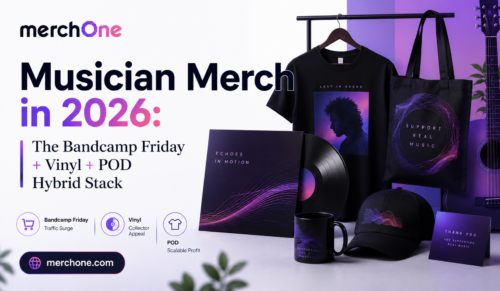
Musician Merch in 2026: The Bandcamp Friday + Vinyl + POD Hybrid Stack
Quick answer: Musician merch in 2026 works best as a three-layer stack — print-on-demand fulfillment for online orders, bulk inventory for tour tables, and vinyl for collectors. Bandcamp Friday provides a monthly anchor for drops. Album-art canvas and posters extend the catalog above entry-tier apparel for fans who want to own the artwork, not just wear it.
Indie artists who rely on a single product or a single channel leave money on the table at every release cycle. The casual listener wants a shirt or poster. The show attendee wants tour-exclusive physical product. The superfan wants vinyl, signed inserts, and limited collector formats. Each of these buyers requires a different fulfillment model — and none of them is well served by the same approach.
This guide covers the full musician merch model: Bandcamp Friday planning, vinyl economics, POD vs bulk inventory, genre-based blank selection, album-art canvas strategy, international fulfillment, and how merchOne fits the indie artist catalog.
Key Takeaways
- Musician merch needs three stacks: POD for online fulfillment, bulk inventory for tours, and vinyl for collectors — each serves a different buyer at a different moment.
- Bandcamp Friday creates monthly urgency: artists can plan digital releases and merch drops around a predictable first-Friday rhythm, treating it as a 14-day campaign rather than a single-day post.
- Vinyl is not POD: LPs require upfront capital, minimum runs of 250–500 units, 8–16 weeks of lead time, pre-orders, and release planning before a single record is pressed.
- Genre affects blank choice: folk, punk, metal, electronic, jazz, and hyperpop audiences expect different cuts, weights, and fabric feel — the wrong blank makes merch feel generic.
- Album-art canvas sits above apparel in the value stack: T-shirts bring entry-tier buyers in; framed canvas creates collector-tier AOV for fans who want the artwork in their space.
- Dual-region fulfillment reduces international drop-off: artists with US and European listeners lose conversion when shipping is expensive, slow, or customs-heavy — production closer to the buyer fixes this structurally.
Musician Merch Products: POD, Bulk, and Vinyl at a Glance
The strongest musician merch catalogs cover entry-tier fans, tour buyers, and collectors without forcing every product into one fulfillment model.
| Product | Fulfillment model | Fan moment | merchOne fit |
|---|---|---|---|
| T-shirts | POD or bulk | Entry-tier fan purchase | Apparel catalog |
| Hoodies | POD or limited drop | Premium fan identity | Hoodies and sweatshirts |
| Posters | POD or tour bulk | Tour memory or album-cycle keepsake | Print-on-demand posters |
| Album-art canvas | POD | Collector-tier home décor | Print-on-demand canvas |
| Vinyl | Bulk pressing only | Superfan and collector demand | Not POD — plan separately |
Why Bandcamp Friday Became the Indie Music Merch Anchor
Bandcamp Friday gives indie artists a predictable monthly sales moment that fans already understand: buy directly, support the artist, and make the purchase feel more meaningful than a stream or a social click. Bandcamp waives its standard revenue share during these windows, which shifts more of each sale directly to the artist. (Source: bandcamp.com, Bandcamp Friday FAQ, accessed 2026.)
That makes Bandcamp Friday useful for more than digital albums. It anchors limited merch drops, vinyl pre-orders, album-art canvas releases, poster bundles, and end-of-cycle catalog pushes. The window is predictable — first Friday of every month — which means it can be planned around, not reacted to. The strongest campaigns treat the date as a 14-day runway, not a single-day post.
| Timeline | Action | Purpose |
|---|---|---|
| D-14 | Email subscriber announcement | Give core fans early context |
| D-7 | Single, teaser, or product preview | Connect the merch drop to the music moment |
| D-1 | Countdown email and social reminder | Create next-day urgency |
| Friday | Full drop at 9 AM local time | Capture the highest-intent purchase window |
| D+1 to D+7 | Follow-up bundle offer | Convert fans who clicked but did not buy on the day |
The 2026 Bandcamp Friday Planning Calendar
Bandcamp Friday works best when artists connect each first-Friday window to a clear merch or release purpose. These dates serve as planning anchors — assigned to an album cycle, a tour announce, or a seasonal drop — rather than last-minute reminders.
| Date | Campaign angle | Suggested merch |
|---|---|---|
| February 6 | Q1 winter merch | Hoodie, poster, and leftover December bundle |
| March 6 | Spring single or festival news | Single artwork tee and poster |
| May 1 | Pre-summer album cycle | Album-art canvas and vinyl pre-order |
| August 7 | Back-to-school and fall tease | T-shirt restock and tour poster preview |
| September 4 | Fall tour announce | Tour poster and limited apparel |
| October 2 | Halloween or dark-aesthetic artists | Moody artwork drop or limited poster |
| November 6 | Holiday merch launch | Hoodie, vinyl, canvas bundle |
| December 4 | Year-end fan push | Canvas gift and giftable merch bundle |
Why Vinyl Still Changes the Merch Math
Vinyl cannot be fulfilled one order at a time. It requires upfront capital, minimum pressing runs, mastering, artwork preparation, and a realistic pre-order plan before the pressing plant begins work. That makes vinyl risky for artists who treat it as a last-minute merch idea — and highly effective for artists who plan it as the collector-tier anchor of a release cycle.
A 500-unit vinyl run typically costs $3,500–$6,000 and takes 8–16 weeks from order to delivery, depending on the pressing plant and current queue. Artists with a loyal email list, an active Bandcamp audience, or a confirmed tour calendar can use pre-orders to validate demand before committing capital. The pre-order is not a workaround — it is the correct planning tool for vinyl economics.
| Vinyl requirement | Typical range | What it means for planning |
|---|---|---|
| Minimum order | 250–500 units | Pre-orders should validate demand before committing cash |
| Lead time | 8–16 weeks | Start months before the intended release week |
| Upfront cost | $3,500–$6,000 for 500-unit runs | Use email and Bandcamp audience to test demand first |
| Primary buyer | Collector and superfan | Bundle with posters, canvas, or signed inserts for higher AOV |
The 3-Stack Hybrid Model: POD, Bulk, and Vinyl
POD and bulk inventory are not alternatives — they are complements. POD handles long-tail online demand across all sizes, designs, and international shipping. Bulk inventory handles tour booths and proven high-volume products. Vinyl serves collectors who want the album as a physical artifact, not just as a wearable or a poster.
A POD-only shop misses tour-table cash. A bulk-only shop cannot serve international fans efficiently. A vinyl-only strategy ignores casual buyers who want a shirt or poster but are not ready to buy an LP. Each stack has a buyer it serves better than the others — and most working artists need all three at different points in the release cycle.
| Stack | What it covers | Products | Buyer moment |
|---|---|---|---|
| POD | Online store, long-tail sizes, international orders | T-shirts, hoodies, canvas, posters, mugs | Discovery and casual buyer |
| Bulk | Tour booth, proven high-volume items | Core tees, tour posters, tote bags | Show attendee |
| Vinyl | Album release, limited variants, collector tier | Standard LPs, color variants, signed editions | Superfan and collector |
Genre Dictates Blank Choice
Music audiences are aesthetic-driven in a way that most other product categories are not. A blank that works for a metal band can feel completely wrong for an indie folk artist. A lightweight fashion tee that fits an electronic audience may disappoint a punk crowd that expects heavier cotton. Getting the blank wrong is not a minor error — it affects return rates, perceived price, and whether the merch feels like a real artist product or generic promotional clothing.
| Genre | Blank direction | Why it fits |
|---|---|---|
| Indie folk / singer-songwriter | Stanley Stella organic or relaxed styles | Neutral palette, softer feel, sustainability values match the audience |
| Electronic / ambient / IDM | Bella Canvas 3001 | Lightweight fit for club, festival, and casual wear |
| Punk / metal | Gildan 5000 or heavyweight styles | Heavier cotton matches gig and pit expectations |
| Vintage soul / R&B / jazz | Garment-dyed, comfort-style fit | Soft, pre-washed texture matches the retro visual language of the genre |
| Hyperpop / Y2K | Relaxed or oversized silhouettes | Streetwear and internet-aesthetic audience expect current silhouette trends |
Why Album-Art Canvas Works Alongside Apparel
Album-art canvas and apparel serve different buyers at different points in the fan relationship. T-shirts are entry-tier signals — easy to buy, low-commitment, accessible to a first-time fan. Framed canvas is a collector-tier product for fans who want the album artwork in their room, studio, or listening space. These are not competing products. They serve the same fan at different moments in their relationship with the music.
A fan may buy the tee after hearing one song. They return for the canvas after the album becomes part of their daily life. That sequence means canvas should sit above apparel in the catalog — priced higher, positioned as a more considered purchase, and marketed to fans who already own or have worn the artist’s other merch.
| Product | Role in catalog | Why artists need it |
|---|---|---|
| T-shirt | Entry-tier product | Easy buy for new and casual fans, low commitment |
| Poster | Affordable visual keepsake | Tour art, single art, and bedroom or studio wall presence |
| Framed album-art canvas | Collector-tier product | Higher AOV, stronger emotional connection to the album cycle |
For artists with strong cover art, the visual identity should not stop at the album thumbnail. The same artwork can become posters, framed canvas, acrylic prints, limited wall art drops, and premium bundles — each at a different price point for a different fan commitment level.
Why Dual-Region Fulfillment Matters for Indie Musicians
Many indie artists have listeners outside their home country. Streaming removes geography from music discovery — an artist based in Austin can have 40% of their audience in Germany, the UK, or Japan. But merch does not follow the same rules. If the store ships from one region only, international fans face high shipping costs, long delivery windows, and customs friction. That combination cuts conversion even when the fan is motivated to buy.
Dual-region production reduces this by routing orders to the production facility closest to the buyer. For artists with meaningful US and European demand, this means domestic shipping speeds and costs in both markets — rather than cross-border economics that make the purchase feel risky or expensive.
| Fulfillment setup | International buyer experience | Conversion impact |
|---|---|---|
| Single-region shipping | High cross-border shipping costs, longer delivery, customs risk | Lower international conversion rate |
| Dual-region production | Orders route to the facility closest to the buyer | Domestic delivery economics in both US and EU markets |
How merchOne Fits the Musician Merch Stack
merchOne is a print-on-demand manufacturer specializing in high-quality wall art and home décor, produced in-house at four facilities the company owns and runs — three in Europe (Latvia, Poland, and Germany) and one in the US (Columbus). Wall art and home décor are manufactured using HP Latex water-based inks and FSC-certified wood frames, with timber from sustainably managed forests in Latvia. With 30,000 m² of production space and 2.5 million units of daily capacity, the operation targets 95% on-time shipping — 2 business days for canvas and posters, 3 business days for other products.
For musician merch specifically, that dual-region production model covers both the US and EU markets from owned facilities — which matters for artists with international audiences. White-label packaging keeps every delivery branded to the artist’s store, not the production partner. Sellers connect through a Shopify app, REST API, or Order Desk — covering Amazon, Etsy, eBay, WooCommerce, BigCommerce, TikTok Shop, and 30+ other e-commerce platforms.
Products relevant to musician merch catalogs
- Apparel: T-shirts, hoodies, and sweatshirts with high-quality fabrics, durable materials, and precise print finishing — available in genre-appropriate blanks including Bella Canvas 3001, Gildan 5000, and Stanley Stella options.
- Posters: tour art, single art, album art, and wall drops in standard and large-format sizes.
- Canvas: album-art canvas for collector-tier catalog extension — framed canvas, unframed canvas, and wall-ready formats.
- Wall decoration: framed canvas, framed poster, acrylic print, metal print, wood panel, MIXPIX®, and framed MIXPIX® for collectors who want album artwork in premium formats.
- Home décor accessories: mugs, premium pillows, blankets, tote bags, puzzle, and giftable products for extending the merch catalog beyond apparel and wall art.
Pricing, Policies, and Help Center Resources
Musician merch works better when product setup, shipping, pricing, billing, and fulfillment rules are confirmed before the drop goes live. The merchOne product catalog covers base pricing across apparel, wall art, posters, canvas, mugs, and home décor. The shipping policy and Help Center are the most efficient starting points for production region, delivery windows, and order handling. For specific documentation: product setup and print files, shipping and tracking, orders and returns, billing and invoices, how to start with merchOne, North America price drop, privacy policy, and terms of service.
Related Guides on merchOne
- Print on Demand Calendar 2026: Every Sales Date That Matters — campaign planning around high-intent dates including Bandcamp Friday windows.
- Instagram Print on Demand Niches in 2026 — artists selling through visual content and social-first drops.
- Twitch Merch and Print on Demand — creators building apparel and desk-visible merch.
- 15 Most Profitable Print on Demand Niches in 2026 — broader niche and margin context.
- Wall Art or Apparel? POD Data Points to the Clear Profit Leader — comparing apparel and wall-art economics.
- Sell Print on Demand Wall Art with merchOne — wall décor product strategy.
- Best Personalization Options to Add to merchOne Products — custom names, dates, photos, and text-based product ideas.
- How to Avoid Copyright Infringement with Wall Art — safe design sourcing and IP compliance for album art.
Frequently Asked Questions
What is Bandcamp Friday?
Bandcamp Friday is a monthly sales event where Bandcamp waives its standard platform revenue share, allowing more of each sale to go directly to the artist. It runs on the first Friday of each month. Artists who prepare email and social campaigns 7–14 days in advance consistently see higher sales than artists who post only on the day itself — the window rewards planning, not reaction.
Should indie musicians use POD, bulk inventory, or vinyl?
All three, at different points in the release cycle. POD handles online store demand across all sizes and international orders with no upfront inventory. Bulk inventory works for tour booths and proven high-volume products where unit economics justify the upfront cost. Vinyl is for collectors and superfans — it requires 250–500 unit minimums, 8–16 weeks of lead time, and pre-order planning before pressing begins. Each model serves a different buyer at a different moment.
Do album-art canvases sell better than T-shirts?
They serve different buyer tiers and should not be compared on volume. T-shirts typically perform better on total units because the price point and commitment level are lower. Album-art canvas performs better on AOV because it targets fans who are deeper into their relationship with the music. Artists with strong cover art should carry both — apparel as the entry product, canvas as the collector upgrade for fans who return after the album becomes part of their life.
Why does blank choice matter for musician merch?
Music audiences are aesthetic-driven. A folk artist’s audience expects a different fabric weight, silhouette, and brand feel than a metal band’s audience. The wrong blank makes merch feel like generic promotional clothing rather than a real piece of the artist’s world. Blank choice affects perceived price, return rates, and whether the product reinforces or contradicts the artist’s visual identity. Order samples before committing to a blank for a large drop.
Why do musicians need international fulfillment?
Streaming has made music discovery global, but merch stores often haven’t followed. An artist based in the US with a large European audience who ships all orders from the US imposes cross-border shipping costs, long delivery windows, and customs friction on those fans. Dual-region production — US and EU facilities for the same product catalog — routes each order to the closer facility, giving international fans domestic shipping economics and making the purchase decision easier.
Build Musician Merch With merchOne
Musician merch works best when it matches the fan journey: entry-tier apparel, visual album-art products, collector drops, and reliable international fulfillment behind all of it.
merchOne is a print-on-demand manufacturer specializing in high-quality wall art and home décor, produced in-house at four facilities in Latvia, Poland, Germany, and Columbus (US) — with 30,000 m² of production space, 2.5 million units of daily capacity, 95% on-time shipping, and white-label packaging on every order. Connect through Shopify app, REST API, Order Desk, WooCommerce, Customily, Teeinblue, and 30+ other e-commerce platforms.
Before launching a merch drop, review the platform overview, shipping policy, Help Center, privacy policy, and terms of service.