


Etsy POD Fees & Pricing Math 2026: The Real Cost of Selling Print on Demand on Etsy
Quick answer: Etsy print-on-demand sellers pay a $0.20 listing fee, a 6.5% transaction fee on the full order total including shipping, and a payment processing fee that varies by country — commonly 3% + $0.25 in the US. Offsite Ads add 12% or 15% on attributed orders. The full fee stack on a $30 T-shirt with $5 shipping runs to roughly $3.78 on a regular sale and $7.98 when Offsite Ads apply — which is why pricing needs to be built around blended order economics, not just the baseline fees.
The problem is not that Etsy fees are impossible to manage. The problem is that many POD sellers price for the first sale, then discover that shipping fees, ad attribution, listing renewals, samples, and personalization tools have quietly reduced margin to nothing. The sellers who do well on Etsy long-term price for the full cost stack from day one — and choose product categories where the AOV supports it.
This guide breaks down the real Etsy POD pricing math, shows the difference between regular and Offsite Ads sales with worked examples, compares Etsy and Shopify economics, and explains why product category and production quality decide whether the fee load is worth paying.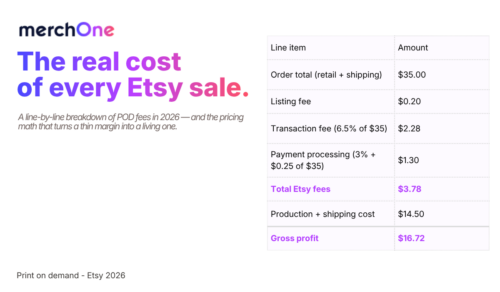
Key Takeaways
- Etsy’s fee stack is layered: listing fee, transaction fee on the full order total including shipping, and payment processing — all before advertising costs are counted.
- Offsite Ads can reshape the margin picture: attributed orders carry an extra 12% or 15% fee; sellers above Etsy’s revenue threshold cannot opt out of the program.
- Shipping is part of the fee base: the transaction fee applies to the order total including shipping — a $30 product with $5 shipping is a $35 fee base, not a $30 fee base.
- POD sellers need product-level pricing math: a $30 T-shirt and an $80 framed canvas do not absorb the same fee load in the same way.
- Premium categories handle Etsy fees better: wall art, framed prints, personalized gifts, and home décor support higher AOV, which distributes fixed fees over more revenue per order.
- Hidden costs reduce real margin: listing renewals, sample orders, personalization tools, mockup creation, and customer support time all cost money that the headline fee table does not show.
- Etsy and Shopify are not mutually exclusive: Etsy captures marketplace discovery; Shopify captures brand control, customer data, and repeat-purchase economics.
Etsy POD Fee Structure at a Glance
Use this table as the first pass before pricing any Etsy POD product. Every fee here applies before advertising costs, personalization tool fees, or sample budgets.
| Fee type | Typical US amount | Why POD sellers must model it |
|---|---|---|
| Listing fee | $0.20 per listing, renewed every 4 months or on each sale | Large catalogs accumulate renewal costs even before sales scale |
| Transaction fee | 6.5% of item price plus shipping and gift wrap | Shipping charges increase the fee base — often missed in early pricing models |
| Payment processing | 3% + $0.25 in the US; varies by seller country | Country-level rate differences change real margin for non-US sellers |
| Offsite Ads | 12% or 15% on attributed orders | Can reduce a healthy margin to a thin one on a single order |
| POD production and shipping | Depends on provider, product, region, and method | The largest non-Etsy cost in most POD orders — must be confirmed before pricing |
The Three Baseline Etsy Fees Every POD Seller Pays
Three fees apply to every Etsy sale regardless of product type, whether the order comes from marketplace search, Offsite Ads, or direct traffic. Understanding each one separately is the starting point for any pricing model.
1. Listing fee
Etsy charges $0.20 to publish or renew a listing. Each listing auto-renews every four months whether or not it has sold, and also renews after each sale. For shops with 50 listings, this is a minor fixed cost. For shops with 300+ listings across multiple size and product variants, it becomes a real catalog overhead cost before any other expense is counted. Sellers who split one design into many separate listings rather than using Etsy’s variation system pay this cost repeatedly across what is functionally the same product.
2. Transaction fee
The transaction fee is 6.5% of the order total — and the order total includes the item price, shipping charges, and gift wrap where applicable. This is where many new sellers miscalculate. A $30 product with $5 buyer-paid shipping is not a $30 transaction for fee purposes. It is a $35 transaction. On a $30 item with $5 shipping, the difference adds roughly $0.33 to the fee compared to calculating only on the product price. That difference compounds across thousands of orders.
3. Payment processing fee
Payment processing through Etsy Payments in the US runs at 3% + $0.25 per transaction. The rate varies by seller country — UK, EU, Australian, and Canadian sellers pay different percentages and fixed components. Non-US sellers should check the current rate for their location before copying any US-based pricing example. A pricing model built on US rates will be wrong for a seller in Germany or Australia by a measurable margin per order.
Pricing rule: Always calculate Etsy fees on the full order total — item price plus shipping. Using only the product price understates the true fee by the shipping rate applied to 6.5%.
Offsite Ads: The Fee That Reshapes POD Economics
Offsite Ads is the fee that catches most growing Etsy POD sellers off guard. It applies only when Etsy’s external advertising — on Google, Facebook, Pinterest, and partner sites — generates a click that leads to a purchase within Etsy’s attribution window. When it applies, it adds 12% or 15% on top of the baseline fees already charged on that order.
Shops below Etsy’s revenue threshold are typically charged 15% on attributed orders and may be able to opt out of the program. Shops above the threshold are enrolled at 12% and generally cannot opt out. (Source: Etsy Seller Handbook, Offsite Ads policy, accessed 2026.) Etsy caps the Offsite Ads fee on a single order — which reduces the impact on very high-ticket products — but for products in the $30–$80 range that make up most POD catalogs, the cap is rarely relevant.
The strategic issue is not the rate itself. It is predictability. A seller who prices only for baseline fees and assumes all orders are organic will find that Offsite Ads-attributed orders are consistently below the target margin. The correct approach is to model a realistic percentage of orders as Offsite Ads-attributed from the start — especially once the shop grows toward or past the mandatory enrollment threshold.
Worked Example: $30 T-Shirt Pricing Math
The following example uses a $30 T-shirt retail price, $5 buyer-paid shipping, $10 production cost, and $4.50 POD shipping cost. These are illustrative figures — actual numbers depend on the specific product, provider, and shipping method.
Regular Etsy sale — no Offsite Ads
| Line item | Amount | Calculation |
|---|---|---|
| Order total (item + shipping) | $35.00 | $30 + $5 |
| Listing fee | $0.20 | Fixed per listing |
| Transaction fee | $2.28 | 6.5% × $35.00 |
| Payment processing | $1.30 | 3% × $35.00 + $0.25 |
| Total Etsy fees | $3.78 | |
| Production + POD shipping | $14.50 | $10.00 + $4.50 |
| Estimated gross profit | $16.72 | $35.00 − $3.78 − $14.50 |
Same sale with 12% Offsite Ads attribution
| Line item | Amount | Calculation |
|---|---|---|
| Baseline Etsy fees | $3.78 | As above |
| Offsite Ads fee | $4.20 | 12% × $35.00 |
| Total Etsy fees | $7.98 | |
| Production + POD shipping | $14.50 | $10.00 + $4.50 |
| Estimated gross profit | $12.52 | $35.00 − $7.98 − $14.50 |
The same product, the same sale, the same buyer — and a $4.20 difference in gross profit depending on whether Offsite Ads attributed the order. That is a 25% reduction in gross profit on a single order. At scale, a shop where 30–40% of orders are Offsite Ads-attributed will have a meaningfully different margin profile than the same shop where that attribution rate is 10%. Sellers should track their Offsite Ads attribution rate in Etsy Shop Manager and factor it into pricing adjustments over time.
Etsy vs Shopify POD Economics
Etsy and Shopify are not alternatives — they solve different problems. Etsy provides marketplace discovery: buyers already on Etsy searching for products can find the shop without any seller-driven traffic. Shopify provides brand control: the seller owns the customer relationship, sets up email flows, runs bundles, and builds repeat-purchase economics without paying per-transaction marketplace fees on every sale.
| Cost or factor | Etsy | Shopify |
|---|---|---|
| Monthly subscription | No standard monthly shop fee | Monthly plan required |
| Listing fee | $0.20 per listing, renews every 4 months | No per-listing fee |
| Transaction fee | 6.5% on full order total including shipping | Depends on payment setup and Shopify plan |
| Offsite Ads | 12–15% on attributed orders, enrollment may be mandatory | No Etsy Offsite Ads fee |
| Traffic source | Marketplace search and Etsy-driven demand | Seller-driven via SEO, ads, email, social, and content |
| Customer ownership | Limited — marketplace restricts direct buyer communication | Full — email list, remarketing, CRM workflows |
| Brand control | Constrained by marketplace design standards | Full storefront customization |
Many established POD sellers run both. Etsy captures search-driven discovery from buyers who would not otherwise find the shop. Shopify captures returning customers, email-driven repeat orders, and bundles that the marketplace environment cannot support. The two channels compound rather than compete when set up correctly.
Why Production Quality Determines Whether Etsy Fees Are Manageable
Etsy fees are a fixed percentage of revenue. The absolute dollar amount those fees take out of each order scales with the retail price. That means premium categories — where the product can command a higher price because of personalization, material quality, or emotional occasion — have structurally better fee economics than commodity products competing on lowest price.
A $25 generic T-shirt leaves thin margin after Etsy fees and production cost. An $85 framed canvas with a buyer’s family photo leaves room to absorb fees, cover sample costs, and still reach a useful profit per order. This is not an argument against apparel — it is an argument for choosing products where the price the market will pay is high enough to absorb the fee stack comfortably.
Production quality sets the retail price ceiling. A canvas that arrives with warped frames or color shift cannot command $85. A canvas that arrives in clean packaging, accurate color, and solid frame construction can — and when it does, the buyer leaves a photo review that drives more conversions from the same listing. Production quality compounds: it affects not just this order’s margin but every future order’s conversion rate.
Why Etsy sellers in premium categories use merchOne
merchOne is a print-on-demand manufacturer specializing in high-quality wall art and home décor, produced in-house at four facilities the company owns and runs — three in Europe (Latvia, Poland, and Germany) and one in the US (Columbus). Wall art and home décor are manufactured using HP Latex water-based inks and FSC-certified wood frames, with timber from sustainably managed forests in Latvia. With 30,000 m² of production space and 2.5 million units of daily capacity, the operation targets 95% on-time shipping — 2 business days for canvas and posters, 3 business days for other products.
For Etsy sellers building around categories that support higher AOV — wall decoration, framed prints, canvas, home décor accessories, mugs, personalized gifts, and pet products — that production consistency directly affects Etsy search ranking. A listing with 4.9 stars and 40 reviews outranks an identical listing with 4.2 stars. The review score comes from what happens after the order ships. White-label packaging on every order keeps the buyer experience tied to the seller’s brand, not the production partner’s. Connect through Shopify app, REST API, or Order Desk — covering Amazon, Etsy, eBay, WooCommerce, BigCommerce, TikTok Shop, and 30+ other e-commerce platforms.
Fee math takeaway: Etsy fees are easier to absorb when the product supports stronger pricing. For most POD sellers, that means moving toward personalized wall art, framed prints, canvas, pet memorials, wedding gifts, and premium home décor — categories where the buyer’s willingness to pay is driven by occasion and personalization, not by price comparison with generic alternatives.
Hidden Costs New Etsy POD Sellers Underestimate
Etsy’s listed fees are only part of the real cost of running a profitable POD shop. The supporting costs that make listings convert — and keep customers satisfied — are often invisible in early pricing models and visible only after the first few months of real operations.
- Listing renewals: a 300-listing catalog renewing every four months generates $15 in renewal fees per cycle before a single sale. Over a year, that is $45 in pure overhead that does not depend on whether any of those listings convert.
- Sample orders: every hero product should be sampled before launch — framed canvas, mugs, pet portrait prints, premium pillows. Samples are not optional if the goal is to verify color accuracy, packaging, and material quality before the first buyer review is written.
- Mockup creation: generic white-background mockups reduce conversion in competitive categories. Lifestyle images — canvas on a living room wall, a mug on a morning coffee table — cost money to create and directly affect click-through and purchase rates.
- Personalization tools: Customily and Teeinblue automate file preparation for custom name, photo, and date products. As personalized order volume grows, manual handling at 8–15 minutes per order becomes the bottleneck — and the tools that remove it carry a subscription cost.
- Customer support time: sizing questions, delivery updates, personalization corrections, and buyer complaints all cost time. At low volume this is manageable. At 20+ orders per day it becomes a real operational cost that should be factored into the margin model.
- Replacements and refunds: transit damage, color mismatch, or production errors generate replacement orders. A 2–3% replacement rate on a high-volume shop is a meaningful cost that pricing should account for before it appears on the bank statement.
How to Build a Safer Etsy POD Price
A reliable Etsy POD price is not a single markup over base cost. It is a model that includes every cost that applies to a real order, built before the first listing goes live. Running the numbers after the first month of thin margins is recoverable but avoidable.
- Start with the confirmed POD base cost and shipping cost from the actual provider for the actual product and region.
- Add Etsy baseline fees calculated on the full order total including buyer-paid shipping — not just the product price.
- Model a realistic percentage of orders as Offsite Ads-attributed. For growing shops, 20–30% is a conservative starting assumption.
- Add per-order costs for personalization tools, proofing, and design if applicable.
- Build in a per-order allocation for sample amortization, listing renewals, and a replacement reserve.
- Set a target gross profit per order before any discounts or promotions.
- Check whether the final retail price is competitive for the category on Etsy — if it is not, the margin problem is a product or supplier problem, not a pricing problem.
The last step matters. Sellers cannot simply raise prices endlessly and expect conversion to hold. The product has to justify the price through personalization depth, material quality, niche specificity, faster delivery, stronger packaging, or a clearer gift occasion. When it does, Etsy fees become a predictable cost of accessing a high-intent buyer marketplace — not a structural barrier to profitability.
Pricing, Policies, and Help Center Resources
Etsy POD sellers should confirm production costs, shipping windows, integration setup, billing, taxation, returns, and print file requirements before scaling. The merchOne product catalog covers base pricing across wall art, home décor, mugs, apparel, and pet products. The shipping policy and Help Center cover production region, delivery windows, and order handling. For specific documentation: product setup and print files, shipping and tracking, orders and returns, billing and invoices, taxation and VAT, REST API integration, privacy policy, and terms of service.
Related Guides on merchOne
- How to Set Up Print on Demand on Etsy 2026 — setup, production partner disclosure, and listing workflow.
- 5 Best Redbubble Alternatives for Print on Demand 2026 — marketplace and fulfillment model comparison.
- Top Print on Demand Mug Companies 2026 — mug provider comparison for Etsy sellers.
- 12 Best Niches for Selling Canvas Prints in 2026 — canvas and wall art niche strategy.
- The Best Wall Art Niches for Print on Demand Sellers — Etsy-ready wall art niches.
- Best Personalization Options to Add to merchOne Products — photo, name, date, and text-based product ideas.
- 15 Most Profitable Print on Demand Niches in 2026 — broader niche and margin planning.
- How to Avoid Copyright Infringement with Wall Art — safe IP and design sourcing for Etsy sellers.
Frequently Asked Questions
What is the total fee Etsy POD sellers pay per sale?
On a regular sale, the baseline fee stack for a US seller on a $30 product with $5 shipping runs to approximately $3.78 — listing fee ($0.20) + transaction fee ($2.28 at 6.5% of $35) + payment processing ($1.30 at 3% + $0.25). On an Offsite Ads-attributed order, an additional 12% or 15% of the order total applies. The exact result depends on seller country, product price, shipping amount, ad attribution rate, and shop revenue status.
Can Etsy sellers opt out of Offsite Ads?
Eligibility depends on Etsy’s current policy and the shop’s revenue history. Sellers below Etsy’s annual revenue threshold may be able to opt out; sellers above the threshold are generally enrolled and cannot opt out. The lower Offsite Ads rate (12%) applies to higher-revenue shops; the higher rate (15%) applies to lower-revenue shops that remain enrolled. Always check the current Offsite Ads policy in Etsy Shop Manager before finalizing prices — the policy applies to future orders, not past ones. (Source: Etsy Seller Handbook, accessed 2026.)
Why does Etsy charge the transaction fee on shipping?
Etsy’s transaction fee applies to the order total, which Etsy defines as item price plus shipping and gift wrap. This is a structural feature of Etsy’s fee model, not a hidden charge — it appears in Etsy’s fee documentation. Sellers who price only on the product price and forget to include shipping in the fee calculation will consistently underestimate total fees per order, particularly on products with higher shipping costs like framed canvas or large-format posters.
How much should an Etsy POD seller mark up over base cost?
There is no universal safe markup percentage because the required markup depends on the full cost stack — POD base cost, shipping cost, baseline Etsy fees, expected Offsite Ads attribution rate, sample amortization, listing renewal allocation, personalization tool cost, and target gross profit. Many new sellers find that the markup required to reach a viable profit is higher than expected, particularly on lower-ticket products where production cost and Etsy fees together consume most of the revenue.
What is the most common Etsy POD pricing mistake?
Pricing only for baseline fees and ignoring Offsite Ads attribution, listing renewals, sample orders, personalization tools, and replacement costs. This makes the product look profitable in a spreadsheet and underperforming in real operations. The second most common mistake is calculating fees on the product price only and forgetting that the transaction fee applies to the full order total including shipping — an error that understates fees by 6.5% of the shipping amount on every order.
Which Etsy POD categories absorb fees most effectively?
Categories where the retail price is driven by personalization, occasion, and emotional value rather than commodity comparison absorb Etsy fees more comfortably. Personalized wall art, framed canvas, pet memorial products, wedding gifts, anniversary keepsakes, and premium home décor typically support higher AOV than generic apparel or basic accessories — which means the fixed and percentage-based fees take a smaller share of the revenue per order.
Does POD partner choice affect Etsy fee math?
Yes, indirectly. The POD partner determines base cost, shipping cost, production consistency, replacement rate, and the retail price ceiling the product can realistically command. A partner whose wall art production supports $80–$120 price points creates better Etsy fee economics than a partner whose output quality caps the realistic retail price at $35–$40. Production quality is not separate from pricing strategy — it determines how much room the seller has to absorb fees and still reach target margin.
Build Fee-Safe Etsy POD Products With merchOne
Etsy fees are easier to absorb when the product supports stronger pricing. Build around categories where buyer intent, personalization, and perceived value justify the retail price — wall art, canvas, framed prints, mugs, pet gifts, and premium home décor.
merchOne is a print-on-demand manufacturer specializing in high-quality wall art and home décor, produced in-house at four facilities in Latvia, Poland, Germany, and Columbus (US) — with 30,000 m² of production space, 2.5 million units of daily capacity, 95% on-time shipping, and white-label packaging on every order. Connect through Shopify app, REST API, Order Desk, WooCommerce, Customily, Teeinblue, and 30+ other e-commerce platforms.
Before launching, review the platform overview, shipping policy, Help Center, privacy policy, and terms of service.