


5 Strategies to Scale Your Print-on-Demand Business
A chief advantage of print-on-demand (POD) as a business model is its accessibility. It’s quick and easy to open an online store and start selling your own designs printed on a modest range of products. For most POD entrepreneurs, scaling their business is challenging — as this requires some research, planning, and strategizing.
So what does it mean to scale a business? Scaling is often conflated with growth. But to grow your business means acquiring more customers and increasing sales–which is usually achieved by increasing investment (which carries obvious risks). Scaling your business, meanwhile, means expanding at a rate that outstrips the increase in costs.
A scalable business model is an adaptable model that can handle rapid changes in order volume while keeping expenditure steady. This means finding agile, cost-effective solutions for your business infrastructure at every stage: development, production, and shipping.
The easiest, most effective way to scale your POD company is to rely on outsourcing. If you can find an established partner who’ll take care of fulfillment and dropshipping, you’ll boost your growth potential at a stroke— without a significant increase in financial risk. We discuss this in our handy list of 5 strategies for scaling your POD business!

Key takeaways
To scale up your business…
- Start by creating a memorable brand and developing a relationship with your target customer base;
- Build trust and authority with a content strategy aligned to your business goals;
- Choose a company that will handle fulfillment on your behalf, letting you focus on design and business growth;
- Expand to major marketing platforms and e-commerce websites;
- Use segmentation to personalize your offering and cater to market demand.
1. Build a strong brand to scale your business

Your business is live once you’ve created your unique designs and your range of print products is available to buy. But this is just the first step. If you want to expand, you need to build a strong foundation. Good branding is key to growing and increasing your customer base.
Establish a brand identity
Your brand identity is as important as the products you’re offering. Creating a catchy name and keeping your brand consistent across different platforms will help you get established.
Clearly define your brand values, as they’ll guide your future product choices and help you fine-tune your marketing. What are you passionate about? What does your brand communicate to the world? It may stand for sustainable production, for example, or support for a social cause.
Build your audience
Keep your target audience in mind through all the stages of building your brand. Invest in researching your target audience to understand their preferences and needs better—helping you develop products that will resonate with them.
Rely on segmentation
The more information you gather about your audience, the easier it will be to “segment” your buyers: to group them into distinct buyer personas with specific tastes and interests. Segmentation can help you boost trade by personalizing your offering to each buyer persona.
Collaborate with influencers
To improve your visibility faster, reach out to influencers—content creators and industry experts. Since they’ve already earned the trust of their followers, they’ll be able to help you establish your brand reputation. Ways they can do this include writing reviews of your products, showcasing your designs, and discussing your core values.
2. Find a reliable print-on-demand partner

Very few print-on-demand businesses handle production in-house. For small businesses, in particular, the process can be slow and risky. So most POD companies partner with larger corporations offering order fulfillment and dropshipping. Using the services of established firms brings the following advantages:
- There is no need to keep inventory, find suppliers, or organize shipping
- Money saved on warehousing and overproduction—since you only pay once you make a sale
- Order updates can be accessed and monitored through a single source
There’s no shortage of manufacturers and suppliers competing to provide end-to-end fulfillment. So how do you choose between them? We recommend you assess potential partners on the following criteria:
- Product range and quality
- Production times & capacity
- Prices
- Shipping terms and costs
- Industry experience
- Extra features offered (e.g. white-label solutions)
- Options for integration with e-commerce platforms
The easiest way to check a provider’s production standards is to order their samples and judge the quality for yourself. Would you buy the items? If so, you can be confident your customers would too.
Tip: A great way to set your store apart is to offer buyers the chance to personalize their designs. It’s well-known that custom products sell better and yield higher margins, and this holds just as true for print-on-demand companies as it does for Tesla or Nike.
3. Promote your unique products cross-platform
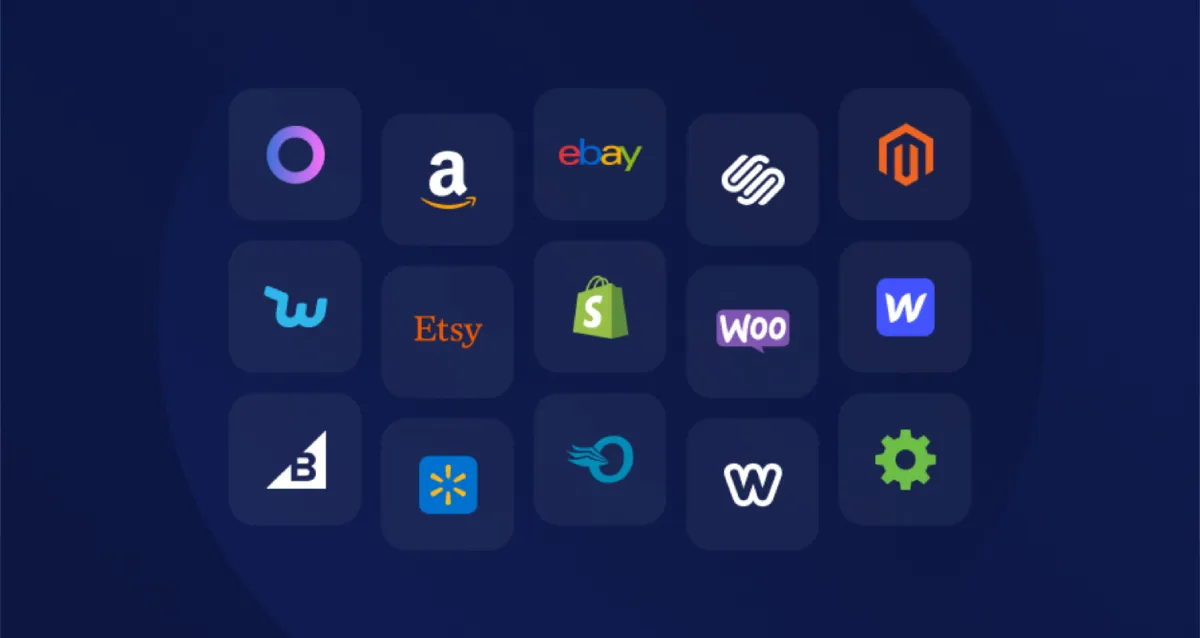
If you only sell through one channel, you’re limiting your business. You can reach far more potential customers by expanding to major marketplaces and e-commerce platforms. To give you an idea of the numbers: Amazon, the largest online marketplace, has an average of 5,200 million monthly visits.
E-commerce platforms are easy to integrate with your core shop and manage from a single dashboard. And they help you establish a consistent brand identity by giving all your stores the same feel (the so-called “omnichannel” sales strategy).
Shopify is a great example of an e-commerce platform popular with stores using the POD model. Secure, fast, and user-friendly, the online heavyweight enjoys worldwide popularity. Other popular examples include Etsy, WooCommerce, BigCommerce, and Magento.
Taking advantage of the game-changing visibility the big platforms can provide is a surefire way to scale your print-on-demand business.
4. Expand your product catalog

Partnering with a thriving fulfillment provider helps you scale your business, allowing you to expand your product offering in new and exciting ways. A bit of market research will help, giving you a better sense of which products your target audience will respond to. That said, you can afford to experiment when you face no upfront costs for materials, production, or warehousing!
Categories that tend to do well include:
- Apparel (T-shirts in particular)
- Home textiles (pillows, blankets, towels)
- Mugs (a perennial favorite) and other inexpensive gifts
- Wall decoration (prints on canvas, acrylic, wood, etc)
You’ll start to pull ahead of your competitors if you can find a specific niche in the market that your designs cater to—whether by reflecting a certain subculture or simply achieving a unique, quirky aesthetic.
Offering bundle options is an effective way to increase order values: for example, if you sell printed T-shirts in men’s and women’s cuts, suggest matching his ’n’ hers packages. Creating products your buyers will want to buy in bulk will also boost your profits.
Keep your shop content short and simple, and remember: thinking from the buyer’s perspective at every stage will help optimize user experience.
5. Learn and communicate to scale your business

Learn from competitors who’ve managed to scale their businesses successfully. What strategies have they implemented? Which e-commerce sites are they selling on? Just bear in mind that there’s a difference between sourcing inspiration from competitors and trying to reproduce their offering because it’s creating and maintaining a unique brand and voice that will pay dividends in the long run.
As you evolve your product portfolio, keep an eye on the market trends energizing your target audience. Use data analytics to create a targeted marketing strategy and get a competitive edge.
Be vocal on social media
Leverage the power of social media to build relationships and promote your offering, concentrating on the platforms where your audience spends the most time. Making your voice heard will significantly contribute to your brand visibility.
Engaging potential buyers allows you to talk about your values and promote what you do, but it can also be useful for market research. Learn what products they’re buying, which designs they’re responding to best, and ways you might fail to meet their expectations.
Build trust and authority
Providing high-quality products and services should always be your core focus, but a content marketing strategy aligned with your business values can run in parallel with this. Clear and informative landing pages, alongside regular blog posts and guides, will help you build authority as an industry expert.
merchOne specializes in POD order fulfillment. Our production facilities handle large volumes of printing on quality merchandise. POD businesses worldwide trust us with their orders, thus maintaining brand identity while scaling. Business metrics soar with merchOne.
Summing up
Scaling your print-on-demand business optimally will rely on a confluence of sound, creative, and strategic decisions. Getting the best results could take time. But if you’re running a small or medium-sized POD company, outsourcing production and shipping is one decision you’re unlikely to regret. It will save you a lot of time and effort, leaving you to concentrate on the finer points of creative commerce: creating exceptional designs and building customer relationships.