

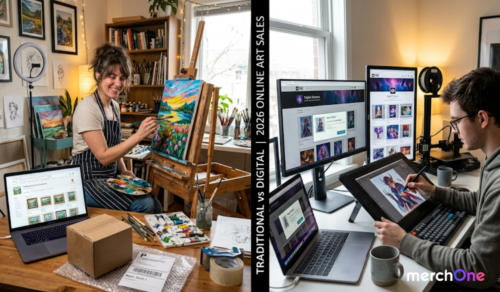
Traditional Art vs Digital Art in 2026: Which Sells Better Online?
In 2026, the stronger business model is often hybrid. Artists can sell originals or commissions at the premium tier, then use POD reproductions to reach buyers who want accessible wall art, personalized gifts, or home décor without the price of an original.
Reports from Art Basel & UBS and Hiscox continue to show a large global art market with meaningful online sales activity. For artists, the takeaway is practical: the medium matters, but distribution, pricing, file quality, product format, and fulfillment quality often decide whether online art becomes repeatable revenue.
Disclaimer: This article is provided for general informational purposes only. Information concerning markets, products, services, prices, features, policies, availability and third-party providers reflects information available as of the date stated and may change over time.
Readers should verify current information with the relevant provider, platform or other authoritative source before making business or purchasing decisions. References to profitability, demand, margins, sales potential or business performance are illustrative only and do not guarantee any particular result.
Key Takeaways
- Traditional art wins on scarcity: originals and commissions can command higher prices because each piece is physical and limited.
- Digital art wins on scalability: one file can sell repeatedly across wall art, apparel, mugs, home décor, and personalized products.
- POD changes both models: traditional artists can scan or photograph originals and turn them into repeatable print products.
- Costs behave differently: traditional art has recurring material costs; digital art usually has higher upfront hardware cost but lower per-piece cost.
- Buyer intent differs: collectors often value provenance and originality, while POD buyers care about room fit, personalization, price, and delivery.
- AI disclosure matters: artists using generative AI should follow marketplace disclosure rules and avoid presenting AI-assisted work as fully handmade.
- Fulfillment quality protects reviews: canvas, framed prints, and premium wall art need consistent color, framing, packaging, and material quality.
Traditional Art vs Digital Art: Quick Comparison Table
The best choice depends on whether the artist wants high-value one-off sales, scalable ecommerce revenue, or a hybrid model that captures both.
| Factor | Traditional Art | Digital Art |
|---|---|---|
| Startup cost | Paint, canvas, brushes, easel, lighting, studio basics | Tablet, stylus, software, storage, optional subscriptions |
| Per-piece consumable cost | New materials for each physical piece | Effectively zero for the file itself |
| Original sale price | Higher per piece because the object is unique | Usually lower unless commission, limited edition, or collector-backed |
| POD print sale price | Works after scanning or photographing the original | Works through direct upload |
| Reproducibility | Limited as an original; scalable after digitization | Highly scalable across formats |
| Time to first online sale | Often slower because inventory, photography, and channel setup take time | Often faster once product files and listings are ready |
| Best distribution channels | Galleries, art fairs, Saatchi Art, Artfinder, Shopify | Etsy, Shopify, POD platforms, Pinterest, Instagram, TikTok |
| Lifetime revenue per artwork | One-time if sold only as an original | Compounding when sold repeatedly through POD |
| AI disclosure | Usually not relevant unless AI is used in the process | Required on many platforms when generative AI is used |
Reference points used in this article include Art Basel & UBS Global Art Market Report 2025, Hiscox Online Art Trade Report 2025, Etsy marketplace disclosures, and common pricing patterns across online art platforms.
What Counts as Traditional Art in 2026?
Traditional art covers physical works created with non-digital tools: oil and acrylic painting, watercolor, charcoal, graphite, pen and ink, pastels, sculpture, ceramics, mixed media, lithography, etching, and other physical processes.
The defining feature is the object itself. Each original exists as a singular physical artifact, which gives traditional art its scarcity value. That scarcity can support higher pricing, but it also limits how many times the same artwork can sell unless it is digitized for prints.
Where Traditional Art Sells
- High-end galleries and auction houses: Sotheby’s, Christie’s, Phillips, and established gallery programs.
- Mid-tier online platforms: Saatchi Art, Artfinder, Singulart, Artsy, and artist marketplace platforms.
- Direct-to-consumer storefronts: Shopify, Squarespace, and artist-owned websites.
- Marketplace channels: Etsy, Amazon Handmade, and niche handmade platforms.
- Physical venues: local galleries, art fairs, pop-up exhibitions, cafés, hotels, and interior-design partnerships.
Practical takeaway: Traditional art is strongest when the buyer values originality, handwork, texture, and provenance. It can also become scalable when the artist digitizes the original for POD reproductions.
What Counts as Digital Art in 2026?
Digital art covers work created with software and digital hardware, including Procreate, Photoshop, Adobe Fresco, Clip Studio Paint, Krita, Affinity Designer, Wacom tablets, iPad Pro, Huion tablets, 3D software, vector tools, animation tools, and AI-assisted workflows where allowed and disclosed.
Its commercial advantage is reproducibility. One high-resolution file can become canvas prints, framed posters, mugs, T-shirts, pillows, blankets, phone cases, and other POD products without creating physical inventory first.
Common Digital Art Tools
| Tool | Best for | Commercial note |
|---|---|---|
| Procreate | iPad illustration and painting | Strong for fast social-first illustration workflows |
| Adobe Photoshop and Fresco | Professional illustration, editing, and color correction | Useful for print file preparation |
| Clip Studio Paint | Comics, manga, character art, and animation | Strong for illustration-led POD catalogs |
| Krita | Open-source digital painting | Low-cost starting point |
| Affinity Designer and Photo | Vector and raster work without subscription dependence | Useful for artists managing costs |
| Adobe Firefly and AI tools | Concepting, asset generation, and assisted workflows | Use disclosure where required and verify commercial rights |
Practical takeaway: Digital art is strongest when the artist wants speed, repeatability, multi-format products, and scalable distribution through Etsy, Shopify, and POD channels.
How Big Is the Online Art Market in 2026?
Online art buying is no longer limited to collectors. Buyers now discover original art, digital downloads, canvas prints, framed posters, personalized portraits, and home décor through Etsy, Pinterest, Instagram, TikTok, Google Images, Shopify stores, online galleries, and POD marketplaces.
Three online segments matter most for artists building revenue in 2026:
- Print-on-demand wall art and home décor: canvas, framed prints, posters, personalized home décor, and giftable wall art sit at the intersection of art, ecommerce, and gifting.
- Affordable digital downloads: printable wall art and digital posters remain attractive because they have low marginal cost and global delivery.
- Mid-tier original works: online platforms make it easier for buyers to purchase physical originals without traditional gallery markup.
Real Production Costs: Traditional vs Digital Art
Traditional art and digital art have different cost curves. Traditional art can be cheaper to start at a hobby level, but materials compound with every piece. Digital art can cost more upfront, but the per-file cost becomes very low once the setup is in place.
Traditional Art Startup Costs
| Item | Cost logic |
|---|---|
| Paint, paper, canvas, or surface | Recurring material cost for each new work |
| Brushes, tools, easel, lighting | Upfront setup cost with occasional replacement |
| Studio and storage | Can become meaningful as inventory grows |
| Packaging and shipping | Higher risk for originals because damage is harder to replace |
Digital Art Startup Costs
| Item | Cost logic |
|---|---|
| Tablet, stylus, or display tablet | Higher upfront investment for serious workflows |
| Software | One-time purchase or subscription, depending on tool |
| File storage and backup | Important as catalogs scale |
| Per-piece material cost | Near-zero for the file itself |
The crossover point depends on output volume. Artists making only a few originals per year may prefer traditional workflows. Artists building dozens or hundreds of ecommerce listings often benefit from digital or digitized workflows because each file can become multiple sellable products.
How Sale Prices Compare
Traditional originals generally capture higher per-sale revenue. Digital art and POD reproductions usually sell at lower price points, but they can compound because the same file sells repeatedly.
| Format | Pricing logic | Source medium |
|---|---|---|
| Original oil or acrylic painting | Higher collector price because the object is unique | Traditional |
| Custom traditional commission | Premium pricing based on labor, material, and uniqueness | Traditional |
| Digital commission | Usually lower than physical originals but faster to revise and deliver | Digital |
| Open-edition canvas print | Scalable POD format with accessible premium pricing | Traditional or digital |
| Framed poster or fine art print | Mid-tier wall art format for décor and gifts | Traditional or digital |
| Digital download | Low retail price, high margin, buyer prints independently | Digital |
Strategic implication: Traditional originals can create stronger one-time revenue. Digital art and POD reproductions can create stronger lifetime revenue when one piece sells repeatedly across multiple products and buyer segments.
Which Medium Reaches More Buyers Through Print on Demand?
Both mediums can reach global buyers through POD fulfillment. The difference is the production workflow.
Digital Art to POD Workflow
- Export the artwork at the correct size and resolution for the product.
- Upload the file to a POD partner such as merchOne or to the connected ecommerce workflow.
- Configure products such as canvas, framed prints, posters, mugs, apparel, pillows, or blankets.
- List products on Shopify, Etsy, WooCommerce, or another selling channel.
- The POD partner prints, packs, and ships when orders arrive.
Traditional Art to POD Workflow
- Create the original artwork.
- Scan or photograph the original at high resolution.
- Color-correct the file using a calibrated workflow.
- Upload the digitized file to the POD system.
- Sell reproductions while the original remains available for collector sale.
For traditional artists, color accuracy is the critical step. If the reproduction looks flat, too dark, oversaturated, or visibly different from the original, reviews can suffer. Wall-art-focused production quality matters more here than it does for simple graphic products.
Who Buys Each Type of Art?
Buyer intent differs across medium and product format. Traditional buyers often seek originality and provenance. POD buyers often seek style, personalization, price, room fit, and reliable delivery.
| Buyer type | What they value | Best product fit |
|---|---|---|
| Collector | Originality, artist story, scarcity, provenance | Original traditional work, signed prints, limited editions |
| Home décor buyer | Room fit, style, size, frame, delivery speed | Canvas, framed posters, acrylic prints, gallery wall sets |
| Gift buyer | Personalization, emotional relevance, occasion fit | Custom portraits, pet portraits, wedding art, family prints |
| Social-first buyer | Aesthetic, trend alignment, shareability | Digital prints, posters, apparel, lifestyle products |
Trends Shaping Art Sales in 2026
Three trends matter for both traditional and digital artists selling online.
1. AI-Assisted Creation Requires More Transparency
Marketplaces increasingly expect artists to disclose generative AI involvement when AI tools meaningfully contribute to the artwork. The safest approach is to be clear, keep process records, and avoid describing AI-assisted work as fully handmade.
2. Personalization Outperforms Generic Prints
Pet portraits, family illustrations, wedding art, scripture prints, name art, and milestone pieces often convert better than generic open-edition art because buyers have a personal reason to purchase.
3. Wall Art Buyers Scrutinize Material Quality
Buyer-photo reviews quickly expose warped frames, dull color, weak canvas, poor packaging, and low-grade materials. Artists selling premium wall art need a fulfillment partner that protects the value of the artwork after the file leaves the studio.
How Artists Should Choose Between Traditional and Digital
The decision is less about which medium is “better” and more about the business model the artist wants to build.
| Goal | Better fit | Why |
|---|---|---|
| Sell a small number of high-value originals | Traditional | Scarcity and physical craftsmanship matter most |
| Build a large ecommerce catalog | Digital | Files scale across formats faster |
| Sell originals and reproductions | Hybrid | Captures collector and accessible price tiers |
| Launch quickly on Etsy or Shopify | Digital or hybrid | Faster listing and product creation |
How Print on Demand Changes the Economics of Both Mediums
Print on demand removes the need to pre-print inventory, store framed products, or guess which sizes will sell. For digital art, POD creates instant product scalability. For traditional art, POD creates a second revenue stream from originals that would otherwise sell only once.
For artists building around wall art, framed prints, and home décor, the fulfillment partner becomes part of the artwork experience. Print fidelity, frame consistency, canvas finish, packaging, and shipping reliability all affect whether the buyer experiences the product as premium art or commodity décor.
merchOne Wall Art Formats for Artists
- Canvas prints including classic and gallery-profile formats.
- Framed canvas and framed poster formats for premium presentation.
- Acrylic print, premium acrylic print, acrylic print on metal, and metal print formats.
- Wood panel, wall tapestry, photo board, round photo print, and decorative wall products.
- MIXPIX®, framed MIXPIX®, passepartout, and modular wall décor options.
This format depth lets artists release a single artwork across multiple price tiers without rebuilding the catalog on separate platforms. One design can become a canvas for premium buyers, a framed poster for décor buyers, a mug for gift buyers, and a home décor product for lifestyle shoppers.
Pricing, Policies, and Help Center Resources
Artists selling through POD should understand file requirements, product setup, shipping, billing, taxation, and policies before scaling a catalog. These merchOne resources help connect the creative workflow with fulfillment operations:
- merchOne pricing and platform overview for product categories, seller setup, and margin planning.
- Wall decoration catalog for canvas, framed canvas, framed posters, acrylic, metal, and modular wall art formats.
- Print-on-demand canvas catalog for art reproductions, gallery-style products, and premium wall art.
- Print-on-demand mugs for giftable art products and lower-ticket catalog extensions.
- merchOne shipping policy for production regions, delivery expectations, and shipping information.
- merchOne Help Center for setup, product, order, billing, taxation, and shipping documentation.
- Products help center for print files, RGB and CMYK questions, product editing, and setup guidance.
- Shipping help center for tracking, delivery partners, parcels, shipping times, and shipping-price questions.
- Orders help center for order creation, samples, cancellations, complaints, and return-policy questions.
- Billing help center for invoices, payment methods, payment issues, and customs-fee questions.
- Taxation help center for tax-related seller documentation.
- API integration for sellers building custom art storefront workflows.
- merchOne privacy policy for privacy and data-processing information.
- merchOne terms of service for platform rights, seller responsibilities, and service terms.
About merchOne
merchOne is a print-on-demand manufacturer built for sellers who need premium quality at scale. For artists, the strongest fit is wall art and home décor: canvas, framed prints, posters, acrylic, metal, mugs, gifts, and personalized products can all turn one artwork into a broader product catalog.
Integration is available through the Shopify app, REST API, or Order Desk for Amazon, Etsy, eBay, WooCommerce, BigCommerce, TikTok Shop, and 30+ e-commerce platforms. That helps artists test art sales on Etsy or Shopify first, then expand across additional channels without rebuilding fulfillment manually.
What sellers say about merchOne
“With merchOne, we have had a strong partner at our side for years who shares our vision for high-quality, personalized products. Together, we grow a little further with every order.”
“Working with merchOne has been instrumental from the scaling point of view. Entering new markets, especially the U.S., was significantly smoother. No customs fees and delays — just fast and effective fulfilment to scale.”
“Very efficient way to produce and ship high quality print products. The customer support is very fast and reliable. Absolutely recommend working with merchOne to automate and scale your POD business.”
Related Guides on merchOne
- How to Set Up Print on Demand on Etsy 2026 for Etsy setup, production partner disclosure, and listing workflow.
- Etsy POD Fees & Pricing Math 2026 for fees, pricing, and margin calculations.
- 5 Best Redbubble Alternatives for Print on Demand 2026 for platform and fulfillment comparisons.
- 12 Best Niches for Selling Canvas Prints in 2026 for canvas-specific art and niche planning.
- The Best Wall Art Niches for Print on Demand Sellers for format-led wall art strategy.
- Sell Print on Demand Wall Art with merchOne for wall décor product strategy.
- Best Personalization Options to Add to merchOne Products for custom text, photos, dates, maps, and design personalization.
- How to Avoid Copyright Infringement with Wall Art for safe design sourcing and IP compliance.
Frequently Asked Questions
Can traditional artists sell their work as digital prints online?
Yes. Traditional artists can scan or photograph original works at high resolution, color-correct the files, and sell reproductions through POD platforms as canvas, framed prints, posters, mugs, and home décor. The original can remain available for collector sale while reproductions create repeatable revenue.
Is digital art considered real art?
Yes. Digital art is widely accepted as a legitimate creative medium. The commercial question is not whether it is real art, but how the artist handles authorship, technique, process transparency, file quality, and disclosure when AI-assisted tools are used.
Which medium has higher profit margins for online artists?
Profit margins depend more on business model than medium. Traditional originals can create higher per-unit revenue, but they sell once. Digital POD products often have lower revenue per sale, but they can sell repeatedly with near-zero file reproduction cost.
Which AI art tools are most useful for artists?
Artists commonly use AI tools for concepting, mood boards, background ideas, reference support, and assisted workflows. The safest commercial approach is to confirm platform rules, check usage rights, and disclose AI involvement when the marketplace requires it.
Can I sell traditional and digital art in the same Shopify or Etsy store?
Yes. Many artists use a three-tier structure: originals at the premium tier, signed or limited prints in the middle, and POD open editions at the entry tier. Production partner disclosure applies where required for POD listings.
What is the easiest way for a traditional artist to start selling digital prints?
Start with 5 to 10 strong originals, scan or photograph them properly, color-correct the files, upload them to a POD workflow, configure canvas and framed print formats, then list them through Shopify, Etsy, or WooCommerce.
How much can a digital artist earn from POD?
Earnings vary widely by niche, design quality, product format, catalog depth, SEO, traffic, pricing, and reviews. New shops usually need time to build visibility, while established art shops with strong positioning and many optimized listings can generate meaningful recurring revenue.
Should I use an iPad Pro or a Wacom Cintiq for digital art?
iPad Pro works well for portable Procreate-based illustration. Wacom Cintiq works well for artists who prefer a desktop setup, larger screen, and Adobe-heavy workflow. The best choice depends on process, budget, and whether the artist prioritizes mobility or studio control.
Turn Art Into Scalable Products with merchOne
Traditional and digital artists do not have to choose between originals and scalable products. The strongest ecommerce model often uses both: premium originals for collectors and POD reproductions for broader buyers.
With merchOne, artists can connect through the Shopify app, REST API, or Order Desk for multi-channel POD order routing, route orders from 30+ ecommerce platforms, and build white-label catalogs across canvas, framed prints, posters, mugs, apparel, wall art, home décor, and personalized gifts.
Before launching, review merchOne’s pricing and platform overview, shipping policy, Help Center, privacy policy, and terms of service.